
Upward trend since the third quarter
Effects of the coronavirus pandemic shape the Port of Hamburg's results
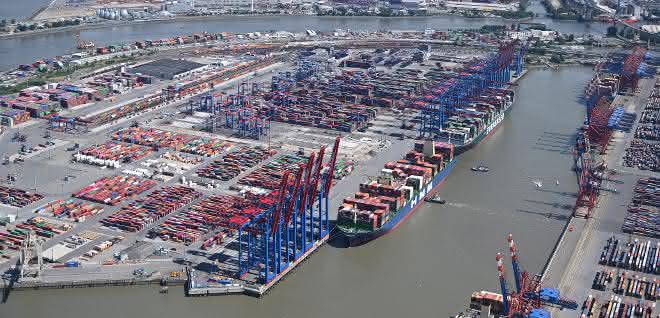
Seaborne cargo throughput in the Port of Hamburg developed more positively than expected in the fourth quarter of 2020. This upward trend has been noticeable since the third quarter. With an increase of around three percent, seaborne cargo throughput in the fourth quarter was even better than in the same quarter of the previous year. Container throughput was only 1.2% below the comparable figure for the previous year. Overall, however, at 126.3 million tons (-7.6%), the handling result for 2020 as a whole remained below the previous year's good figure of 136.6 million tons.
The global impact of the coronavirus pandemic hit the Port of Hamburg particularly hard in the first half of 2020. "The first six months were characterized by the shutdown of many economic sectors, weaker consumer demand and a reduction in liner service departures. This led to a double-digit decline in throughput in Hamburg. We are pleased that the turnaround in throughput set in during the second half of the year and that the overall result for 2020 only shows a single-digit minus," explains Axel Mattern, CEO of Port of Hamburg Marketing e.V. (HHM).
For Ingo Egloff, Axel Mattern's colleague on the Executive Board, 2020 was a special challenge for the port as a whole. "In a joint effort, we succeeded in keeping the port with its handling terminals, logistics and service operations as well as the transport links with the inland fully operational throughout the entire period. My thanks go to all the people who work with great dedication 24/7 along global transport chains and in the Port of Hamburg under difficult conditions. Ship crews, specialists in handling and logistics, pilots and all other employees in companies, authorities and organizations involved in port handling make a valuable contribution to the safe supply of people and the economy every day," Egloff emphasizes.
Seaborne cargo handling in the Port of Hamburg in 2020
In 2020 as a whole, 126.3 million tons of seaborne goods were loaded or unloaded at the terminals in the Port of Hamburg. This is a decrease of 7.6 percent compared to the previous year's good result. Both general cargo handling, which fell by 7.9 percent to 87.8 million tons, and bulk cargo handling, at 38.5 million tons (-6.7 percent), were affected. In the container handling segment, a total of 8.5 million TEU (20-foot standard containers) were handled in Hamburg in 2020. Compared to the previous year, this is a decrease of 7.9 percent. "It is interesting to note that in Hamburg, imports of 4.4 million TEU (-7.8 percent) and exports of 4.2 million TEU (-8.2 percent) developed at almost the same level. One reason for this was the sharp decline in imports from Asia in the first half of the year. It is also interesting to note that landside hinterland traffic was very stable and only fell by 5.8%. Transhipment handling was stronger with a decline of 11.6 percent," says Mattern.
Within the bulk cargo segment, the handling of suction cargo developed positively with a total of 7.5 million tons, achieving an increase of 19.7 percent. Grain exports in particular contributed to this growth. At 2.2 million tons (+198.6 percent), this led to a very good overall result in the agribulk segment. Another factor was a 6.8% increase in imports of a total of 3.2 million tons of oilseeds.
At Greifergut, imports of coal/coke (-35 percent/4.7 million tons) and ores (-4.4 percent/9.5 million tons) declined due to the drop in steel production and less coal-fired power generation. A total of 19.4 million tons (-13.2 percent) of grab cargo was handled in Hamburg.
In the liquid cargo segment, throughput in 2020 totalled 11.6 million tons (-8.4 percent). Fewer imports of mineral oil products and other liquid cargo are primarily responsible for the decline. Export increases of 15.7 percent in the "other liquid cargo" sector, which includes biofuels, were unable to fully compensate for the reductions.
Hamburg's top 10 trade lanes developed differently
Container throughput in the Port of Hamburg's ten most important trading partners developed very differently in 2020. In particular, the decline in seaborne container throughput volumes with China (-8.2 percent), Hamburg's most important trading partner by far, could not be offset by positive developments with other countries. In addition to China, Russia (-12.7 percent), Sweden (-8.6 percent), South Korea (-10.4 percent), Brazil (-11.1 percent) and Poland (-7.3 percent) also recorded double-digit declines in seaborne container throughput in some cases.
In addition to the USA (+1.8 percent), the Port of Hamburg's top 10 trading partners with growth in container traffic include Singapore (+5.3 percent), the United Kingdom (+28.2 percent) and Malaysia (+6.0 percent). The USA, which follows Hamburg in second place in the ranking of container partners, achieved a record result in 2020 with a total of 591,000 TEU. "The continued positive container traffic development with the USA is surprising against the backdrop of the economic performance there being impaired by coronavirus and falling demand. The positive development in container traffic with the UK rose to a record volume of 266,000 TEU and is due to increased shipments for the German market and increased deliveries to the UK before Brexit," explains Ingo Egloff.
Second-best result for the Hamburg port railway
At 46.6 million tons and 2.6 million TEU, Hamburg's seaport hinterland transport by rail was largely stable overall in 2020. At 4.4 percent, the decline in containers transported by rail was significantly weaker than the decline in total container throughput. "In terms of cargo volume, 2020 saw the third-best result in the history of the Hamburg port railroad, and the second-best result in terms of containers transported," emphasizes Mattern. In seaport-hinterland transport, the rail share of the modal split even increased to 50.7 percent (+1.3 percent).
Good prospects for the port thanks to investments and favorable regulations
Axel Mattern points out that both the Hamburg Port Authority (HPA) and the companies in the port have used the year to further expand and modernize the infrastructure and equip handling facilities with the latest technology. For example, terminal operators HHLA and EUROGATE invested in additional container gantry cranes for the handling facilities at Waltershofer Hafen. The container terminals in Hamburg are thus ideally equipped to handle large container ships, which can now also reach the port more easily. "The adjustment of the fairway, which is important for Hamburg, has cleared the final hurdle late, but not too late. The trend towards larger ships, which has also been confirmed to us in discussions with the shipping companies, is continuing, and the completed meeting box off Hamburg now allows particularly large ships to meet on the Elbe. This is a very good signal to our port customers," says Jens Meier, CEO of the Hamburg Port Authority.
Michael Westhagemann, Senator for Economics and Innovation of the Free and Hanseatic City of Hamburg, emphasizes: "In 2021, we will also complete the fairway adjustment of the Lower and Outer Elbe. This is an important and necessary signal to the port's international clientele and an indispensable prerequisite for continuing to play in the concert of the major European ports. The Port of Hamburg is one of the most important economic factors in the whole of northern Germany and, as a hub for international goods traffic, plays an extremely important role for the entire German economic system. It therefore makes a significant and lasting contribution to social prosperity - both regionally and nationally."
The HHM Executive Board also sees overarching measures, such as the suspension of the navigation tax for the Kiel Canal and the first federally funded shore power supply for container ships in a European port, as very positive signs. According to Mattern, these measures will help to make the port fit for the future and achieve the climate protection targets. He also believes that inland and port shipping will benefit from the expansion of shore-side power supply.
In addition, importers have been able to benefit from a new legal regulation since December 2020. "In our view, one of the positive overarching measures is the usable liquidity effect of the import sales tax. This arises from the postponement of the due date for import VAT and now makes imports via German ports more attractive. This is an important step in the right direction," says Mattern.
Outlook for 2021
For 2021, the Port of Hamburg's marketing organization expects seaborne cargo handling to be more stable overall. With the resumption of suspended liner service departures and new services, a handling result of 130 million tons and 8.7 million TEU is achievable in a hopefully improving global situation.


You might also be interested in
ConnectChains: Improving logistics for disaster relief
The Logistics Hall of Fame brought together top-class international experts for the first time at the ConnectChains conference at the Federal Ministry of Transport in Berlin for networking and knowledge transfer. The players in humanitarian...
 read more...
Lenze again Top Employer
For the 18th time, automation specialist Lenze has been named Top Employer Germany by the Top Employers Institute in Amsterdam.
read more...Ralf Morawietz appointed Head of IT at Dachser
Ralf Morawietz has been responsible for Dachser's corporate IT and its more than 600 employees since January 1, 2023. In particular, the Logistics IT Manager will continue to develop the global logistics service provider's IT strategy and drive...
read more...XSTAFF opens location in Hamburg
On January 1, 2023, logistics service provider XSTAFF will open a new location in Hamburg, taking into account the continuous growth of recent years and at the same time sending a clear signal for the future.
read more...Gala reception of the Logistics Hall of Fame in Berlin
Applause and flashes of lightning for Lynn C. Fritz and Gudrun Winner-Athens: On 25 November, the US-American "founder of logistics for humanitarian organizations" and the German family entrepreneur were inducted into the World Logistics Hall of...
read more...Founder of humanitarian logistics
Lynn C. Fritz enters the Logistics Hall of Fame
The decision on the new member of the Logistics Hall of Fame has been made: Lynn C. Fritz has been inducted into the international Logistics Hall of Fame.
read more...material flow PRODUCT OF THE YEAR 2021: PAKis e-voucher in 1st place
On March 24, the winner in the logistics category of the materialfluss PRODUCTS OF THE YEAR 2021 was announced: PAKi Logistics e-Voucher came in first place, followed by Arvato Supply Chain Solutions and RUD Ketten.
read more...Logistics as a driver of digital innovation
Discover Germany's third largest economic sector on Logistics Day
On April 15, the annual "Logistics Day" offers the public the opportunity to gain an insight into logistics processes and technologies at free events.
read more...Autonomous wet floor cleaning against Covid-19
The outbreak of Covid-19 has brought the importance of cleanliness even further into focus in all industries. Autonomous solutions such as the Liberty SC50 from the Bellenberg-based cleaning equipment specialist Nilfisk bring relief to the situation.
read more...