
From LT-manager 3-4/2019
Taking the wrecking ball to the data silos
Ignorance or the fear of setting up a comprehensive digital supply chain and tackling outdated processes: These are just two of the reasons why SMEs in particular steer clear of supply chain software. However, the platform of the start-up Limbiq, a spin-off of the IT company Setlog, is paving a new way for companies.
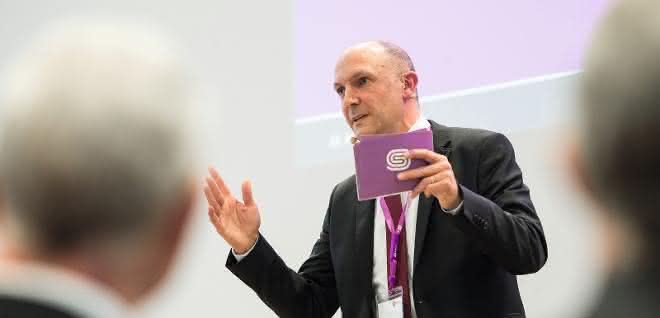
Munich, transport logistic 2019, Hall B5. On the second day of the international logistics trade fair, journalists gather around a man at the joint stand of the state of North Rhine-Westphalia who is gesticulating so enthusiastically in front of a flat screen that he has to keep pushing his glasses back a little on his nose. The occasion: for the first time, the start-up Limbiq, a spin-off of the Bochum-based SCM software company Setlog founded in 2018, is presenting the first function of its new cloud-based platform: Purchase Order Tracking. The man with the glasses: Guido Brackelsberg, Managing Director of limbiq GmbH.
You can tell that Brackelsberg is not fresh out of university like other founders in logistics. No beard, no sneakers, no story from the hipster nightlife. Wearing suit trousers and a white shirt, the man from the Ruhr region radiates a down-to-earth attitude. He doesn't have to tell the journalists that since July 2001, as one of the managing directors of Setlog, he has convinced dozens of bosses of large companies to use the SCM software OSCA in future. Nor does Brackelsberg have to recite Setlog's company history. You can subliminally hear his experience in his sentences. What the man in his late forties has in common with the young start-up enthusiast, however, is his complete conviction in an idea. And the tireless drumming for it.
B2B tools in a user-friendly format
To explain the idea behind the Limbiq network platform to the journalists, Brackelsberg first tells them what makes him tick. He only needs three simple sketches: one shows Google with its simple search function, the other an Apple product with a touch function. The third, on the other hand, is intended to reflect current software from the B2B sector - small-scale, confusing, complex. "Why do we still have to work with such user-unfriendly tools in the B2B sector? Everyone in the B2C sector has long been familiar with self-explanatory applications," emphasizes Brackelsberg.
In principle, the man from the district already anticipates in this sentence the most important requirements that he and his team formulated before they developed the new, cloud-based platform for supply chain management. His credo: with the help of standardized processes, all functions must be easy to operate and quick to use. No frills. And the platform must also be inexpensive. A supply chain software for everyone, so to speak, with the aim of functioning according to the plug & play principle and making the complexity in the supply chain simply disappear.
Sounds simple, but it's not. Before Brackelsberg demonstrates on a monitor how easy it is for a medium-sized company to use the first function of the platform and how suppliers and manufacturers from industry can track their goods along the value chain in real time via the Internet, he explains why supply chain software is as much a matter of course for large corporations in the 21st century as a telephone.
Goodbye Excel lists: desire for more transparency
Take the clothing industry, for example: most well-known brands in Europe either have their garments manufactured entirely in low-wage countries in Asia or simply finish the well-traveled product in some European country with low wage levels. Booking agents and transporters are typically involved in the journey of the goods from the supplier to the customer. From product order to confirmation and transportation, up to 19 communication processes are necessary - if nothing goes wrong. The majority of companies still try to manage these processes with the help of sophisticated Excel lists and e-mails or pick up the phone when things go wrong.
Sooner or later, however, this kind of approach causes headaches for everyone involved: manufacturers and importers complain about media disruptions, the constant fear of the next unexpected delay notification or expensive synchronization with the ERP system. Suppliers and transporters suffer from a lack of transparency, time pressure and additional work in order to meet individual customer requirements. In other words, all players in the chain want more transparency and control, an early warning system, simple, fast communication and a single tool for exchanging documents.

In use at 150 brands
Experienced companies therefore rely on SCM software. Guido Brackelsberg, Jakob Gielen and Ralf Düster founded Setlog to bring such a solution to the market. That was 18 years ago. Over the years, the OSCA software has been developed to such an extent that customer-specific programming can solve almost any customer requirement. Anyone in the textile industry or other sectors who takes care of their logistics is a customer. In total, the software "made in Bochum" is now used by more than 150 brands from the clothing, electronics, food, consumer goods and hardware sectors, including companies such as Tom Tailor and Zalando.
For Ralf Düster, Brackelsberg's fellow board member at Setlog Holding AG, it has paid off that he has been rushing from conference to conference for years, tirelessly preaching that companies need to bring more transparency to their supply chain - and should keep their hands off Excel. "Every manager's alarm bells should ring when employees wave Excel spreadsheets and use data from their silos to explain the status quo in supply chain management," emphasizes Düster. "These tables reinforce the creation of silos and create media disruptions and data inconsistencies. Because the lists cannot be used optimally across departments, let alone across companies, this leads to inconsistencies in statements."
For anyone who doubts Duster's statements, the Setlog board member with a decade of experience as a supply chain expert at a fashion company explains every case down to the smallest detail. He has already done this for dozens of users. Today, 40,000 users in 92 countries work with OSCA every day. More than 500,000 orders and 100,000 shipments are processed via the software every year. So why is Guido Brackelsberg beating the drum for Limbiq at transport logistic? "Quite simply," explains the Bochum native: "Because a customer-specific solution like OSCA is not profitable for everyone. In many cases, no comprehensive tools or special solutions are required."
Great customer potential with forwarding agents and transporters
Individual solutions always involve costs. And costs are indeed an issue - especially for SMEs, which make up 80 percent of all companies in Germany. That's why Limbiq focuses on an entry-level price for importers of less than 125 euros per month. Because not only manufacturers and their suppliers can benefit from Software-as-a-Service (SaaS), but also freight forwarders, the customer potential is huge. "In North Rhine-Westphalia alone, we have 11,000 registered freight forwarders or carriers, 99 percent of whom still rely on email and Excel for their customer communication," calculates Brackelsberg. "However, customers increasingly want a modern, simple portal for interaction. And this is exactly where digital freight forwarders such as Flexport and Co. score points. With Limbiq, we are creating neutral alternatives for the traditional industry."
Good feedback: quick and easy to get started
Five logistics service providers have put the brand new platform with the Purchase Order Management function through its paces. Brackelsberg is "very pleased" with the feedback. Customers cite the uncomplicated access in particular - it takes less than a day to connect to the ERP system or the TMS system of a freight forwarder - as well as the simple presentation of the supply chain as advantages of the system. Anyone looking at the tool immediately sees that the display is basically not much different from that of a parcel that can be tracked via smartphone on the DHL, UPS or Hermes platforms.
However, Limbiq also offers other benefits such as workflow and document management. The next step will be to offer reporting and analysis functions. Following the talks with the journalists, experts from logistics service providers have announced their intention to have the platform explained to them at the trade fair. The name Limbiq is still only known to a few. But Brackelsberg and Düster are working to spread the message that the name Limbiq is backed by more than 18 years of Setlog expertise. Both have the following written on their bald foreheads: "Look, it's a top dog from the SCM software sector that is making a name for itself with a spin-off from the Ruhr region in the age of the platform economy. It's not a hipster software company from Berlin or an IT giant from Silicon Valley."
In less than 30 minutes, Brackelsberg explained to the journalists how supply chains work, explained Limbiq in detail and thought aloud about the upcoming functions - for example in the area of customs. The next appointment is coming up. The man who is constantly running on adrenaline does not allow himself much time to relax. The trade fair is expecting more than 60,000 visitors. Brackelsberg moves on - to drum for Limbiq. Thilo Jörgl
About Setlog
Setlog Holding is a provider of supply chain management (SCM) solutions. Its core product is the cloud-based SCM software OSCA, which is used by over 150 brands in the apparel, electronics, food, consumer goods and hardware sectors. Setlog GmbH is a wholly owned subsidiary of Setlog Holding AG. The company was founded in 2001 and is now one of the leading providers of SCM software with over 45,000 users in 92 countries. The software company employs 60 people at its locations in Bochum (headquarters), Cologne and New York.


You might also be interested in
New version of Röhlig Realtime
Röhlig Logistics presents the enhanced version of "Röhlig Realtime". The company is supplementing its digital service portfolio with a central platform that ensures greater transparency and networking throughout supply chain management.
 read more...
Inventory effort reduced to a minimum via cloud solution
Lacroix Electronics, electronics supplier and part of the globally active Lacroix Group, has successfully optimized its inventory process with the help of Remira.
read more...Körber Business Area Supply Chain: Edward Auriemma becomes CEO of the Software Division
Edward Auriemma will be the new CEO for the software business of the Körber Business Area Supply Chain, a joint venture with KKR, from July 8, 2024.
read more...project44 revises Movement platform
project44, a platform for supply chain visibility, is updating its Movement platform with two new features: Firstly, there is an update for transparency and real-time tracking in crisis situations. The other new feature is Detention & Demurrage...
read more...Extended Osca software generation
Setlog will be presenting its enhanced supply chain management software Osca DC (Digital Core) at LogiMAT 2024. The cloud-based tool provides companies with transparency for their supply chain and improves management, collaboration and communication.
read more...ConnectChains: Improving logistics for disaster relief
The Logistics Hall of Fame brought together top-class international experts for the first time at the ConnectChains conference at the Federal Ministry of Transport in Berlin for networking and knowledge transfer. The players in humanitarian...
read more...Supply Chain Management Software
Setlog is now part of Rhenus
The software manufacturer Setlog has been part of the Rhenus Group since October 24, 2023. Setlog was founded in 2001 by Guido Brackelsberg, Ralf Düster and Jakob Gielen and has since developed into a specialist for end-to-end supply chain...
read more...German Logistics Association (BVL) presents study on cyber security
The cross-company protection of supply chains against cyber attacks has so far only been a marginal issue for most companies.
read more...Increased throughput thanks to greenfield-brownfield project
For 25 years, Witron has been the partner of choice for the Austrian food group Spar for the construction and expansion of its central warehouse in Wels. In the fourth construction phase, capacity, efficiency and performance increased dramatically....
read more...