
Logistics service providers
Outsourcing - The better alternative
Direct maintenance costs for personnel and materials are a measurable factor in the annual balance sheet for the management of intralogistics systems and influence the question of system modernization. But how do the costs of systems with an identical level of automation compare? A guest article by Jürgen Dönges, Managing Director of Telogs GmbH.

What significance is attributed to indirect maintenance costs in the event of system downtime due to a lack of availability? A study conducted by the Technical University of Munich in collaboration with Telogs GmbH shows interesting results for operators of automated warehouse and distribution centers.
Of the original 90 survey participants, a large number broke off the questionnaire at the point where specific cost information on maintenance expenditure was requested. Is this a sign that the allocated costs are not clearly recorded in the companies? In most cases, there is no information at all on indirect maintenance costs. An allocation of lost profit, costs of machine downtime and compensation measures obviously does not take place in the overall business management presentation of maintenance expenditure. It is precisely here that the quality of preventive measures and the speed of reactive maintenance are demonstrated. A system maintained at minimum cost level, which results in production interruptions in the event of a malfunction, produces a multiple of indirect costs.
Maintenance intensity as an index
The total costs recorded annually say nothing about the efficiency of the organization and maintenance measures unless they are assigned to a comparative key figure. This is defined as maintenance intensity as follows: It should not be questioned if the value for maintenance intensity resulting from the surveys shows a very wide spread: from just under 1 % to over 11 %, with an average of 4.4 %. Individual factors such as the age of the system, useful life, availability requirements, size and degree of automation of the system, maintenance strategy: reactive, preventive or condition-based, maintenance organization and retrofit measures carried out are decisive for the variation. A system with a replacement value of, for example, 10 million euros, a low degree of automation and single-shift operation should therefore have annual maintenance costs of less than 4.4% (< 440,000 euros). In two-shift operation with support from technicians to ensure the highest possible availability, on the other hand, the costs will be significantly higher than 4.4%.
The selected maintenance strategy also has a significant influence on availability and costs: reactive maintenance, in which components are operated up to or beyond the wear limit, generates the lowest costs in the short term, but cannot ensure availability. Preventive or even condition-based maintenance models - with component replacement defined according to service life or wear - lead to higher costs (maintenance intensity here averages 5.1 %), but also deliver availability levels of over 99 %. Retrofit measures are the fresh cell treatment of an ageing system. This usually involves upgrading to the latest version of the control modules. A general overhaul of the mechanical and electrical systems also results in a significant improvement in availability - which was confirmed by 78% of survey participants. 67% of respondents also reported a reduction in ongoing maintenance costs after the retrofit measures were completed.
Distribution of core competencies
The involvement of external service specialists for maintenance tasks is growing. Their share of the total expenditure for all maintenance measures was 38% on average across all respondents. While the proportion was still below 30% in 2011, it is now tending towards 60%. This is due to the increasing complexity of systems and the focus on the core competencies of system operators and service providers. The use of external experts also automatically answers these questions:
- How do I avoid the shortage of skilled workers?
- Who guarantees my availability?
- How can I plan my maintenance costs in the long term?
- Who establishes and enforces warranty claims?
- Who will ensure the long-term preservation of my investment?
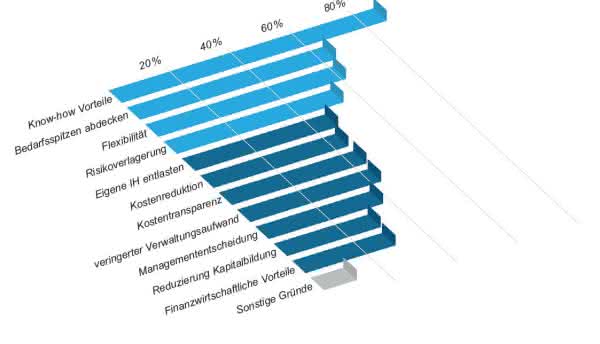
From the survey, those participants who had already outsourced some or all of their maintenance tasks to a service provider cited various reasons for outsourcing (see image above). Cost benefits only played a subordinate role. Functional reliability and flexibility are more important. Manufacturer-independent service providers such as Telogs offer a modular concept of different service levels. Hardly any operator today does without access to an expert hotline, possibly combined with a mobile service to send a specialist to the system. Maintenance contracts with service providers ensure that the proper condition of the system at regular intervals guarantees fail-safe operation until the next maintenance period. System manufacturers often require proof of maintenance work carried out in order to grant warranty claims. Here it is important to ensure that a right of delegation is already granted in the supply contract for the system.
Maintenance contracts that are linked to condition monitoring are another way of increasing system availability. However, technical requirements such as sensor technology, measurement data acquisition and automatic measurement data processing must be created here. However, it also offers the greatest potential for cost savings, as the service life of critical system components can be practically fully utilized.
Clear trend towards outsourcing
Transferring the complete technical and operational support of a system to a service provider relieves the operator. On the basis of a multi-year service contract, the service company undertakes to provide a service by an on-site team of specialists. As a rule, monthly payment is made at an agreed fixed price. This gives the client far-reaching planning security.
There is a clear trend towards outsourcing maintenance services where the logistics system is the main technical facility of a location. The most recent examples of this are e-commerce-driven distribution centers.
www.tum.dewww.telogs.de


You might also be interested in
Winner material flow PRODUCTS OF THE YEAR 2023
Conductix-Wampfler: ChargeLine 0865
Two-pole conductor rail segments for efficient opportunity charging of shuttles, suitable for thousands of cycles per day.
 read more...
Hermann Grewer celebrates his 80th birthday
Hermann Grewer, Honorary Chairman of the North Rhine-Westphalia Transport and Logistics Association (VVWL) and Honorary President of the German Road Haulage, Logistics and Disposal Association (BGL), celebrated his 80th birthday on June 6.
read more...Well chilled for sure
V-Zug Kühltechnik AG, developer and manufacturer of refrigeration appliances and part of the successful V-Zug Group, has set up a new production facility for refrigerators of all heights and dimensions at its Swiss site in Sulgen.
read more...Advantageous automation of small parts warehouses
The RSX1 shuttle system will be at the center of Rocketsolution's presence at this year's Logimat trade fair.
read more...Reduced energy requirements in the high-bay warehouse
One of Germany's leading premium car manufacturers is already focusing on energy efficiency in the production of its new SUV model with electric drive. The storage and retrieval machines in a high-bay warehouse at the production site have been...
read more...Low lift pallet truck for light duty applications
Clark has launched a new low lift pallet truck with the model designation LWio15 for light transport tasks. The truck has a load capacity of 1500 kg and is suitable for short distances in goods distribution, production or warehousing.
read more...Internationalization as an opportunity
E-commerce is in a state of flux. Changes in purchasing behavior and procurement problems are keeping e-commerce retailers busy. Logistics plays a decisive role in the overall online shopping experience.
read more...Fulfillment Center for Frisco.pl
Polish eGrocery specialist and TGW deepen partnership
TGW is building a highly automated fulfillment center for Frisco.pl in the Polish capital Warsaw. This is the second project in a row that the two companies have implemented together.
read more...Which world will it be in 2023?
Michael Schreckenberg teaches at the University of Duisburg-Essen as Professor of Physics of Transport and Traffic. Once a year, he addresses the readers of materialfluss, formerly LT-manager, with a critical and humorous expert article on transport...
read more...