
Hellmann Innovation Day
On course for the future
The first Hellmann Innovation Day took place in Osnabrück on March 28. New technologies from various manufacturers and cooperation partners were presented as part of an exhibition. There was also a series of guest lectures from the worlds of politics, business and science.
In his welcoming address, CEO Reiner Heiken introduced Hellmann as a company to around 150 guests. As part of the Innovation Day, Hellmann presented new technologies that are already being used today or are still in the trial phase: Smart Visibility, Logistic Lights, Smart Glasses and promising e-mobility concepts such as Rytle's cargo bike or BPW's e-truck are just some of the examples presented in the exhibition that are already in use at Hellmann. "Only those who set, recognize and follow trends can hold their own on the market in the long term. This applies today more than ever," commented the CEO. "Our task is to anchor future topics such as digitalization, big data and AI in our corporate strategy," Reiner Heiken continued. As a trained navigator, he is very familiar with setting the course. For Hellmann, he is currently sounding out: "Where do we stand today?" But even more important for navigation is the question: "Where do we want to go?"
Science offers a compass
Prof. Dr. Stölzle from the University of St. Gallen presented a compass for the course towards the "digitalization of logistics". The cooperative study of the same name examined the degree of maturity and potential applications of digital technologies and categorized them in a "hype cycle". It was found that there are many innovations whose potential has not yet been fully exploited. At the same time, many topics are "cooked hotter than they are eaten", said the Swiss professor.
Prof. Dr. Schüller from Osnabrück University of Applied Sciences explained the actual benefits of the trends in logistics. He mapped the terms "blockchain", "robotics", "artificial intelligence" and "big data" in a coordinate system to measure their degree of sustainability, networking, individuality, automation and transparency. Especially when it comes to transparency, real added value can be created.
In order to stay on course, safe fairways are needed, which must be marked out by politicians. Against this backdrop, Dr Herbert Zeisel from the Federal Ministry of Education and Research and Stefan Muhle, State Secretary in the Lower Saxony Ministry of Economic Affairs, Labour, Transport and Digitalization, were present as guest speakers. Dr. Zeisel emphasized the importance of sound training for skilled workers in order to dovetail human skills and artificial intelligence in the best possible way. Stefan Muhle rounded off the political perspective with his appeal to German SMEs to boldly drive things forward. Hellmann's commitment is a good example of future-oriented, entrepreneurial action.
Examples from practice
How far Hellmann has come in practice was outlined using case studies, for example during the presentation of initial findings from the field test of the MB Vario retrofitted with an e-axle. Hellmann is the first company to test this prototype of the e-truck at different locations with varying requirements. Other new technologies presented to the interested specialist audience were the "Logistic Lights" and the "Glasshouse" project.
Glasshouse project
Hellmann has been testing the use of smart glasses since 2015. As part of the Innovation Day, visitors were able to try out the data glasses for themselves. The data glasses send information directly to the user's eyes. The glasses can be operated by hand, gesture or voice control. The work instructions come from the cloud in real time. They also enable the scanning of barcodes or video calls. The absolute added value is the "hands-free aspect", which saves the user valuable time.
Logistic Lights with Symbic
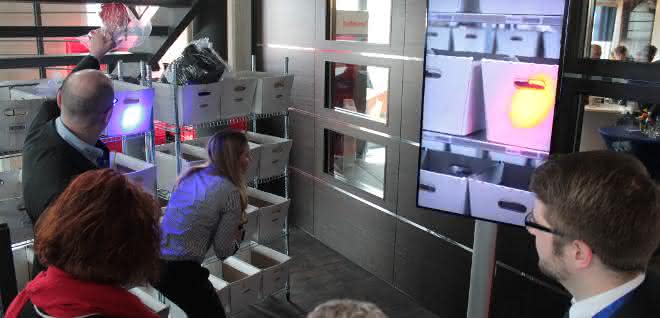
The "Logistic Lights" are commercially available spotlights. Connected to the warehouse management system, they become an effective tool for recognizing storage locations. By scanning an item with the MDE or finger scanner, the spotlight knows which of the carton locations needs to be illuminated so that the pickers can see at a glance where they need to sort the item. In addition to its intuitive operation, the system is characterized by a high degree of flexibility. The start-up Symbic developed the "Logistic Lights" together with Hellmann for contract logistics.
Smart Visibility
Smart Visibility is a live shipment tracking service that makes it possible to determine the location, condition and security of shipments in real time anywhere in the world. The highlight is the innovative returns management: the postcard-sized device can be dropped into the nearest letterbox after use and returned by the user without any further effort. With the new tracking box, customers can seamlessly track their flow of goods within complex supply chains and optimize their supply chain and storage management based on real-time data. The box provides details on temperature, humidity, vibration, light incidence, door openings and deviations from the schedule.
E-mobility in local transport
After some adjustments to the vehicle, BPW's electric truck has been in operation in Lehrte since March. Among other things, data on charging times, range and optimum route structures is being collected here. The MB Vario with the retrofitted eTransport axle was transported to Osnabrück for Innovation Day. The drive of the 7.5-tonne vehicle is fully electric, recovers braking energy and improves the maneuverability of the van by actively supporting the steering behavior via the rear axle (torque vectoring). BPW puts the range at around 100 kilometers at a top speed of 90 km/h. Following the test in Lehrte, the vehicle will also be used in Osnabrück and Bielefeld.
City logistics with Rytle
In times of particulate matter and diesel discussions, city logistics requires new concepts for the last mile. One frequently invoked means of clean transportation is cargo bikes. Hellmann is currently working with Rytle and other Bremen institutions on the "Urban-BRE" project, which is funded by the Bremen Senate. The core idea of the concept is to supply Bremen's city center with general cargo by linking various "green modes of transport". The consignments are finally picked at so-called micro-hubs in the city and then delivered by cargo bike.
The Innovation Day concluded with a panel discussion with host Matthias Magnor, COO Road and Rail, Stefan Muhle and Prof. Dr. Franz Vallée, BVL spokesperson for the Münster/Osnabrück regional group. "Innovations are an alliance with the future," said Magnor in his closing words. A fitting conclusion to this day full of glimpses into the future of logistics.


You might also be interested in
Winner material flow PRODUCTS OF THE YEAR 2023
Conductix-Wampfler: ChargeLine 0865
Two-pole conductor rail segments for efficient opportunity charging of shuttles, suitable for thousands of cycles per day.
 read more...
Hermann Grewer celebrates his 80th birthday
Hermann Grewer, Honorary Chairman of the North Rhine-Westphalia Transport and Logistics Association (VVWL) and Honorary President of the German Road Haulage, Logistics and Disposal Association (BGL), celebrated his 80th birthday on June 6.
read more...Well chilled for sure
V-Zug Kühltechnik AG, developer and manufacturer of refrigeration appliances and part of the successful V-Zug Group, has set up a new production facility for refrigerators of all heights and dimensions at its Swiss site in Sulgen.
read more...Advantageous automation of small parts warehouses
The RSX1 shuttle system will be at the center of Rocketsolution's presence at this year's Logimat trade fair.
read more...Reduced energy requirements in the high-bay warehouse
One of Germany's leading premium car manufacturers is already focusing on energy efficiency in the production of its new SUV model with electric drive. The storage and retrieval machines in a high-bay warehouse at the production site have been...
read more...Low lift pallet truck for light duty applications
Clark has launched a new low lift pallet truck with the model designation LWio15 for light transport tasks. The truck has a load capacity of 1500 kg and is suitable for short distances in goods distribution, production or warehousing.
read more...Internationalization as an opportunity
E-commerce is in a state of flux. Changes in purchasing behavior and procurement problems are keeping e-commerce retailers busy. Logistics plays a decisive role in the overall online shopping experience.
read more...Fulfillment Center for Frisco.pl
Polish eGrocery specialist and TGW deepen partnership
TGW is building a highly automated fulfillment center for Frisco.pl in the Polish capital Warsaw. This is the second project in a row that the two companies have implemented together.
read more...Which world will it be in 2023?
Michael Schreckenberg teaches at the University of Duisburg-Essen as Professor of Physics of Transport and Traffic. Once a year, he addresses the readers of materialfluss, formerly LT-manager, with a critical and humorous expert article on transport...
read more...