
Logistics service providers
Logistics is IT
As a full-service logistics provider, Zufall logistics group has evolved from a standard logistics service provider to a company with a highly complex service portfolio. The contract logistics business area is growing the fastest. However, customer requirements and further developments can only be met with appropriate IT support.
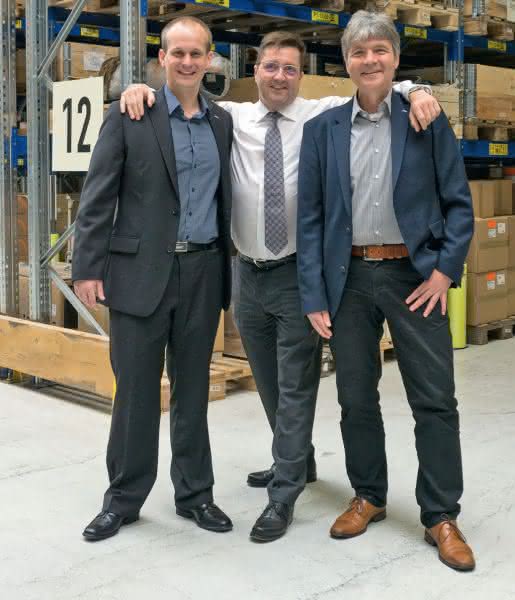
materialfluss spoke with Michael Tillner, member of the management board of Friedrich Zufall GmbH & Co. KG, about the company's development, the driving role of customer expectations and the existential function of logistics IT. In the warehouse area, Zufall uses PSIwms from PSI Logistics GmbH, which successfully manages this business with a complex solution landscape thanks to its software architecture.
materialfluss: Mr. Tillner, you have been working in distribution logistics for more than 25 years. You have been a member of the Zufall logistics group's management board since 2013, where you are responsible for land transportation in Germany, air and sea freight, controlling and IT. The group generated net sales of 304.8 million euros in 2016. Where does the company stand today?Michael Tillner: Zufall develops in spurts, so to speak - similar to other companies in our industry. However, our credo is: growth and development yes, but in such a way that it does not overburden the company as a whole. This stability has a positive effect on our employees and thus directly benefits our customers. If we look at our logistics services, we have achieved an extraordinarily high level in transport logistics. Transport logistics includes overland transport in Germany and Europe as well as highly specialized services such as our overnight express service "Night Star Express". In sea freight, 2016 saw the integration of a company acquisition in Hamburg. And in air freight, we are really picking up speed in 2017. IT plays a key role in these services; we are currently investing seven-figure sums in transport management systems and middleware. Everyone understands "development" differently - I understand development as a continuous process that interlinks our services ever more closely. I see Zufall as a central service provider for our customers as the goal of our development. Ideally, we should have complete information capabilities and the IT infrastructure to support this. If you ask me where I classify us: Many of our customers want logistics services from a single source. We know that we can't yet compete with the really big players in our industry because, for example, we don't (yet) have our own locations in China or the United States. But I see us as having an advantage when we compare ourselves with companies of a similar size.
About PSI Software AG
PSI Software AG, headquartered in Berlin, develops and integrates complete solutions for energy management (energy networks, energy trading), production management (raw material extraction, metal production, automotive, mechanical engineering, logistics) and infrastructure management for transportation and safety on the basis of its own software products. PSI was founded in 1969 and employs 1,650 people worldwide. PSI Logistics GmbH is a subsidiary focusing on software solutions for warehousing, transportation, supply chain and airports. It has offices in Berlin, Aschaffenburg, Dortmund, Poznan and Moscow and employs 120 people.
When we talk about the development of a standard logistics service provider into a company with a complex service portfolio, how can we characterize the differences in the processes that need to be organized?
Let's take a look at an overall process: we operate a contract logistics warehouse on behalf of a customer. We are dealing with standard processes from goods receipt to processing, inventory management and loading. However, there are also upstream processes such as procurement logistics. After all, all the items in the warehouse have to get there. The customer has the option of having everything delivered free of charge. When a reorder point is reached, Zufall offers to procure the item for the customer throughout Germany, Europe or worldwide. And this at fixed agreed conditions. On the distribution side, Zufall in turn dispatches goods from the warehouse to our customers' recipients worldwide by truck, rail, air or ship, manages loading equipment and takes care of customs clearance and documentation. Until a few years ago, we were only marginally involved in this complexity.
mfl: You carry out an annual customer satisfaction survey in order to determine the needs and satisfaction of your customers in a condensed form. Your results are positive, as 87.9 percent were also satisfied with Zufall logistics group in 2016. How satisfied are you yourself?Tillner: We are self-critical. Customer surveys provide a snapshot. A mistake can overshadow a good performance in the past. And so we try to anticipate the requirements for quality and flexibility and adapt to them technically and organizationally.
"Customer surveys provide a snapshot. A mistake can overshadow a good performance in the past."Michael Tillner Member of the Management Board at Friedrich Zufall GmbH & Co.
But: No customer satisfaction without satisfaction with the suppliers. That is why the topic of supplier relationship management is just as important. Again, this is not self-evident: while the topic of customer satisfaction receives partial or formal attention and is at least perceived by companies as an aspect of sales marketing, the topic of supplier relationships and satisfaction with suppliers tends to be neglected.
I agree with you on that. I always say: good cooperation is not the result of a formulated contract, but rather of a positive working atmosphere based on partnership. We attach great importance to long-term cooperation with our service providers, and I don't just mean IT service providers, but also freight carriers, trading partners and tradespeople, for example. Our supplier relationship management is still in its infancy, but we have a clear idea of what we want to achieve here.
mfl: Logistics doesn't just need IT, your credo: logistics is IT. The existential role of IT is undeniable. What must IT be able to do in order to do justice to your business, and in which IT steps does the leap take place?Tillner: Quite simply. IT must enable us to bring our processes as close as possible to our customers' value chains. Every process designed by our customers must be able to be mapped. This places high demands on our infrastructure and our expertise, which we have to constantly develop further.
mfl: Contract logistics is quantitatively and qualitatively very important at Zufall. It accounts for 16.4% of all business areas. You are responsible for warehouse management at various locations for your customers from a wide range of industries. You use PSIwms from PSI Logistics GmbH for this purpose - how satisfied are you with the software? Are you also spoiled by PSI?Tillner : The spoiling is probably a matter of chance ... no, joking aside. We are really satisfied. The software itself is in use at all locations and for all logistics customers. The integration capability meets our high standards. And last but not least, the cooperation with PSI is very cooperative at all levels - and that is of central importance for success in this area of logistics. They are there when you need them.
materialfluss: Mr. Tillner, thank you for the interview.
Gisela Upmeyer, GMP, spoke with Michael Tillner


You might also be interested in
e2open bonded warehouse solution for several European countries
e2open, a provider of networked supply chain platforms, has expanded its customs warehouse management in Europe. Companies that import goods to Europe now have the option of using various customs warehouse programs.
 read more...
New start-up aims to facilitate access to robotics
Pssbl.Robotics, a start-up founded jointly by Schubert and Weiss, aims to simplify the introduction of robotics in mechanical and plant engineering.
read more...Test shipment with RoRo Car Carrier via Bremerhaven
Last August, the RoRo Car Carrier MV Cosco Shengshi moored in the northern port of Bremerhaven and started its first test shipment in order to expand the service to Europe.
read more...Rhenus grows at sea and on the road
At the northern tip of Lower Saxony, the logistics service provider is preparing for the growing import of cars via Cuxhaven; in Nuremberg, Rhenus is building a new logistics center next to the existing high-bay warehouse; in Dietzenbach, Hesse, the...
read more...Hermann Grewer celebrates his 80th birthday
Hermann Grewer, Honorary Chairman of the North Rhine-Westphalia Transport and Logistics Association (VVWL) and Honorary President of the German Road Haulage, Logistics and Disposal Association (BGL), celebrated his 80th birthday on June 6.
read more...Group7 expands corporate headquarters
The logistics service provider is planning 60,000 square meters of service and logistics center and an administration building with 5,000 square meters of floor space near Munich Airport.
read more...Cross-channel logistics: overcoming hurdles after Brexit
Hardly any other event has presented European road freight transport with such enormous challenges as Brexit. But there are solutions.
read more...Transport Logistic 2023
After a four-year break with a virtual interlude in 2021, Transport Logistic will return to the Munich exhibition grounds from May 9 to 12, 2023.
read more...Focus on internationalization
L.I.T. will be represented twice at Transport Logistic. The Brake-based logistics service provider's service portfolio ranges from warehousing and transportation using various modes of transport to contract logistics and comprehensive value-added...
read more...