
Ident technology/RFID
Let's talk about interfaces
The successful use of logistics software always involves two parties. The management of IT interfaces is therefore also a challenge for the user.

Industry 4.0, digitalization and the networking of things - these terms currently dominate the business world and suggest a paradisiacal future scenario of comprehensive data exchange between all economic players with a myriad of autonomously interacting systems. But the road ahead is long and rocky. Up to now, there has been a lack of communication standards in the interaction between the systems. This is evident in the interface management of software systems. This is where the question of "debt to be discharged" comes into play.
Networked supply chain requires networked systems
In our increasingly complex business world, companies within the supply chain are merging more and more with the structures of their suppliers and customers. As a result, internal and cross-company processes must be planned and operationally controlled at the software level. The value contribution that IT makes to companies is therefore higher than ever: business processes are based on a complex system of interconnected and interdependent software applications, and their smooth operation is an important factor for sustainable market success.
Smart logistics needs IT
In other words, we are talking about systems that communicate via interfaces. These form the transition between different programs and thus enable the exchange of data - the output of A is the input for B. For this exchange to take place synchronously, the interfaces and data structures of the programs must fit together, they must be compatible. Communication problems are virtually pre-programmed. But which customer hoping for smarter logistics processes for their company by purchasing software wants to open up additional construction sites that are also associated with additional financial outlay?
Interfaces are a sensitive topic
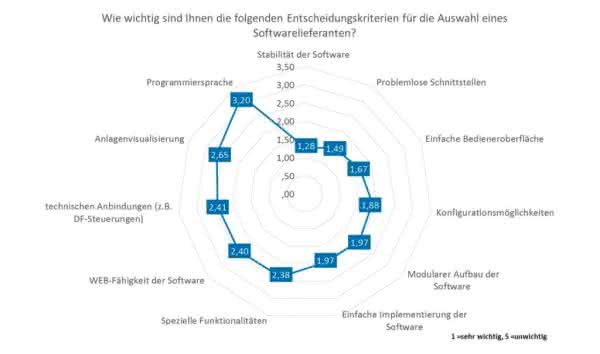
According to a recent study by GMP Munich, the topic of "interfaces" in the context of logistics software is therefore one of the most sensitive of all. When selecting a provider, particular attention is therefore paid to the ability to manage interfaces effectively. The questions to be answered are: "What does this management actually look like?" and: "Who actually has to manage what?" The task of the software provider in this context is to install a functional solution that congruently reflects the customer's wishes. The task of the future user is to be able to deliver data that is workable and resilient in the first place. This is not a matter of course. Very few people think about the fact that the customer himself has to "co-manage" interfaces when implementing new logistics software before making a purchase decision.
The customer must "co-manage"
It is therefore important for customers to know what their own ERP system can do. The required interfaces are sometimes not even planned in the systems. This means that quite a few of them are outdated or not designed for interaction with other systems. A lot of data no longer comes via standard interfaces. Additional segments often have to be built in or even completely new interfaces generated. The customer must therefore prepare himself for the use of the new software. What he intends to do with it in the future is one thing. But the current status is important in order to get started at all.
Often the question of feasibility does not arise in a project, but rather the question of time and costs. Due to different budget expectations, people sometimes prefer to continue working manually with Excel. Effectiveness or not. This is also the reason why many users only react under pressure from their customers and invest in IT, rather than out of economic foresight.
Rethink your own processes
Around 95 percent of all customer cases require interfaces, around 40 percent of which are in-depth. And another 20 percent of these are very complex. The acquisition of a transport management system or a warehouse management system forces customers to check their data consistency and rethink their own processes.
The biggest problem is often the clean procurement of data. The data must firstly be exportable, secondly available and thirdly available in structured form as database information. The technology as such is not a problem, but the organizational aspect, the procurement of the structured data records. The customer must be able to supply the prepared data for storage or transportation.
The procedure is clear: the customer articulates what they want to achieve with the software, the software provider works backwards from these objectives and tells them what data is required. It is often underestimated that this is necessary in this compatible order. There are hardly any differences between the individual sectors. The interface problem always includes the question of responsibility - and this also includes the customer's sovereignty over their interfaces and their compatible, structured data export. Instead of interface management, it is therefore perhaps better to speak of interface capability on both sides - provider and user.
Alexander Fuchs


You might also be interested in
"Logistics is a competitive factor for us"
With the move to the new "Campus Criesbach" site, the system manufacturer Bürkert Fluid Control Systems has significantly increased the level of automation. In the new building, planned and implemented by SITLog as general contractor for the...
 read more...
More transparency for production logistics
In order to supply production with the right amount of material at all times, Schmidt Technology needs full transparency of the stocks in the FIFO racks. The company found the answer to this in the simple retrofit solution...
read more...Digital oil lubricates the operational gearbox
Contract and procurement logistics is a particularly labor-intensive area in the portfolio of large logistics service providers. This also applies to Schenker Deutschland AG. This makes it all the more important to optimize the personnel and...
read more...Flexible pooling at fair conditions
In a joint statement, pallet pooling service provider PAKi and logistics service provider Dachser have given their thoughts on the practice of exchanging pallets in an open pool, which is being discussed in the market. Materialfluss documents the...
read more...Commitment to safety and environmental protection
Night after night, employees at the central warehouse of Palibex, Spain's first express distribution network for palletized goods, coordinate the dispatch of 2,500 pallets in Madrid. To accomplish this task in a safe and emission-free working...
read more...Material Flow Round Table: IFOY, hurray! This is what winners look like
On the evening of May 9, the industry celebrated the winners of the IFOY Awards 2017. The following morning, Materialfluss hosted the winners' round table. Curtain up for a conversation about products, innovations and industry visions. Oliver...
read more...Service makes the difference
Exceptional service is much more than a corporate trademark for Hamburg-based Still GmbH. It is an important differentiating factor with which Still has established itself as one of the leading providers of customized...
read more...All-rounder: double girder bridge crane with slewing trolleys
It weighs around 53 tons and is yellow. It can carry loads of up to 16 tons and has a span of 40 meters. On February 13, the overhead crane was delivered from Remscheid to the customer in Dormagen. The crane was designed and manufactured...
read more...Comprehensive range of tasks safely under control
Whether bridge and gantry cranes serving the entire hall or slewing jib cranes for workstations in assembly and production, whether loads weighing many tons or just kilograms - cranes prove to be versatile transport and handling equipment...
read more...