
Guest article
Asset tracking - the possibilities
Faster processes in logistics and production are among the greatest promises associated with the Internet of Things. As there are stumbling blocks such as metal walls and legal hurdles, pilots and large-scale projects stumble time and again. IoT consultant Timm Huber from Comarch explains how things can be done differently, how asset tracking can be implemented technically and what legal considerations need to be taken into account.
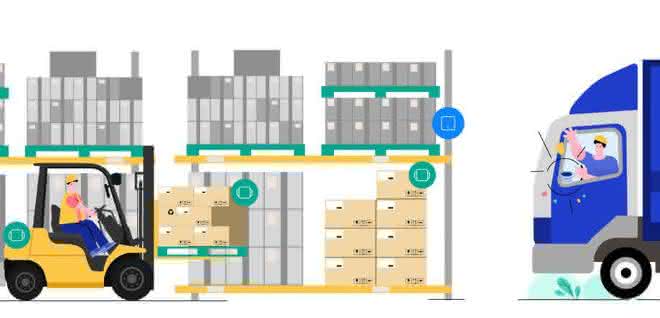
Asset tracking is an innovative technology that is used in logistics and production to control important operating resources (assets). Both on the production line and in the warehouse, it is possible to track where which items are located when and in which process step. This provides a clear overview of how operating resources are distributed. The process flow and the actual status of things can be monitored live. Such comprehensive control goes far beyond the previous knowledge, which consisted at most of how items were booked. With asset tracking, the actual status is recorded in real time for the first time.
The technological implementation
Various technologies have become established for the implementation of asset tracking. Depending on the purpose and location, RFID tags, Bluetooth low-energy tags or ultra-wideband tags are suitable for indoor tracking. In addition to these three transmission technologies, GPS technology is also suitable for outdoor tracking.
The actual asset tracking process has a modular structure. Three building blocks form a three-part architecture consisting of sensors, gateway and software. Small sensors are usually attached indirectly to trolleys that transport the assets. They send out a signal. Any number of these sensors can be used. The signal from the sensors is recorded by a gateway. The gateway converts the signal into information and forwards the data to a cloud.
The information is recorded in software in the cloud. Here, the pieces of the mosaic now form a comprehensive overall picture, which then provides the respective employees with a digital overview of all processes on a tablet or desktop - in real time. Several software systems can be connected to a gateway, for example ERP, MES, BI or AI solutions. However, the following aspects must be taken into account.
What is allowed with asset tracking?
Asset tracking as monitoring of operating equipment is permitted in German-speaking countries. There are no restrictions on tracking this equipment with signals, especially if your own production or storage facilities are to be monitored. However, it is very important that no personal data is recorded in this process. In Germany, Austria and Switzerland, it is not permitted to subject employees to tracking, nor may they be indirectly monitored using localization measures. A special look at the individual process steps is necessary here: If a means of transportation is equipped with a sensor, the driver is also indirectly tagged and tracked. As a result, rest periods of the means of transport can also provide clear information about the driver's whereabouts.
If the process steps are zoomed in too closely and it can be assigned exactly which employee has worked on which assets because they are responsible, legal problems are the result. Comarch always draws attention to such legal requirements in projects in German-speaking countries. Technically, however, the global IT manufacturer uses solutions for tracking employees in other countries, for example with transmitters in the form of a wristband around the arm. In this country, it is not possible to track and monitor employees in this way. However, there are so many other legally compliant options for optimization in Germany that asset tracking is likely to play a much greater role in the future.
How asset tracking is used today
RFID chips are already widely used in German warehouses. They are used here, for example, to track pallets. What is not recorded is the exact location of the assets on these pallets. In addition, no information is automatically transferred to connected systems. These shortcomings are currently being addressed in a number of projects. Individual warehouses are virtually divided into zones. This enables geofencing, i.e. the automated triggering of an action when a geolocalized boundary is crossed.
Integration with ERP and BI
If you want to know exactly where the forklift truck and the load it is transporting are located, you should opt for a dual solution: With ultra-wideband tags on the forklift truck and RFID tags on the pallets, the exact location of assets in the warehouse can be tracked. Intelligent linking of the individual technologies is currently cutting edge, state of the art in terms of IoT innovations. This technology also enables live tracking with spaghetti diagrams.
Although already technically feasible, these are relatively new features that are not yet widely used in German production halls and warehouses. It also paves the way for comprehensive warehouse optimization: the additional data and the evaluation by artificial intelligence enable precise analysis so that forklift drivers can drive optimized routes. If, for example, waste products have to be collected from production, the concept of intelligent logistics comes into play. The analysis shows what quantities of metal, cardboard and aluminum are produced at what time. An optimized route is then taken based on the analysis.
In general, product integration with other systems (such as ERP, MES, BI) opens the door to comprehensive process automation. The generated reports and analysis tools help to identify bottlenecks and optimize the use of resources. Looking into the future enables more precise planning and real-time analysis.
The article appeared in materialfluss 3/22.


You might also be interested in
Winner material flow PRODUCTS OF THE YEAR 2023
Conductix-Wampfler: ChargeLine 0865
Two-pole conductor rail segments for efficient opportunity charging of shuttles, suitable for thousands of cycles per day.
 read more...
Hermann Grewer celebrates his 80th birthday
Hermann Grewer, Honorary Chairman of the North Rhine-Westphalia Transport and Logistics Association (VVWL) and Honorary President of the German Road Haulage, Logistics and Disposal Association (BGL), celebrated his 80th birthday on June 6.
read more...Well chilled for sure
V-Zug Kühltechnik AG, developer and manufacturer of refrigeration appliances and part of the successful V-Zug Group, has set up a new production facility for refrigerators of all heights and dimensions at its Swiss site in Sulgen.
read more...Advantageous automation of small parts warehouses
The RSX1 shuttle system will be at the center of Rocketsolution's presence at this year's Logimat trade fair.
read more...Reduced energy requirements in the high-bay warehouse
One of Germany's leading premium car manufacturers is already focusing on energy efficiency in the production of its new SUV model with electric drive. The storage and retrieval machines in a high-bay warehouse at the production site have been...
read more...Low lift pallet truck for light duty applications
Clark has launched a new low lift pallet truck with the model designation LWio15 for light transport tasks. The truck has a load capacity of 1500 kg and is suitable for short distances in goods distribution, production or warehousing.
read more...Internationalization as an opportunity
E-commerce is in a state of flux. Changes in purchasing behavior and procurement problems are keeping e-commerce retailers busy. Logistics plays a decisive role in the overall online shopping experience.
read more...Fulfillment Center for Frisco.pl
Polish eGrocery specialist and TGW deepen partnership
TGW is building a highly automated fulfillment center for Frisco.pl in the Polish capital Warsaw. This is the second project in a row that the two companies have implemented together.
read more...Which world will it be in 2023?
Michael Schreckenberg teaches at the University of Duisburg-Essen as Professor of Physics of Transport and Traffic. Once a year, he addresses the readers of materialfluss, formerly LT-manager, with a critical and humorous expert article on transport...
read more...