
Industrial trucks
Trend report forklift trucks - Autonomy makes you productive
As the well-founded and detailed responses to the materialfluss survey show, "autonomous industrial trucks" are an important topic for forklift truck manufacturers. To anticipate this aspect, the close cooperation with customers when it comes to equipping forklift trucks for autonomous operation is also remarkable ...
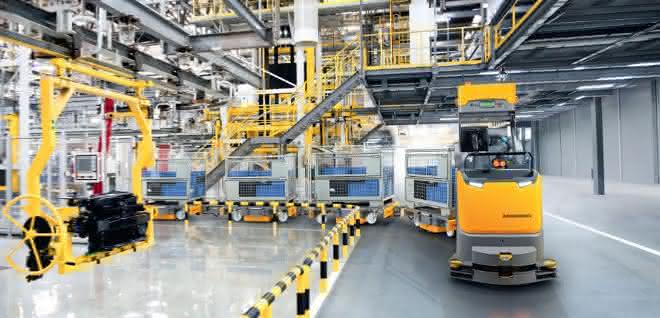
Which of your industrial trucks are currently equipped for autonomous use?" was our first question. "So far, we have our CX 20 order picker available as an autonomous vehicle in series production," says Christian Fischer, Head of Product Management Business & Automation Solutions at Still. "Further vehicles will follow soon".
"Linde's product portfolio of automated equipment includes Linde T-Matic low lift trucks, Linde L-Matic and L-Matic AC (with cantilever forks) high lift trucks, Linde P-Matic tow tractors and Linde K-Matic narrow-aisle order pickers," explains Philipp Stephan, Product Manager Linde robotics, Linde Material Handling. "We are planning to launch an autonomous reach truck, the R-Matic, before the end of this year. This will enable us to automate a wide range of tasks, such as pallet transportation, storage/retrieval, filling machines and supplying production lines".

"Thanks to the continuous development of processors, sensor technologies and improvements in navigation technologies, more and more warehouse processes can be automated with industrial trucks"Philipp Stephan, Linde MH
Series devices are automated
"Jungheinrich only automates series trucks from its own line production," says Irene Pichlmaier, Product Manager Automated Trucks at Jungheinrich. "This has the advantage that we are dealing with tried-and-tested trucks that are constantly being developed further, on which we then base the automation with navigation and additional safety technology."
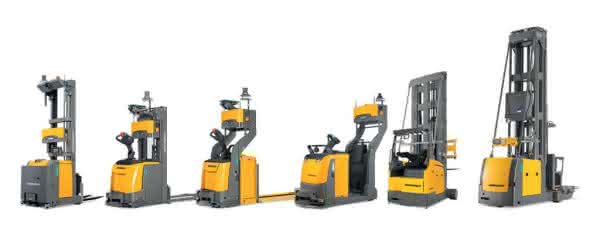
"Jungheinrich's automated guided vehicle systems (AGVs) include trucks with a transport capacity of up to 5.0 tons and lifting heights of up to 6.0 metres. This enables us to respond to a wide range of requirements. The following AGVs are in the portfolio: The compact ERC 215a is also suitable for use in confined spaces. The ERE 225a low lift pallet truck is well suited for area and multi-pallet transport, as it can be realized with different fork lengths. The EZS 350a automatic tow tractor with a pulling force of five tons is particularly interesting for companies that currently supply their production lines with manual tugger trains. The EKXa and ETXa high-rack stackers round off the fleet.
Sophisticated laser sensor technology at Crown
"Crown offers various technologies for semi-automation," says Ken Dufford, Vice President Europe, Crown. "QuickPick Remote picking technology has recently become available for other product ranges. Thanks to laser sensor technology, the operator controls his forklift truck via the remote control integrated into a work glove without having to enter the driver's cab.
The system is now available for the entire GPC 3000 order picker series and can also be used with the MPC 3000 series multifunctional forklift trucks and TC 3000 series tow tractors. This opens up new potential for greater productivity and for relieving the physical strain on operators. The glove is also used with QuickPick Remote lifting technology. This allows operators of the ES/ET 4000 pallet trucks to operate the fork height remotely and always adjust it to an ergonomic working height.
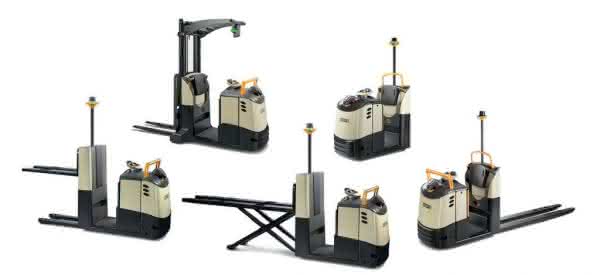
"We offer RFID-based navigation and safety systems such as Auto Fence technology for the narrow-aisle forklift trucks in the TSP series. This minimizes the risk of damage or injury. And the Auto Positioning System increases productivity by up to 25 percent.
Status to date: Project basis
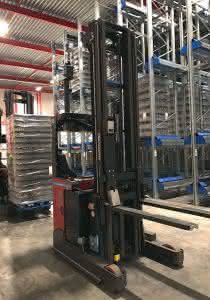
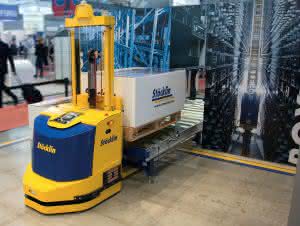
"So far, we have only equipped industrial trucks for autonomous use on a project basis," explains Mikåel Persson, Vice President Products at UniCarriers Europe AB. "The models are mainly pedestrian stackers with a foldable platform, such as our PSP pallet stacker. We have also successfully implemented solutions for autonomous operation in reach trucks". "We have not equipped any of our manual industrial trucks for autonomous use, but have developed the vehicles specifically for autonomous operation," says Markus Beck, AGV specialist at Stöcklin Logistik. Eagle-Ant-0 is designed for transporting pallets at floor level, Eagle-Ant-1 for lifting pallets up to a height of one meter, for example onto a conveyor system.
Autonomy - but where?
The answers to the second question describe a wide range of applications: "For which areas of application is autonomous operation best suited, such as incoming and outgoing goods, cab operations, longer transport routes, tugger train operations, order picking?"
"In general, there are many areas of application for autonomous vehicles. We have identified order picking as one of the areas in which they provide relief and support for employees while at the same time increasing efficiency - that's why we developed the iGo neo CX 20," explains Fischer. "But cab operations or longer transport routes are also ideal for the use of autonomous vehicles. The intelligent vehicles recognize and avoid obstacles".
"Automation in warehouses and production halls comes into question above all when logistics processes are routinely repeated and cover longer distances," says Stephan. "If the devices also run at least in two-shift operation, the essential requirements are met in order to benefit from the advantages of robot-controlled logistics."
"If a company wants to make its internal transport processes more efficient, the use of AGVs is often a sensible approach," states Irene Pichlmaier. "In particular, standardized routine tasks and recurring internal transport tasks, which would otherwise tie up a considerable number of employees, can be easily automated."

"Our goal is to offer our customers an optimal portfolio of automated trucks that meets their requirements and maximizes their benefits"Irene Pichlmaier, Jungheinrich
According to Dufford, automation is "clearly one of the most important challenges in the material flow industry and makes sense wherever standardized and predictable processes can be identified. Our technologies are based on the picking process in the broadest sense, but are by no means limited to this. For example, QuickPick Remote technologies also provide valuable support in production supply.
Longer, consistent routes
"Autonomous operation is generally suitable for material handling in the production area, as there is a steady, continuously repeating flow of goods," explains Persson. "For example, tugger trains with tugs are used here. It is also suitable for order picking". According to Beck, autonomous operation is "suitable for transporting pallets between the storage and production areas and within the production area, as well as for longer, consistent transport routes indoors".
The decisive factor is always the utility value, therefore: "What operational and economic advantages do industrial trucks with autonomous functions offer?" "With the iGo neo CX 20, you can clearly see how the driver's workload is reduced: He normally climbs up and down an average of 1,600 times per shift during order picking; but since the truck follows him every step of the way, this is no longer necessary," emphasizes Fischer. "The iGo neo always stops right next to the driver, so all he has to do is turn around, pick the goods from the shelf and place them on the relevant pallet. Overall, we achieve efficiency gains of up to 47 percent."
"The use of autonomous devices increases the transparency of processes and process reliability; the availability of the devices also increases as they work without a break," emphasizes Philipp Stephan. "Another advantage is the reduced risk of errors and transport damage."
"With the use of AGVs, employees can focus on their core work," says Irene Pichlmaier. "Damage to goods and warehouse equipment, which is commonplace when using manual industrial trucks, can be significantly reduced. Automation is particularly worthwhile in multi-shift operations, as the payback period for the investment is particularly attractive here.
"First and foremost, automated processes bring significant increases in productivity and efficiency," emphasizes Ken Dufford. "For example, with the Crown Auto Positioning System, a novice can achieve the same precision as a professional. Safety systems such as Auto Fence also prevent injuries and damage.
At least as important is the physical relief for employees. With QuickPick Remote order picking technology, operators benefit from up to 50% fewer walking distances with and without a load and up to 70% fewer entry and exit processes. "Key benefits are a lower error rate and greater safety when operating the industrial trucks," says Mikael Persson.

"A large number of customers confirm the high practical suitability of our automation technologies. The use of Quick Pick Remote results in up to 25% higher productivity"Ken Dufford, Crown
The advantages from Stöcklin's point of view: "Continuous 24-hour operation is possible, fixed breaks are only required to charge the battery. Fewer drivers are required for manual forklift trucks, they are relieved of constant transports and the risk of accidents is reduced".
And what do the practitioners say?
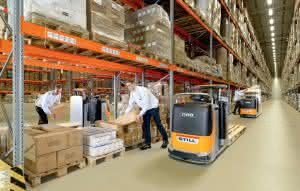
As the answers to the question: "Is there already feedback from customers who are using industrial trucks with an autonomous function? If so, how have the trucks proved themselves so far?", there is intensive communication with customers: "Both customers and operators are delighted with the neo. The order pickers were already familiar with the vehicle and the new way of working after just half a day," says Still. "They also all reported that they felt fitter at the end of a shift than before. The iGo neo CX 20 was perceived by everyone as a real innovation. By working in partnership with the customers, the vehicles were able to be further developed during the test phases."
Uncomplicated integration into existing fleets
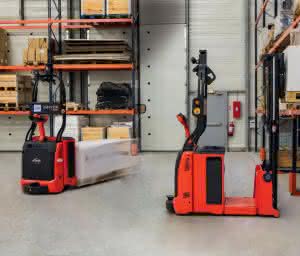
"The feedback from our customers is very positive," reports Linde. "The most important criterion is that the technology works reliably. Our customers also appreciate the quick and easy installation of the solution and the geo-navigation, in which the devices orient themselves to existing structures such as walls, shelves or pillars. Changes in routing or surroundings can therefore be easily adapted, the vehicles can be easily integrated into existing fleets or warehouse layouts and allow for gradual expansion." "Yes, a great many," reports Jungheinrich, referring to the numerous "Automated material handling references" listed on the company website, for example about applications at the BMW Group. Hero, ThyssenKrupp and Rudolph Logistik.
"A large number of customers regularly confirm the high practical suitability of our automation technologies," says Crown's experience. "With QuickPick Remote, our customers benefit from up to 25 percent higher productivity with less strain on employees".
"Fully automated devices such as automated guided vehicles (AGVs) are often still considered too slow for intensive use in distribution centers," reports UniCarriers. "The user cannot change the maximum performance of an industrial truck. This must meet the requirements and ensure a return on investment - only then are AGVs a real economic alternative".
"So far, we have mainly received positive feedback after the familiarization period," says Beck. "Customers are already planning extensions to their systems".
www.crown.com/de-de www.jungheinrich.de www.linde-mh.de www.still.de www.stoecklin.com www.unicarrierseurope.com/de


You might also be interested in
HTEC and Embotech Expand Autonomous Industrial Logistics
HTEC and Embotech aim to accelerate the adoption of autonomous driving solutions in industrial logistics. The strategic partnership is intended to facilitate the rollout to additional vehicle platforms, customer projects, and locations.
 read more...
Standardized in design, flexible in use
Automated guided vehicles are increasingly in demand in production and logistics as they automate processes efficiently - but in addition to the vehicle, the right peripherals are also crucial for safe operation. A new solution consisting of a...
read more...Outdoor AGV networks production and logistics
An international company in the plastics industry is automating its intralogistics at its German site with a solution from ek robotics. A specially developed vehicle model from the Out Move series, an outdoor AGV, is being used.
read more...Transport systems for automated material flow
The Leo transporters from Bito make it easier for users to get started with the automation of material processes, which is possible from 20,000 euros. The system is a flexible all-in-one complete solution that is ready for immediate use and can be...
read more...Automated logistics for the university hospital
As part of the new construction of the University Hospital of Reims (CHU), France, the hospital has taken a number of steps to improve the needs of its patients and the working environment of its employees.
read more...K.Hartwall: Topping-out ceremony for the German site
The topping-out wreath was raised at the new building in the TIP Innovationspark Nordheide in Buchholz near Hamburg on February 27: The new K.Hartwall plant will comprise approx. 3,500 m² of hall space and around 2,000 m² of office and social areas.
read more...Noerpel Group tests driverless high lift trucks
The Noerpel Group has tested driverless pallet trucks in one of its two logistics facilities in Giengen. During a four-week trial, two autonomous systems were used to transport goods within the warehouse.
read more...Supply and disposal of printing machines by AGV
Numerous companies rely on AGVs in intralogistics to increase efficiency and meet challenges such as the shortage of skilled workers. One such company is GGP Media GmbH in Pößneck, Thuringia.
read more...Sophisticated automation: AGV and cobot combined
On behalf of Krefeld-based Saurer Technologies, the engineering team from Project Automation & Consulting developed a solution for production logistics that combines AGVs and cobots.
read more...