

Forklift truck
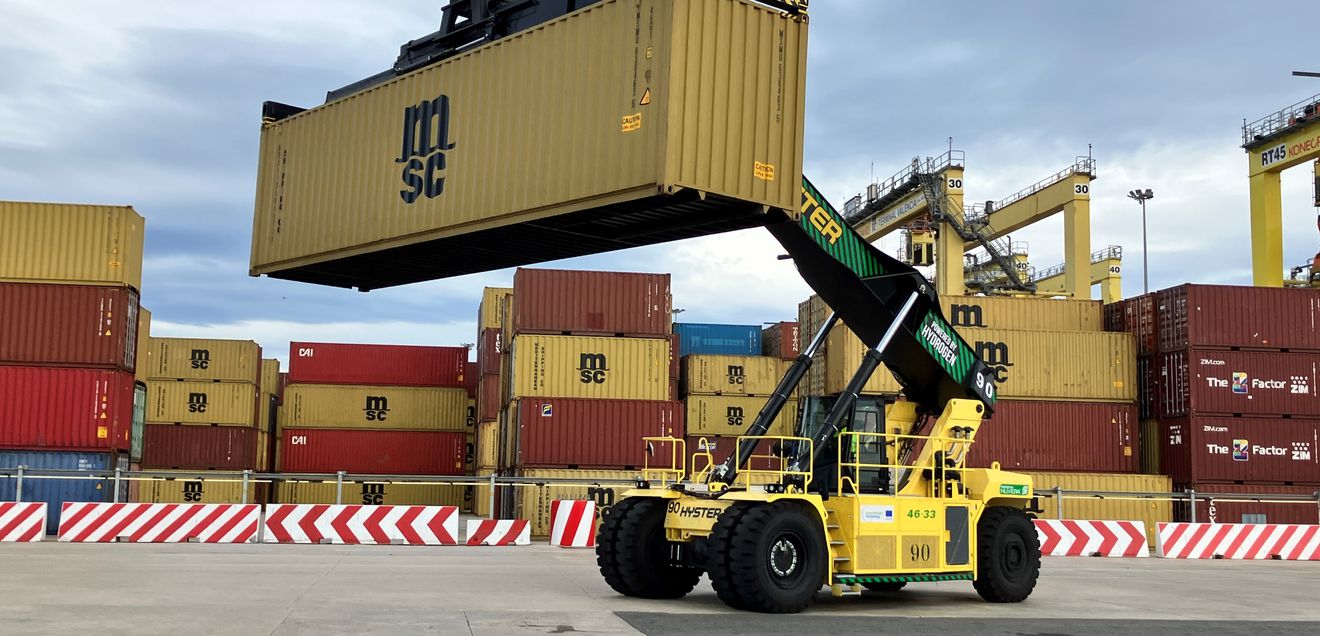
Hyster trucks for container handling in the port
With stricter regulations and shrinking margins, ports need equipment that improves throughput. It should not only reduce operating costs but also emissions with minimal downtime. Hyster develops full and empty container handlers as well as reach stackers with different drive options. Handling equipment with HVO100 fuel or hydrogen fuel cell technology completes the portfolio.
The more compact Hyster empty container handlers H6XD-12EC3 to H7XD-12EC4 are suitable for handling empty containers. Based on the H16XD6, the series is reliable and efficient when handling individual containers up to the third and fourth stacking height. Empty container stackers 6/9 high can handle up to nine containers on top of each other. The heavy-duty model with a load capacity of 11 tons can handle two 40-foot reefer containers with refrigeration units on the same side. The series offers various models for single or double container pick-up.
Use in a dynamic port environment
With a load capacity of 46000 kg, the reach stackers from Hyster are suitable for heavy-duty applications. The XD series stackers are equipped with a cab that supports maximum driver comfort and long operating times. Information and truck controls are easily accessible in the cab. Diagnostics and access to the truck's performance modes can be carried out quickly and without connecting to a computer. The curved one-piece windshield improves forward visibility, while the largest roof window in the industry provides a clear view upwards. The steering angle is fully adjustable.
Ports are a dynamic environment Vehicle fleets, cranes, container stackers, etc. have to transport heavy loads continuously with minimal downtime. Sufficient power must be available for this. Factors such as performance, cost and reliability therefore play a key role when evaluating emission-free options. While combustion engines benefit from an established fossil fuel supply, alternative drive solutions place special demands on the local electrical infrastructure or a reliable hydrogen supply. Hyster develops port equipment with different power supply options. Customers can choose the power source that best suits the application. Battery drive for light applications, where the modular design of the battery pack and the size of the charger matches the requirement. For demanding applications with two to three shifts and medium to high intensity, hydrogen and fuel cells are suitable, with a battery pack smoothing out peaks in energy demand if required. For extreme operating conditions with high intensity in three-shift operation, diesel is suitable, if possible as a reserve for peak times. HVO 100 as a fuel can reduce emissions by up to 90 percent.
Sustainability and energy efficiency are important factors for inland terminals. HHLA has opted for an empty container stacker powered by hydrogen fuel cells and a terminal tractor powered by hydrogen fuel cells. Both vehicles are powered by Nuvera hydrogen fuel cells and run on hydrogen fuel. They are in operation in the Clean Port & Logistics Cluster at HHLA Container Terminal Tollerort in Hamburg.
Savings potential through digitalization
Preventive and predictive maintenance of large forklift trucks and port equipment is important. For this reason, Hyster has been involved in the iTerminals 4.0 project for several years. The project won the Waterborne Award for Best Innovation Project in September 2023. As an EU-funded project as part of the Connecting Europe Facility program, iTerminals 4.0 aims to close the gap between the port and terminal industry and other sectors. This involves digitalization concepts such as the Internet of Things, big data, artificial intelligence, cloud computing, robotics and automation. iTerminals 4.0 comprises pilot projects in which digital technologies are used in the real operation of European ports and terminals and has led to the establishment of the TIC 4.0 (Terminal Industry Committee). TIC 4.0 has the task of defining standards for cargo handling. Hyster is one of the founding members.
Electrification of port facilities
Electrification is often a question of space. In port terminals, every square centimeter counts for maximum storage capacity. Cranes need to be accommodated and paths for container handling need to be kept clear. Charging stations for batteries sometimes need a lot of space. It can be difficult to integrate them into the terminal area - especially for larger fleets that require more space, more power and more charging time. "The development of hydrogen propulsion infrastructure and equipment powered by hydrogen fuel cells is already a reality. Our experts will determine which zero-emission solution is the right long-term solution for the respective application in the port," says Ricky Hirani, Global Commercial Product Leader Big Trucks and Port Equipment at Hyster, underlining the decision to electrify port operations.


You might also be interested in
Industrial trucks for luxury cars
Optimized logistics for super sports cars
Automobili Lamborghini manufactures exclusive luxury and super sports cars. Founded in 1963 by Ferruccio Lamborghini, the company is still based at its traditional headquarters in Sant'Agata Bolognese.
 read more...
Explosion-proof forklift trucks for production and warehouses
Sherwin-Williams (legal entity Inver) from Dresden produces industrial coatings for various industries. In order to create a safe working environment, the company has purchased a fleet of Linde explosion-proof forklift trucks. The industrial trucks...
read more...High-voltage forklift trucks for all weather conditions
EP Equipment presented the EFL 10T high-voltage forklift truck at the IFOY Award 2025 Test Camp in Dortmund. The EFL-HV series, including the EFL 10T, is designed to combine the performance of traditional combustion engine equipment with the modern...
read more...Hub for spare parts: KION Regional Distribution Center Central Europe opened
In order to further shorten delivery times and ensure delivery availability of almost 100 percent in the future, Linde Material Handling has built a new, larger spare parts distribution center equipped with modern technology at its existing site in...
read more...Spare parts efficiently brought to the track
The distribution center and spare parts warehouse of an automotive manufacturer in Wallersdorf, which opened in 2016, covers an area of around 235,000 square meters. Customers all over the world are supplied with spare parts and accessories from...
read more...Flexible for indoors and outdoors: New Toyota MH series
Toyota Material Handling has launched the latest generation of its electric counterbalance trucks - the Toyota Traigo48 series. This is intended to impress in terms of performance and design as well as with a comprehensive package of functions.
read more...Hubtex Group takes over Genkinger GmbH
The Hubtex Group has acquired 100 percent of the shares in Genkinger GmbH, based in Münsingen. The aim of this acquisition is to further strengthen the individual brands internationally and to utilize synergies across locations.
read more...Still invests in Hamburg headquarters: 50 million euros for new mechatronics center
On February 19, intralogistics expert Still and Mercurius Industrial Properties officially broke ground for the Still "Centre of Competence Mechatronics" in Hamburg. Still has also announced further site developments in the Hanseatic city: The...
read more...Lift trucks, stackers and order pickers from a single source
Colorbaby distributes toys, outdoor leisure products and household goods from its warehouse in Ibi, Alicante, Spain. The company previously used a fleet of industrial trucks from various manufacturers. After more than five years of good experience...
read more...