

Forklift truck
Electrically into the future
All beginnings don't always have to be difficult, even when heavy loads are involved. In 2015, the Radeberger Group was one of the first companies in the beverage industry to join forces with Linde Material Handling (MH) and take the step from IC engine-powered to electrically powered forklifts - right up to the highest load capacity classes. A decision that proved to be the right one in many respects.
Radeberg near Dresden, 1872: five gentlemen meet - curiously enough - in a wine shop, put their heads together and finally launch a special brewery. A brewery that was to establish the hitherto largely unknown Pilsner brewing style in Germany. The rest is history. "Admittedly: Our 2015 plan wasn't quite so visionary, but we certainly did pioneering work with the project," reports Jens Berberich with a grin. He heads up the Purchasing, Logistics and Sustainability department at the Radeberger Group, Germany's largest private brewery group.
Almost ten years ago, the company, which includes well-known beer brands such as Jever and Schöfferhofer as well as Radeberger Pilsner, decided to convert its fleet of forklift trucks to climate-friendly electric drives. "At the time, almost no one in our industry dared to use electric drives, especially in the high load capacity classes," recalls Berberich, adding: "We are all the more proud that this project was implemented so successfully together with Linde MH."
CO2 emissions: Those who reduce do not have to compensate
A look at the facts: The Radeberger Group operates numerous production and bottling sites in Germany, as well as numerous logistics centers and other properties, as the company is also active in beverage wholesaling, third-party logistics, beverage retailing and many other areas. Naturally, internal goods handling plays an important role.
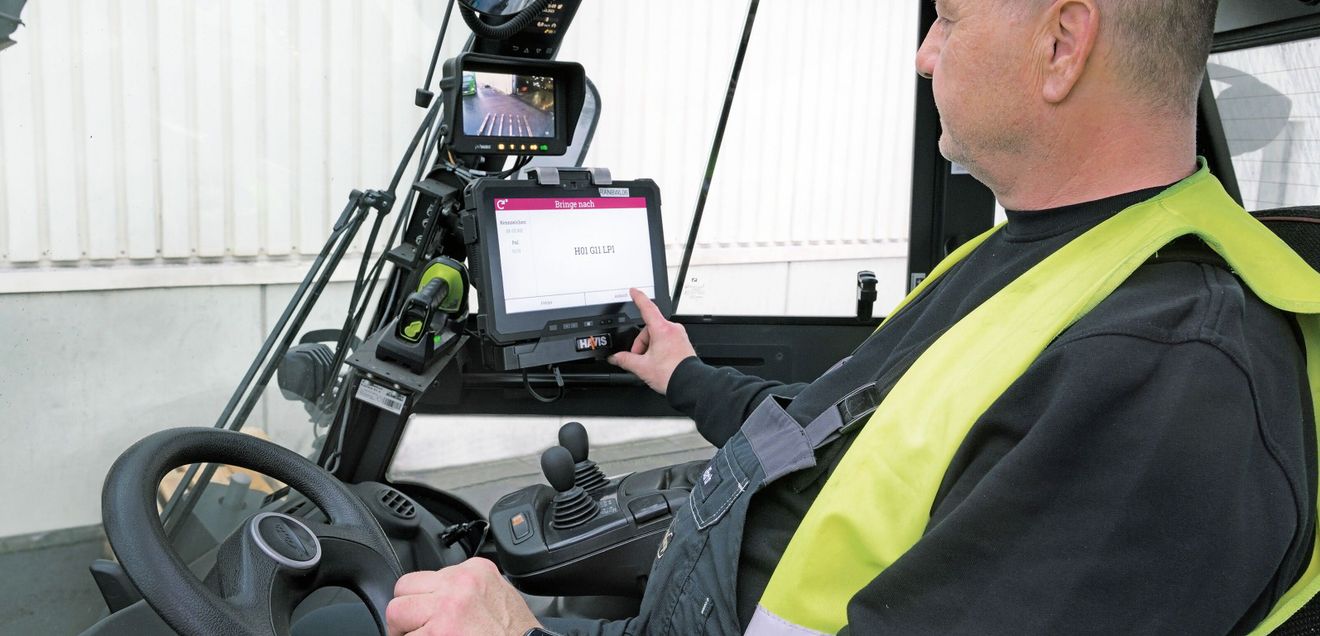
"We operate around 300 forklift trucks across the Group, across all tonnages, from 1.5-ton trucks to heavy 8-ton trucks," says Wolfgang Klee, Head of Logistics at Radeberger Exportbierbrauerei. Up until 2015, when all equipment was still powered by diesel or propellant gas, the fleet emitted around 9,300 tons ofCO2 per year. A balance sheet that certainly challenged those responsible - as colleague Jens Berberich notes: "As a food manufacturer, we are particularly committed to protecting nature and natural resources; and if you seriously want to become more sustainable, we believe you have to start by reducing emissions. Because we don't have to compensate for what we don't emit." So the decision was made to turn to a type of drive that was still considered exotic in the beverage industry at the time.
E-forklift trucks in the beverage industry? Someone has to make the start
"The tender from the Radeberger Group in 2015 was also something special for us," says Christian Kunkel from Linde MH network partner Suffel Fördertechnik, who managed the project together with Nils Bielmann from Willenbrock Fördertechnik. "The tender practically coincided with the market debut of the Linde E80 with lead-acid battery, so we didn't really have many references for this category of equipment to present to the customer." The Linde experts were therefore keen to see how the new power packs would fare in a direct comparison with the electric forklift trucks of other manufacturers.
"We launched an internal competition to compare more than just figures; the specific feedback from the forklift drivers was at least as important to us," reports Radeberger Group Manager Jens Berberich. The staff were particularly impressed by the ergonomics and sensitivity of the Linde E80. After the forklift truck had already won this race, the new electric model also scored highly in the one-year long-term test at the Krostitz site. "With more than 3,000 operating hours within twelve months, we really didn't give the Linde forklift anything away; at the same time, we were always in close contact with the Linde project team and were able to place our special requirements - for example in the areas of air conditioning and heating. The support from Linde was really excellent," says Jens Berberich.
Li-ion technology brings further tangible benefits
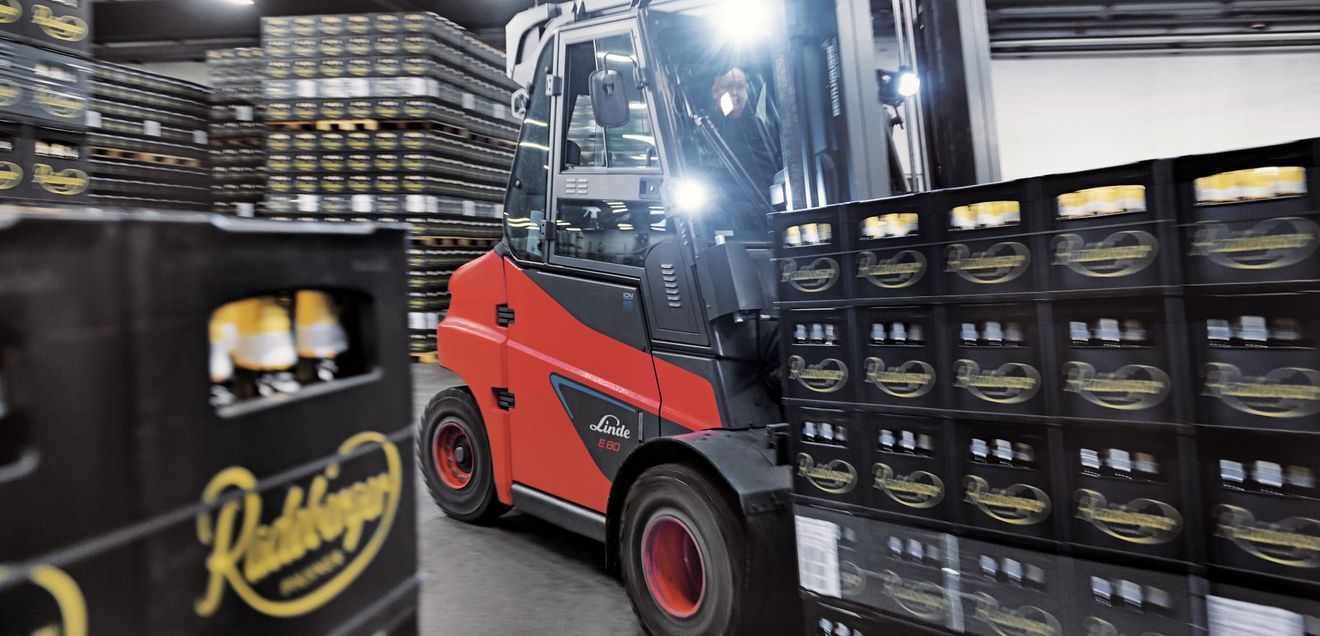
After this journey back in time to the early years of the transformation project, the route leads us to Radeberg. Here, where only Radeberger Pilsener and Radeberger Alkoholfrei with genuine Pilsner character and Callista aroma hops from regional cultivation are produced in the brewing kettles, you can see red forklift trucks whirring back and forth between meters-high stacks of black crates with the golden brand lettering. "In two-shift operation, we handle 20 trucks with full and empty containers per hour at the absolute peak," says Logistics Manager Wolfgang Klee, describing the operating profile of the electric 8-ton trucks.
These now no longer draw their energy from lead-acid batteries, as was initially the case, but from lithium-ion energy storage systems. Klee: "Radeberg was one of the first sites within the Group to switch to modern battery technology following the decision in favor of Linde MH and the switch from V to electric forklifts." According to Klee's colleague Jens Berberich, this was the next logical step in the company's sustainability efforts. "By 2026, we will only be using Li-ion trucks from Linde - and thanks to the higher energy efficiency, we will be able to reduce ourcarbon footprint by a further 30 percent." Apart from that, Berberich continues, this will save the comparatively time-consuming process of changing the lead-acid batteries. The fact that the Radeberger Group already uses 80 percent green electricity throughout the company and intends to gradually increase the proportion of self-generated energy rounds off the project perfectly.
"Nobody here wants the combustion engine back"
Fact: Anyone who uses new technologies usually has to give up old habits in their day-to-day work. "In the days of combustion engines, one person here in Radeberg used the same vehicle from the beginning to the end of a shift. Due to our high work intensity and the sometimes long distances, this was no longer possible with the electric forklift trucks," explains Logistics Manager Wolfgang Klee.
However, a solution to this challenge was quickly found together with the Linde project team - in the form of an individual charging logic. Wolfgang Klee: "We recharge the trucks for half an hour each day during the work breaks at 9 am and 6 pm. We have also defined certain threshold values for the trucks. If the charge level falls below this, the vehicles are connected to the chargers and you simply switch to another device with a higher charge level." The logistics manager goes on to explain that this system very quickly became second nature to the team, so that the required handling capacity is achieved effortlessly: "A Linde E80 with a 6-way clamp completes a full truck in less than ten minutes. Our people simply work with the trucks as if they had never driven anything else. And I no longer know anyone who would like to go back to combustion engines."


You might also be interested in
Industrial trucks for luxury cars
Optimized logistics for super sports cars
Automobili Lamborghini manufactures exclusive luxury and super sports cars. Founded in 1963 by Ferruccio Lamborghini, the company is still based at its traditional headquarters in Sant'Agata Bolognese.
 read more...
Explosion-proof forklift trucks for production and warehouses
Sherwin-Williams (legal entity Inver) from Dresden produces industrial coatings for various industries. In order to create a safe working environment, the company has purchased a fleet of Linde explosion-proof forklift trucks. The industrial trucks...
read more...High-voltage forklift trucks for all weather conditions
EP Equipment presented the EFL 10T high-voltage forklift truck at the IFOY Award 2025 Test Camp in Dortmund. The EFL-HV series, including the EFL 10T, is designed to combine the performance of traditional combustion engine equipment with the modern...
read more...Hub for spare parts: KION Regional Distribution Center Central Europe opened
In order to further shorten delivery times and ensure delivery availability of almost 100 percent in the future, Linde Material Handling has built a new, larger spare parts distribution center equipped with modern technology at its existing site in...
read more...Spare parts efficiently brought to the track
The distribution center and spare parts warehouse of an automotive manufacturer in Wallersdorf, which opened in 2016, covers an area of around 235,000 square meters. Customers all over the world are supplied with spare parts and accessories from...
read more...Flexible for indoors and outdoors: New Toyota MH series
Toyota Material Handling has launched the latest generation of its electric counterbalance trucks - the Toyota Traigo48 series. This is intended to impress in terms of performance and design as well as with a comprehensive package of functions.
read more...Hubtex Group takes over Genkinger GmbH
The Hubtex Group has acquired 100 percent of the shares in Genkinger GmbH, based in Münsingen. The aim of this acquisition is to further strengthen the individual brands internationally and to utilize synergies across locations.
read more...Still invests in Hamburg headquarters: 50 million euros for new mechatronics center
On February 19, intralogistics expert Still and Mercurius Industrial Properties officially broke ground for the Still "Centre of Competence Mechatronics" in Hamburg. Still has also announced further site developments in the Hanseatic city: The...
read more...Lift trucks, stackers and order pickers from a single source
Colorbaby distributes toys, outdoor leisure products and household goods from its warehouse in Ibi, Alicante, Spain. The company previously used a fleet of industrial trucks from various manufacturers. After more than five years of good experience...
read more...