
Hangcha Germany offers lithium-ion technology
The right battery type for the forklift truck
Lithium-ion batteries have long since established themselves in portable devices such as cell phones and tablets. Electric forklift trucks are a different story: the classic lead-acid battery still dominates here. We explain the differences.
The properties of lithium-ion batteries sound fascinating. Their energy density is around four times higher than that of lead batteries. And they can be "refueled" in a very short time. Just twenty minutes, for example, results in a charge of around 25 percent; and after two hours, such a power storage unit is fully charged. They can also be charged or almost completely drained in between - without affecting their service life. In terms of efficiency, the new type of battery is also impressive: a lead-acid battery only provides around 70 percent of the electricity originally used; the modern equivalent, on the other hand, makes around 93 percent usable. This leads to significantly lower energy costs.
General recommendation impossible
Li-ion batteries also have a much longer service life. Self-discharge hardly plays a role. In addition, the advanced storage technology eliminates the time-consuming refilling of water, battery changes and maintenance and cleaning measures. However, the new energy systems also have disadvantages. For one thing, unlike lead batteries, they have a disappointingly low recycling rate. Secondly, their purchase price is many times higher than that of a corresponding conventional energy storage system. A general overall cost comparison of the two battery types remains illusory: "You have to analyze each case on an application-specific basis," sums up Thomas Schmehl. The Managing Director of Burger Hub- und Transportmittel GmbH admits that lithium-ion batteries are most likely to pay for themselves in multi-shift operation. But even then
the right solution is not automatically determined.
Better to rent Li-Ion batteries
The general importer of Hangcha machines knows: "Li-ion has no chance in practice without an appropriate time window for charging in between. No matter how favorable the cost calculation is." On the other hand, the innovative traction batteries are convincing even in applications where the lead solution would be more cost-effective. As a prime example, the engineer cites "smaller devices in ramp operation whose lead batteries are never serviced and therefore often fail". If lithium-ion batteries were rented instead of bought, the technology would pay off - perhaps not in terms of life cycle costs, but definitely from an availability perspective. The trendy power storage systems are also highly attractive in sensitive working environments, particularly in the pharmaceutical and food industries: contamination from battery gases and acids is simply not possible.
Completely new forklift creations
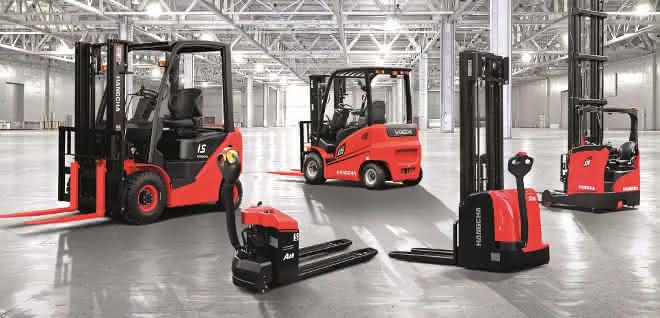
The characteristics of the high-tech batteries also make it possible to design completely new industrial truck variants. Hangcha's products include the CBD12 low lift pallet truck. This lifting device for the so-called "last mile" weighs 180 kg less than a similarly powerful lead model. And it allows the delivery driver to transport substantially more freight with the same payload. Schmehl now offers all electrically powered Hangcha models with an optional lithium-ion battery. The intralogistics specialist from Herborn has brought the Münsterland-based supplier Benning on board. The family-owned company, founded in 1938, relies on lithium iron phosphate cells. For chemical reasons, these modules are a particularly safe design. Each storage unit is characterized by a service life of around 3,000 cycles and an intelligent battery management system.


You might also be interested in
New low lift pallet truck with lithium-ion technology
Clark presents a completely newly developed electric pallet truck with lithium-ion technology (Li-Ion).
 read more...
material flow PRODUCT OF THE YEAR 2024
Category 3: Conductix-Wampfler - ContactCharger
The KontaktCharger is the solution for efficient and economical conductive charging of lithium-ion vehicle batteries in intralogistics.
read more...ReachStacker with hydrogen fuel cell
Hyster, a provider of container handling solutions, has delivered a reach stacker with a hydrogen fuel cell to the Port of Valencia in Spain. It is part of the H2Ports project. The aim of H2Ports is to introduce hydrogen-powered vehicles and...
read more...Material flow in pure culture
Electromobility is booming and the demand for batteries is greater than ever. In order to serve this market, more and more battery plants are currently being built in Europe. Mobile systems from SEW-Eurodrive are being used in the new plant of a...
read more...Winner material flow PRODUCTS OF THE YEAR 2023
Wagner Group: Fire protection solution for the storage of lithium-ion batteries at Kettler Alu-Rad
For the fully automated high-bay warehouse at the new production site, in which up to 50,000 e-bikes can be packed ready for dispatch and stored with installed batteries, Wagner implemented a customized fire protection solution that reduces the risk...
read more...Winner material flow PRODUCTS OF THE YEAR 2023
Conductix-Wampfler: ChargeLine 0865
Two-pole conductor rail segments for efficient opportunity charging of shuttles, suitable for thousands of cycles per day.
read more...Intelligent charging with solar energy
Charge industrial trucks with solar power and optimize your own consumption? This is now possible with a new function in the Charge & Connect portal from Fronius Perfect Charging.
read more...Paper manufacturer with innovative production logistics
Paper manufacturer Franz Veit has made its intralogistics operations much more efficient with the help of Linde Material Handling and Ernst Müller Fördertechnik.
read more...Battery logistics and more
Alfred Schuon presented its portfolio of transport and contract logistics services at Transport Logistic. The focus was also on the company's expertise in battery logistics.
read more...