
IC4F project
Secure data exchange in the age of Industry 4.0
Networked production processes and digital factories are an important key to securing Germany's competitiveness and ability to innovate. The lighthouse project IC4F (Industrial Communication for Factories), in which STILL plays a key role, has been working on this topic for almost three and a half years. The Hamburg-based intralogistics provider also hosted the final event at which the results achieved with the project partners were presented on October 22.
Everyone has been talking about the future project Industry 4.0 for years. However, there is still a lack of important tools for putting the new industry standard into practice. The PAiCE funding program (Platforms, Additive Manufacturing, Imaging, Communication, Engineering) of the Federal Ministry of Economics is intended to provide a remedy. One associated project is the IC4F (Industrial Communications for Factories) lighthouse project, in which Hamburg-based intralogistics specialist STILL is playing a key role. "Over the past three and a half years, the 15 project partners from industry and research - including Robert Bosch GmbH, Siemens, Deutsche Telekom AG and Nokia - have developed a technology kit for a trustworthy industrial communications and computing infrastructure," explains Ansgar Bergmann, Project Manager from the Technology & Innovation department, who was responsible for STILL's part in the project. This modular system is based on an open architecture and allows modular extensions for new applications and communication technologies. "The results of our research," Bergmann continues, "will enable users to select suitable information and communication technologies according to the requirements of Industry 4.0 and a specific migration approach." The secure, robust and real-time communication solutions for the manufacturing industry use key technologies from the fields of 5G, multi-access edge computing (MEC), cloud computing, virtualization as well as industrial monitoring and analytics.
In the thick of it instead of just there
Ansgar Bergmann is particularly proud of the fact that STILL not only "simply took part" in this project, but was able to fully contribute its expertise and play a decisive role in its development. "We have put our wealth of experience in the areas of industrial networking and Industry 4.0 to good use. We benefited from the fact that we have already helped to shape several guidelines for industry on behalf of the German government and the VDMA in the past," says the STILL expert. On the other hand, the Hamburg-based intralogistics specialist has also benefited from participating in the IC4F project. Bergmann: "First of all, we proved to ourselves that we have mastered successful networking in the warehouse and that our approaches work. We were also able to gain many new insights, which we will now use profitably for both sides in our collaboration with our customers."
Live demonstrations illustrate project success
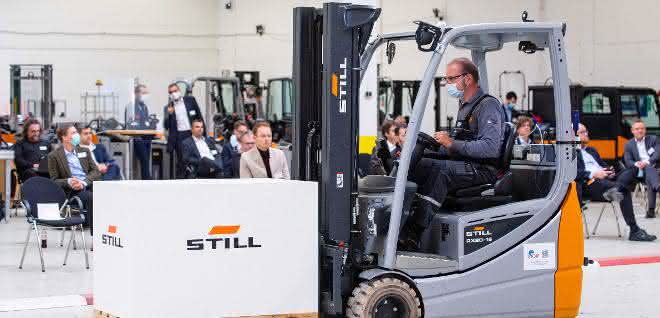
This work came to a provisional conclusion on October 22. STILL invited project partners and internal stakeholders to its headquarters on the Elbe. A mobile communications campus network necessary for the project implementation was also set up there by Nokia, which will serve as a pioneer for new communication technologies such as 5G. The pioneering results of the project work were then presented in several live demonstrations. For example, one live demonstration ("Use Case Truck-to-X Communication"), which was largely developed by STILL, dealt with door control in a factory hall. In this use case, both forklift trucks and other factory installations were integrated into a shared communication environment. Indoor localization provided the position data of the forklifts, which was then processed by various applications of the partners involved in the live demonstration. In this example, the door was controlled purely from a virtual world. The gate opened automatically as soon as a forklift truck approached it. This gate control was implemented as a so-called administration shell. Digital twins of the forklift truck and the door were created for this purpose. All physical properties of the forklift truck and door were then made permanently available in the partial models of the administration shell. The virtual model, which controlled the processes, was thus able to continuously compare this data and, for example, only open the gate if the forklift truck actually fits through in terms of its dimensions. In addition, the truck's drive control system is accessed and the driver is warned if it is getting tight. Gate damage such as that which occurs today would therefore be a thing of the past.
High customer benefit
Overall, a number of live demonstrations and a variety of new or expanded industrial use cases were shown in Hamburg during the presence event, e.g. the "Bring your Own Network" approach from Siemens for easier installation of multi-tenant networks in companies or Telekom's modern "certificate management via the cloud", which increases both security and convenience in the field of industrial communication. "These proof-of-concept implementations serve to check the methodology and validate the use cases," says Ansgar Bergmann. The STILL expert is firmly convinced that many of the findings and experiences from the IC4F project will later flow into industrial applications and be of great benefit to STILL's customers. "With this experience behind us, we are the ideal partner when it comes to Industry 4.0 topics or networking in the warehouse," says Ansgar Bergmann confidently.


You might also be interested in
Winner material flow PRODUCTS OF THE YEAR 2023
Conductix-Wampfler: ChargeLine 0865
Two-pole conductor rail segments for efficient opportunity charging of shuttles, suitable for thousands of cycles per day.
 read more...
Hermann Grewer celebrates his 80th birthday
Hermann Grewer, Honorary Chairman of the North Rhine-Westphalia Transport and Logistics Association (VVWL) and Honorary President of the German Road Haulage, Logistics and Disposal Association (BGL), celebrated his 80th birthday on June 6.
read more...Well chilled for sure
V-Zug Kühltechnik AG, developer and manufacturer of refrigeration appliances and part of the successful V-Zug Group, has set up a new production facility for refrigerators of all heights and dimensions at its Swiss site in Sulgen.
read more...Advantageous automation of small parts warehouses
The RSX1 shuttle system will be at the center of Rocketsolution's presence at this year's Logimat trade fair.
read more...Reduced energy requirements in the high-bay warehouse
One of Germany's leading premium car manufacturers is already focusing on energy efficiency in the production of its new SUV model with electric drive. The storage and retrieval machines in a high-bay warehouse at the production site have been...
read more...Low lift pallet truck for light duty applications
Clark has launched a new low lift pallet truck with the model designation LWio15 for light transport tasks. The truck has a load capacity of 1500 kg and is suitable for short distances in goods distribution, production or warehousing.
read more...Internationalization as an opportunity
E-commerce is in a state of flux. Changes in purchasing behavior and procurement problems are keeping e-commerce retailers busy. Logistics plays a decisive role in the overall online shopping experience.
read more...Fulfillment Center for Frisco.pl
Polish eGrocery specialist and TGW deepen partnership
TGW is building a highly automated fulfillment center for Frisco.pl in the Polish capital Warsaw. This is the second project in a row that the two companies have implemented together.
read more...Which world will it be in 2023?
Michael Schreckenberg teaches at the University of Duisburg-Essen as Professor of Physics of Transport and Traffic. Once a year, he addresses the readers of materialfluss, formerly LT-manager, with a critical and humorous expert article on transport...
read more...