Forklift trucks
Intralogistics 4.0 - the living reality
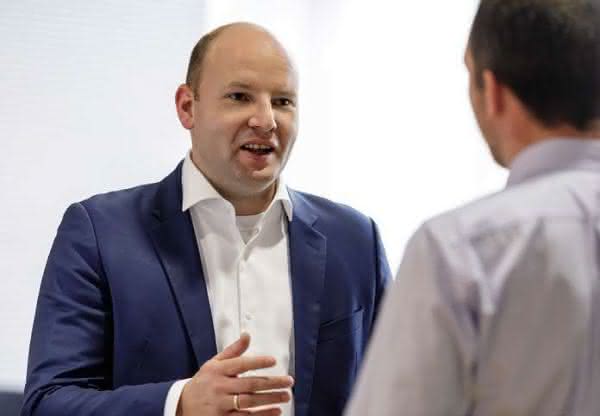
Where is intralogistics heading in the age of digitalization and networking? Hermann Ammermann, Head of Logistics Systems at Jungheinrich's South-West sales office in Bensheim, talks to materialfluss about added value for customers through holistic and increasingly customized solutions.
material flow: When a company wants to digitize its logistics processes, the call for a comprehensive system solution quickly becomes loud. Big providers sound like big costs. Will the system house around the corner do?
Hermann Ammermann:Large and expensive are not necessarily interdependent, nor are small and cheap. Ultimately, the question is which solution is the most economical for the customer in the long term. In addition to the actual performance and the costs of the initial investment, this includes in particular the ability of the software to react economically to changes and expansions. And finally, it is also important to ensure the availability of the solution through professional customer service. I think that we at Jungheinrich are extremely competitive in all of the points mentioned above.
mfl: Everyone is talking about Industry 4.0, digitalization and networking. Is this the future?Ammermann: Digitalization and networking are not just the future, they have long been a reality in many areas of intralogistics. I'm thinking of the paperless office, for example, which is still a real challenge for many of us in our day-to-day work. At the same time, the paperless warehouse is already easy to implement and has met with a high level of acceptance. The decisive factor is the needs of the stakeholders. These in turn result from the requirements of their market. Ultimately, the digitalization and networking of systems is not an end in itself or about following a trend. The decisive factor is and remains the specific customer benefit, and this is precisely where we at Jungheinrich come in.
mfl: Where do you see Jungheinrich's strengths in terms of digitalization and networking?Ammermann: We think holistically. This applies to the products as well as the systems and processes. We don't leave the customer alone with the planned solution, but ensure professional support throughout the entire life cycle. It is a clear advantage that we have both the hardware and the software in our portfolio. The expertise of our employees also plays a key role in this context. We take a very specific look at our customers' processes and engage in in-depth dialog with them. When product and very specific process expertise become one in this way, we can offer the customer clear added value in the optimization of their processes and the associated digitalization and networking.
mfl: Jungheinrich offers a broad portfolio of products. How do these become networked solutions?Ammermann: Networking is always two-dimensional. Firstly, horizontally across the entire intralogistics process from goods receipt to goods issue. Here, our Jungheinrich WMS controls the entire intralogistics process chain as a high-performance warehouse management system. Networking also takes place vertically. The interface software, the Jungheinrich Logistics Interface, is of great importance here. As a link between software and hardware, it contributes to increasing the performance and process quality of individual intralogistics subsystems. All of this is customized according to the customer's needs. We can even design the user interfaces according to the customer's specifications. This brings many tangible benefits: for example, when integrating Jungheinrich warehouse navigation, warehouse navigation in narrow aisles, when using automated guided vehicles or when intelligently controlling a mobile racking system.
VITA
Hermann Ammermann is Head of Logistics Systems Bensheim, Germany. The 35-year-old has held various staff and management positions in the intralogistics industry for over ten years.
mfl: Many technologies today often have very short "half-lives" due to ever faster changing software. How does Jungheinrich deal with this?
Ammermann:The sustainability of our solution is ensured by the architecture of the software. The Jungheinrich WMS is not a static, stand-alone, isolated solution. On the contrary: it is constantly being further developed and always remains release-capable and forward-compatible. We therefore have numerous customers who have not only been using our software to control their intralogistics processes for a very long time. They also use it to proactively shape the ongoing, sometimes massive changes in their intralogistics or their transition from manual systems to partially or even fully automated systems.
mfl: Every warehouse has its own characteristics and requirements. How can digital, intralogistics processes do justice to individual warehouse realities? Ammermann: In my view, the warehouse reality is not so decisive for its digitalization. What is needed first and foremost is appropriate data and process quality on the part of the customer, or at least a willingness to work on both. Our portfolio then allows us to advise customers according to their actual needs. Incidentally, we are quite prepared to say no if we are not convinced that we can offer the customer real added value in the end. This is part of our sales responsibility. For us, sales success and customer satisfaction always go hand in hand.
mfl: How individually must intralogistics be designed today?
Ammermann:Of course, the solutions must be individually designed for our customers. But that is not an end in itself. The only decisive factor is that the individualization brings concrete benefits for our customers. For example, as is the case with the process of introducing a WMS. Customer benefits already arise because they have to deal intensively with their existing processes. Whether the software should then be further individualized or the customer's existing process should be questioned is the result of an intensive dialogue between the customer and our software and intralogistics experts, who have already addressed and solved precisely these issues in numerous other customer projects.
mfl: Getting integrated, complex logistics solutions from a single source sounds temptingly simple. But how dependent does this make companies?Ammermann: Investment decisions are always about trust. And this is largely personal. Jungheinrich's holistic business model always aims to benefit the customer. This involves not only project planning and the sale of solutions, but also professional support over the entire product life cycle through our customer service. In addition, dependencies are always reciprocal. We therefore strive for sustainable partnerships with our customers and know that we are successful when our customers are successful with our services.
mfl: In your view, where is intralogistics heading on its way to 2028, and what role are system providers likely to play for customers then?Ammermann: Intralogistics will continue to develop strongly through innovation, and the momentum will certainly increase. Digitalization and networking are certainly just as much drivers as the demand for high performance with maximum flexibility. Jungheinrich is therefore making targeted investments in corresponding research and development. I am convinced that efficient intralogistics will continue to have manual, semi-automated and fully automated elements in the future. And for this you need a partner like Jungheinrich, who has experience, the right solutions and expertise in these areas.


You might also be interested in
New institute director at Fraunhofer IML
Alice Kirchheim succeeds Michael ten Hompel
On April 1, Prof. Dr.-Ing. Alice Kirchheim took over the Material Flow Systems division at the Fraunhofer IML and the Chair of Materials Handling and Warehousing at the Technical University of Dortmund. She succeeds Prof. Dr. Michael ten Hompel.
 read more...
A new robot system can move up to 150 kilograms
The WZL's innovative large mobile robot enables the flexible manipulation of heavy payloads.
read more...BVL Managing Director leaves
Shortly after the German Logistics Congress, Dr. Martin Schwemmer announced his retirement. He wants to work more scientifically again.
read more...On-board sensors replace GPS
In the "Autodrone in Production" project, researchers at the Institute of Integrated Production Hanover (IPH) have developed a drone that can fly autonomously in unknown indoor spaces.
read more...Sales growth and robust earnings
Jungheinrich reports a "decent" first half of 2022
Jungheinrich AG can look back on what it describes as a decent first half of the 2022 financial year. The intralogistics group was able to increase incoming orders and sales.
read more...Hekatron companies continue to grow
Despite a wide range of challenges, the Hekatron companies will close the 2021 financial year with a turnover of around 215 million euros. For the fire protection experts and EMS specialists, this means continued growth and an increase of 5.5...
read more...embedded world attracts visitors to Nuremberg
After a two-year break, embedded world is back in Nuremberg. In parallel, the embedded world Conference and the electronic displays Conference invite visitors to exchange ideas.
read more...Innovations for the future of logistics
SSI Schäfer founds Enterprise Lab with Fraunhofer IML
In the Enterprise Lab, SSI Schaefer and Fraunhofer IML want to research sustainable, technologically innovative solutions for logistics. The collaboration, which will initially run for three years, will start on June 1, 2022.
read more...Earth Day 2022 sustainability initiative
Getac is committed to reforestation with One Tree Planted
Getac, a provider of rugged computing solutions, announces partnership with One Tree Planted as part of its Earth Day 2022 sustainability initiative.
read more...