
A new approach to trolley transportation
Advantages of logistics train and forklift combined
With the trolley truck, Linde Material Handling aims to combine the advantages of the Linde logistics train with those of a forklift truck. The result is maneuverable and can also reverse.
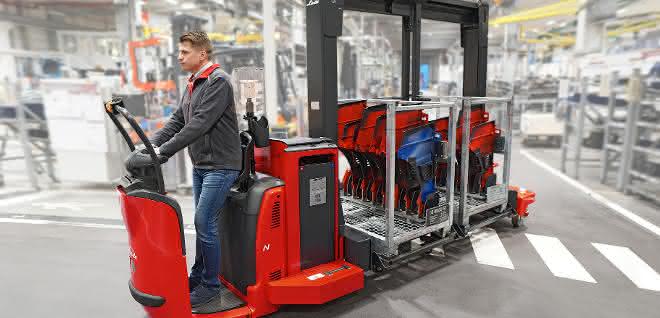
The trolley truck is based on the Linde Matrix concept: the operating unit and drive unit of the load transporter are from the Linde warehouse trucks modular system. A completely new feature, however, is the load unit in the form of a bow trolley with steered wheels, which, according to the company, can achieve efficiency increases of up to 30 percent in material handling in production plants.
Good visibility, less traffic
The idea for the new vehicle concept came about after numerous customer projects and the experience gained there. "It became increasingly clear to us that we needed an additional option, a kind of middle ground between a forklift and a tugger train," reports Ralf Knaut, Project Manager Special Solutions at Linde Material Handling. Test runs in various companies and the forklift assembly at Linde Material Handling confirmed the advantages of the new concept: "First and foremost, the people involved cited the increase in safety compared to individual vehicles, as the Trolley Supply Truck offers the operator very good visibility to the front, rear and around the vehicle. Secondly, the reduced traffic volume and lower risk of accidents were noticeable, as two pallets or trolleys can be transported at the same time," reports the Linde product manager.
In horizontal transportation: route and logistics trains are superior to forklifts
"Many of our customers already rely on forklift-free production supply using route or logistics trains," says Knaut. This is because trains consisting of tractors and trailers are superior to forklifts in many ways, especially when it comes to purely horizontal goods transportation. On the one hand, they are loaded and unloaded from the side and therefore require less space than a forklift truck, which stands at right angles to the roadway when setting down the pallet.


You might also be interested in
Industrial trucks for luxury cars
Optimized logistics for super sports cars
Automobili Lamborghini manufactures exclusive luxury and super sports cars. Founded in 1963 by Ferruccio Lamborghini, the company is still based at its traditional headquarters in Sant'Agata Bolognese.
 read more...
Explosion-proof forklift trucks for production and warehouses
Sherwin-Williams (legal entity Inver) from Dresden produces industrial coatings for various industries. In order to create a safe working environment, the company has purchased a fleet of Linde explosion-proof forklift trucks. The industrial trucks...
read more...High-voltage forklift trucks for all weather conditions
EP Equipment presented the EFL 10T high-voltage forklift truck at the IFOY Award 2025 Test Camp in Dortmund. The EFL-HV series, including the EFL 10T, is designed to combine the performance of traditional combustion engine equipment with the modern...
read more...Hub for spare parts: KION Regional Distribution Center Central Europe opened
In order to further shorten delivery times and ensure delivery availability of almost 100 percent in the future, Linde Material Handling has built a new, larger spare parts distribution center equipped with modern technology at its existing site in...
read more...Spare parts efficiently brought to the track
The distribution center and spare parts warehouse of an automotive manufacturer in Wallersdorf, which opened in 2016, covers an area of around 235,000 square meters. Customers all over the world are supplied with spare parts and accessories from...
read more...Flexible for indoors and outdoors: New Toyota MH series
Toyota Material Handling has launched the latest generation of its electric counterbalance trucks - the Toyota Traigo48 series. This is intended to impress in terms of performance and design as well as with a comprehensive package of functions.
read more...Hubtex Group takes over Genkinger GmbH
The Hubtex Group has acquired 100 percent of the shares in Genkinger GmbH, based in Münsingen. The aim of this acquisition is to further strengthen the individual brands internationally and to utilize synergies across locations.
read more...Still invests in Hamburg headquarters: 50 million euros for new mechatronics center
On February 19, intralogistics expert Still and Mercurius Industrial Properties officially broke ground for the Still "Centre of Competence Mechatronics" in Hamburg. Still has also announced further site developments in the Hanseatic city: The...
read more...Lift trucks, stackers and order pickers from a single source
Colorbaby distributes toys, outdoor leisure products and household goods from its warehouse in Ibi, Alicante, Spain. The company previously used a fleet of industrial trucks from various manufacturers. After more than five years of good experience...
read more...