
Successful deployment
Stahl Cranesystems "ready to take off" in Brazil
Intelligent technology from STAHL CraneSystems for the maintenance of jet engines in Brazil: A case study from the "Cranes and components" section of materialfluss issue 3/19.
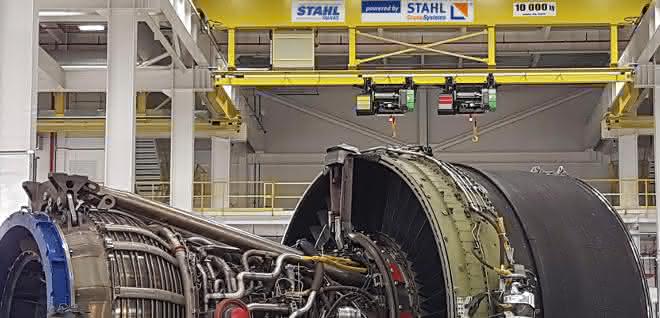
The GE Aviation division of the American conglomerate General Electrics manufactures jet engines for aircraft. To maintain the engines, a new plant with a modern test laboratory was built in Três Rios, Brazil, in 2018, in which technology from Stahl CraneSystems is used. Stahl Talhas, Stahl CraneSystems' Brazilian partner, developed a sophisticated solution with a high degree of automation for transporting the engines through the halls.
The GEnx engines of a Boeing 787 Dreamliner accelerate the aircraft, which weighs up to 245 tons, to speeds of up to 945 km/h on take-off. To ensure the safety of the engines despite the extreme load, they must be regularly serviced and overhauled after 2,500 to 15,000 take-offs/landings. GE Aviation maintains various service locations worldwide for the maintenance of its engines, including GE Celma in Brazil. Over 300 aircraft turbines are serviced each year in Petropolis, GE Celma's main location. The engines are completely dismantled, checked, cleaned, repaired if necessary and then reassembled - a procedure that can take up to 65 days and involve over 12,000 parts. Each jet engine is tested under simulated flight conditions (e.g. take-off, landing, cruising) in a special test cell before it is put back into service. The new large GEnx engines of the Dreamliner require larger maintenance areas and more powerful test cells. For this reason, a new facility was built in Três Rios with one of the largest and most modern test cells in the world. The facility is equipped with comprehensive control and regulation technology for fast data processing, automatic fault diagnosis and real-time display of test results.
The intelligent crane and lifting technology at the plant was supplied by STAHL CraneSystems and installed by the certified partner in Brazil, STAHL Talhas. The engineers and technicians at STAHL Talhas developed and implemented a customized transport system with a high degree of automation, which takes over the entire handling of the turbines - from unloading on arrival to transport to the maintenance stands and safe suspension in the turbine test room. "The complexity of the system required a high level of technical sophistication," explains Sandro Galtieri, Managing Director of STAHL Talhas. "On the one hand, the development of the structural and mechanical design was a particular challenge due to the low construction heights in the plant. Secondly, the entire operating logic, including the electrical design and software, placed high demands on our engineers. The hoists and cranes are in constant communication with each other to ensure that everything runs smoothly in the plant."
The transport system installed by STAHL Talhas consists of a central aisle, eight maintenance areas and a test area. The engines must be transported safely from the center aisle to the eight maintenance bays on the right and left and into the test area. A double girder overhead crane with a lifting capacity of 40 tons handles the turbines in the central aisle. In addition, STAHL Talhas installed a single-girder gantry crane with a load capacity of 10 tons for transporting turbine parts and components. The eight maintenance areas are equipped with monorails. The crane runways are connected with an interlock system for crane interlocking: A modern camera-based system records the current position of the tracks using barcodes and automatically aligns them with a positioning accuracy of ± 1 mm. This ensures that the transition between the crane runways runs smoothly. The cranes and hoists are operated independently by radio remote control. "A special crane construction was required to transport the turbines into the test cell," says Sandro Galtieri. A monorail with a curved section was installed here.
A total of four frequency-controlled SHF 60 wire rope hoists, each with a load capacity of 20 tons, and two frequency-controlled SHF 50 wire rope hoists, each with a load capacity of 5 tons, from STAHL CraneSystems are used. A selector switch on the radio control can be used to switch between tandem operation and normal operation of the hoists. All hoists are equipped with bogie trolleys for entering the test cell. As the height of the monorail in the turbine test room is reduced from 400 to 245 mm and the internal ceiling height is only 201 mm, a special low bogie trolley had to be designed for the SHF 60 wire rope hoists.
When entering the test cell, communication between the hoists and the locking system of the test cell is particularly important. A section of the monorail that can be rotated through 90° is located in the passageway to the test room. This section is motorized and has its own control panel. The hoists can only enter the section if the section of the monorail is not rotated. The track section is released by means of specially developed sensors that communicate with the programmable logic controller (PLC) of the control panels. "The door of the test room can only be closed when the rotating section of the monorail is in the rotated position. Our system can also communicate with the customer's own control panel," explains Sandro Galtieri.
During the test operation, the drive unit must be supported by the integrated holding device of the test cell and not by the hoists. With the help of the slack rope monitoring of the STAHL CraneSystems hoists, the control system recognizes the correct positioning of the drive units in the holding frame. Only when this is ensured are the support pins between the hoist and the suspension device released. This ensures that the entire weight of the drive unit rests on the support structure and the test can be carried out correctly.
After two years of construction, the new plant in Três Rios was officially opened on October 17, 2018. Covering an area of 61.8 hectares, the facility will test an average of 700 engines per year and prepare up to 12 engines for testing in parallel. One more step is needed for the new plant to reach its full capacity. "The engines have to be moved into the maintenance bays with the rear section first. This makes it necessary to turn the engines 180° in the center aisle to enter the left-hand maintenance bays. So far, only the maintenance bays on the right-hand side can be used - a slewing trolley will therefore soon be installed on the double girder bridge crane to complete the system," explains Sandro Galtieri. The Brazilian is visibly enthusiastic and delighted with the project: "The communication and coordination with GE Celma was very good and perfectly coordinated despite the many companies involved in the construction of the plant. With expertise and components from STAHL CraneSystems, we have developed and built a state-of-the-art system for one of the world's leading aviation companies. We are really proud of that."
STAHL CraneSystems is a global manufacturer of intelligent hoists and crane components from Germany. The company, which has been in existence for over 140 years, is one of the global market leaders for explosion-protected crane technology with an extensive, comprehensive product portfolio. Whether icy cold, extreme heat, dust or confined spaces - STAHL CraneSystems technology works reliably in all operating conditions. With a close network of 9 subsidiaries and over 140 crane construction partners worldwide, STAHL CraneSystems provides all customers with direct contacts and local service. STAHL CraneSystems has been part of the American Columbus McKinnon Group since January 2017. Within the Group, STAHL CraneSystems works closely with Magnetek to develop intelligent and efficient solutions for all requirements.


You might also be interested in
Crane retrofit in Emmerich
In the inland port of Emmerich, Tsubaki Kabelschlepp has overhauled the cable routing of a container gantry crane belonging to Contargo Rhein-Waal-Lippe. A pre-assembled Totaltrax solution was used, which the experts for energy chain systems...
 read more...
For drumming and towing - cables that pull along
With the Reeltec and Festoontec product series, TKD Kabel offers a portfolio of robust cable solutions for cranes and hoists. The specialist for application-oriented cable solutions thus also supports the increasing digitalization and automation of...
read more...Crane retrofit in Emmerich
In the inland port of Emmerich, Tsubaki Kabelschlepp has overhauled the cable routing of a container gantry crane belonging to Contargo Rhein-Waal-Lippe. A pre-assembled Totaltrax solution was used, which the experts for energy chain systems...
read more..."Customer awareness of environmental issues is increasing"
What trends and developments are there in the industry when it comes to green logistics? Experts provide insights: Christian Heid is Managing Director, SWF Krantechnik.
read more...New standards in lifting technology and material handling
Crane technology manufacturer SWF is now embracing digitalization and networking with a vengeance. Intelligent control aids make work safer and easier.
read more...Next generation electric wire rope hoist
SWF Krantechnik, supplier of components for industrial cranes and hoists, presented its new product innovationsto a broad specialist audience for the first timeat LogiMAT.
read more...Premieres for wire rope hoist and chain hoist
Rope hoist, chain hoist, Demag KBK light crane system: Demag will be presenting new products in each of the three product areas at Logimat.
read more...Crane technology: Konecranes presents solutions for material handling
Konecranes will present its latest Industrial Service and Equipment products at Logimat. Konecranes has pioneered safer, more productive and more sustainable material handling equipment.
read more...Starting signal for the intralogistics trade fair
The annual event opened its doors to trade visitors at 9 a.m. today. By midday, it was clear that there was a high level of interest from visitors, which corresponds to the fully booked halls.
read more...