
Cranes & Components
More than silk in cashmere
In order to meet the comfort and demands of tourists, investments are being made in India. One of the emerging projects is the Kishanganga hydropower plant, which was built near the Pakistan-India border near the village of Bandipora. Stahl CraneSystems developed and supplied the winch system, which was able to lower the water lock with a total weight of 100 tons.
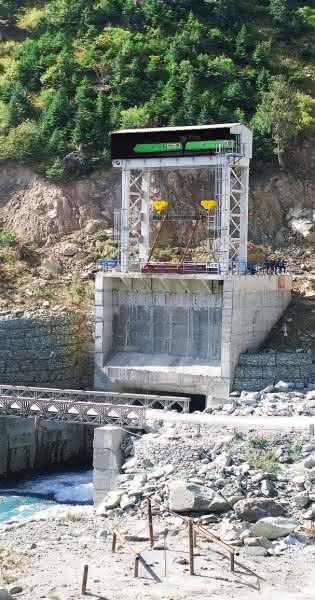
If there is a paradise on earth, it is here", is how the Mughal ruler Jahangir described the landscape of the north Indian state of Jammu and Kashmir four centuries ago. Situated at the foot of the Himalayan massif, the region has a wide variety of different climate zones in a small area: from temperate to Mediterranean-subtropical to high alpine conditions. The idyllic nature attracts many hikers every year and even filmmakers from Bollywood seek out the beautiful scenery. The power plant is part of a large hydroelectric power plant program being implemented by the Indian state-owned energy supplier NHPC Ltd (formerly the National Hydroelectric Power Corporation). NHPC Ltd. is supported by the German engineering companies DSD Noell GmbH and Stahl CraneSystems as well as the Indian civil engineering company Hindustan Construction Company.
The Kishanganga hydropower plant is built at over 2,400 meters above sea level. Icy temperatures prevail at these altitudes from November to May. In the summer months, landslides make the region difficult to access. This was one of the reasons why the client, NHPC Ltd, was looking for partners who could guarantee that the work would be carried out reliably and on time. DSD Noell GmbH from Würzburg and Stahl CraneSystems from Künzelsau were up to the task.
Weir with lifting technology from Stahl CraneSystems
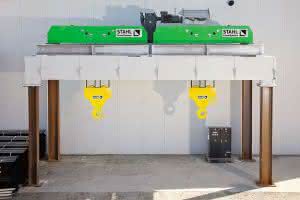
The continuous flow of water must be guaranteed in order to permanently drive the turbine generators of the Kishanganga hydropower plant, which are to generate a total of 330 megawatts of electricity. This was to be ensured by damming up the Kishanganga River. As a specialist in the field of hydraulic steel construction equipment in waterways, weir systems and hydropower plants, DSD Noell GmbH planned and erected the 37 m high weir. Stahl CraneSystems, the crane technology specialist with the world's largest range of high-quality lifting technology, developed and supplied the winch system, which was able to lower the water sluice with a total weight of 100 tons.
The demands on the hoist were high, as it had to function reliably in the adverse environmental conditions in the mountainous region. At Stahl CraneSystems' headquarters in Künzelsau, Hohenlohe, the initial planning concept for the special solution began back in 2009: a stationary SHW 8 winch with a load capacity of 2 x 60,000 kg consisting of two rope drums and a gearbox. To distribute the weight evenly, the hoist was fitted with a reeving system of 2 x 12/2-1 and the drum was manufactured in the length L4. The lifting height achieved after completion was 21.5 m with 2 x 150 m rope length. Thanks to the double symmetrical arrangement of the reeving, it was possible to achieve absolute synchronous running of the two load hooks. The total length of the winch is almost 9 m.
The rope drums are flanged to the gearbox with special couplings, which compensate for all tolerances, for example between the machine and the steel structure. The geared motor is arranged vertically due to the on-site conditions. This unusual design means that the hoist motor is mounted above one of the two rope drums.
Sevenfold security is the trump card
To ensure that the lock is lowered safely, the engineers at Stahl CraneSystems designed the ropes with 7-fold safety. They also planned a second brake in the winch as a safety brake, which was flange-mounted directly to the gearbox. The hoist was equipped with an overload cut-off for each of the two load hooks and the load was set down separately for each hook using a slack rope cut-off. Both current hook positions can optionally be read on a display on the control cabinet door. In addition, the motor currents of the hoist motor are displayed on ammeters.
The hoist is designed for an ambient temperature between -25 °C and +40 °C, depending on its place of use. Robust pole-changing technology with wide tolerance fields enables operation even with an unstable mains voltage supply. A forced ventilation system with an overrun control was installed in the hoist motor, which ensures that the lifting technology can be used continuously for 15 minutes with a subsequent cool-down break. The Windwerk's special paint finish with a 270 µm thick top coat of polyurethane makes it weatherproof. Due to the humidity, Stahl CraneSystems also equipped the equipment box and the hoist motor of the individual hoist with a heater. A hoist brake with built-in brake ventilation lowers the load with pauses in the event of a power failure. The load weight is continuously determined by the SMC multi-controller using analog measuring sensors. In the event of an overload, the lifting movement is switched off immediately. The Multi-Controller can also be used to record additional data.
Test setup guarantees functionality
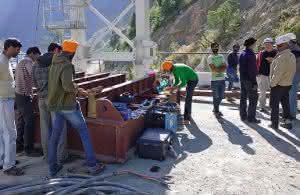
At the end of September 2011, the functionality of the winch was demonstrated during a test assembly at the certified Stahl CraneSystems partner Haslinger GmbH Metallbau + Krantechnik. With the "Partner of" concept, Stahl CraneSystems has been pursuing the strategy of separating crane construction and crane technology since 2009. Crane builders take on the planning and production, while Stahl CraneSystems specializes in the development and production of hoists and crane technology at the highest level worldwide. Haslinger GmbH Metallbau + Krantechnik, one of Stahl CraneSystems' most important partners in Germany, manufactured the steel portal for the order in the Himalayas, including the ladders, the walkway, the frame construction for the winch and the enclosure for the lifting technology. After successfully passing all the tests, the lifting technology was delivered to the site together with the crane system.
Construction work on the Kischanganga River was almost completed during this period: In the fall of 2016, the weir was constructed, which diverts part of the river into a newly made riverbed. The remaining water is used to continuously supply the hydropower plant. It is first collected from the reservoir in an equalization basin through a 24-kilometre tunnel before being fed into the underground power plant with three Pelton turbines. Each of the turbines generates an output of 110 megawatts.
The crane system was commissioned on site by the Stahl CraneSystems customer service team. The time had finally come in mid-July 2017: the water lock was lowered using the special winch. Since then, the reservoir has been filling up day by day. The Kishanganga hydropower plant is expected to go into operation in 2018. Despite delays due to the impassable terrain and unrest on the nearby border with Pakistan, all companies involved and the client were satisfied with the progress of the major project.
www.nhpcindia.comwww.stahlcranes.com


You might also be interested in
Crane technology: Konecranes presents solutions for material handling
Konecranes will present its latest Industrial Service and Equipment products at Logimat. Konecranes has pioneered safer, more productive and more sustainable material handling equipment.
 read more...
Flexible system products for lifting and conveying
Expresso recently exhibited three flexible systems for optimizing intralogistics processes at Logimat.
read more...Ergonomic tube lifters for intralogistics
This year, Timmer will once again be presenting its further developed vacuum tube lifters at Logimat. The vacuum tube lifters from the Quicklift and Heavylift series can be used to lift and lower various goods ergonomically and safely.
read more...Configurable conveyor rollers
Torwegge will be exhibiting various conveyor technology solutions from its comprehensive product portfolio at LogiMAT.
read more...Individual conveyor technology
Torwegge will be showcasing various conveyor technology solutions from its product portfolio at this year's LogiMAT. Among other things, the system provider for internal material flow will be showcasing its well-known FlexO rollers.
read more...Lifting columns for electric height adjustment
Versatile solutions
Lifting columns from RK Rose+Krieger are typically used for the electrical height adjustment of (assembly) workstations, medical facilities or complex systems in mechanical engineering.
read more...KITO ER2 electric chain hoist in use at Bharat Forge CDP
Bharat Forge CDP has been working with the KITO ER2 electric chain hoist for lifting oven grates in a production hall since 2020. Due to the high level of satisfaction, the number of chain hoists has now been increased to six.
read more...Exceptional ITEA Award of Excellence
Innovation, standardization and market impact awarded
The international Optimum project, carried out under the project management of Demag Cranes & Components and funded in Germany by the Federal Ministry of Education and Research (BMBF), was honored with the "Exceptional ITEA Award of Excellence".
read more...Flexibility in a four-pack
Haslinger, crane construction partner of Stahl Crane Systems, has realized four bracket cranes for an automobile manufacturer. Thanks to thorough planning and organization, the deinstallation of the existing cranes and complete installation of the...
read more...