
Process cranes
Demag introduces remote control station
Operator-controlled or automated? Demag traditionally offers two variants for controlling process cranes. Now the company is introducing a third operating technology: The Demag Remote Operating Station (ROS) is a remote control station that allows the operator to control the crane from any convenient working environment.
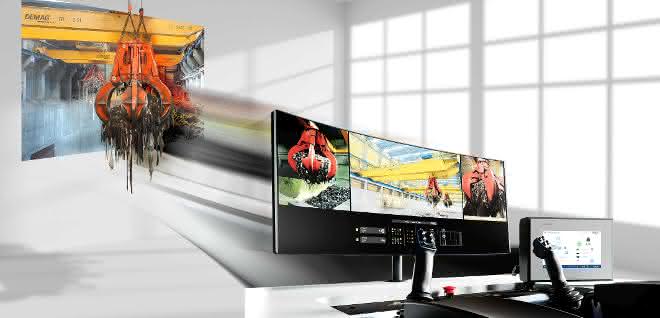
Where is the best position to operate an overhead crane? For decades, the answer was: on the crane bridge, because this is where the operator has the best overview. In many areas of application, however, (often additional) radio remote control has now become established. It creates the conditions for sensitive handling of the load. For manually controlled cranes in aggressive environments such as waste incineration plants, control stations are also installed behind glass cabins. Now the crane operator can choose another option: the Demag Remote Operating Station (ROS).
In simple terms, the ROS is a complete, location-independent operating station for cranes. The operator has access to all the controls that are usually installed in a crane cab. Just like in the cabin, the operating unit can be optimally adapted to the operator's requirements. With ROS, however, the operator can decide where the "virtual" cabin is located.
With the ROS, all operating elements are compactly and ergonomically integrated into a table whose height can be adjusted so that the crane - wherever it is located - can be operated both in a sitting and standing position. In addition to the usual joysticks with adjustable armrests, a touch panel or - depending on the user's choice - a tablet is available as a human-machine interface, which the operator can use to call up additional information.
A widescreen monitor, which receives real-time images from several cameras, provides a view of the process. The operator can configure the screen layout with up to eight individual images as required. A dashboard with process-relevant information is clearly visible at the bottom of the screen. Loudspeakers integrated into the monitor make the operating situation appear even more realistic. This provides the operator with acoustic feedback from the process, which supports him in operating the system and allows him to better assess any process faults.
Compared to the usual crane cab, Demag ROS offers the operator an even better view. This is because the cameras can also "look" where the normal field of vision would be restricted. Zoom functions via an additional joystick or the display of additional information (graphics) are also possible. And the ability to save screenshots or digital videos and make them accessible to third parties makes it easier to train staff, for example.
A typical application for this new operating technology is bulk material cranes, e.g. in waste recycling. Waste handling, including feeding the incineration lines, can be carried out from a safe and comfortable position. In other environments, such as warehouses for coils, containers or other goods, Demag ROS can also be used for loading and unloading trucks. This not only offers a high level of comfort for the operators and therefore a good basis for concentrated, safe working. It also significantly reduces investment and operating costs because no cabs need to be installed on the cranes themselves and access to the cab can be dispensed with.
Demag sees the "Remote Operating Station" as a "virtual crane cab" for cranes that operate in unfavorable ambient conditions. In addition to waste management (waste incineration plants, biomass/composting plants), examples include metal production and processing, such as foundries and steelworks. In principle, however, there are no limits to the use of ROS in any application and environment. It goes without saying that both the ROS itself and the (remote) data transmission meet all the relevant safety requirements for crane control systems.
Experience to date with Demag ROS shows that this new type of remote crane control not only increases crane productivity and reduces costs. The cranes operated by ROS also work with a very high level of safety and low risk of damage because the operator always has the best view of the process and works in an ergonomic and comfortable environment.


You might also be interested in
Crane retrofit in Emmerich
In the inland port of Emmerich, Tsubaki Kabelschlepp has overhauled the cable routing of a container gantry crane belonging to Contargo Rhein-Waal-Lippe. A pre-assembled Totaltrax solution was used, which the experts for energy chain systems...
 read more...
For drumming and towing - cables that pull along
With the Reeltec and Festoontec product series, TKD Kabel offers a portfolio of robust cable solutions for cranes and hoists. The specialist for application-oriented cable solutions thus also supports the increasing digitalization and automation of...
read more...Crane retrofit in Emmerich
In the inland port of Emmerich, Tsubaki Kabelschlepp has overhauled the cable routing of a container gantry crane belonging to Contargo Rhein-Waal-Lippe. A pre-assembled Totaltrax solution was used, which the experts for energy chain systems...
read more..."Customer awareness of environmental issues is increasing"
What trends and developments are there in the industry when it comes to green logistics? Experts provide insights: Christian Heid is Managing Director, SWF Krantechnik.
read more...New standards in lifting technology and material handling
Crane technology manufacturer SWF is now embracing digitalization and networking with a vengeance. Intelligent control aids make work safer and easier.
read more...Next generation electric wire rope hoist
SWF Krantechnik, supplier of components for industrial cranes and hoists, presented its new product innovationsto a broad specialist audience for the first timeat LogiMAT.
read more...Premieres for wire rope hoist and chain hoist
Rope hoist, chain hoist, Demag KBK light crane system: Demag will be presenting new products in each of the three product areas at Logimat.
read more...Crane technology: Konecranes presents solutions for material handling
Konecranes will present its latest Industrial Service and Equipment products at Logimat. Konecranes has pioneered safer, more productive and more sustainable material handling equipment.
read more...Starting signal for the intralogistics trade fair
The annual event opened its doors to trade visitors at 9 a.m. today. By midday, it was clear that there was a high level of interest from visitors, which corresponds to the fully booked halls.
read more...