
Dr. Willmar Schwabe and Gebhardt
Pharmaceuticals at the highest level
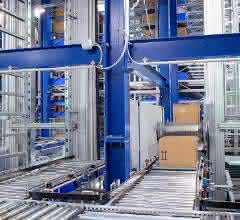
This is what the Dr. Willmar Schwabe group of companies from Karlsruhe stands for. Together with the Gebhardt Intralogistics Group and the SAP project house IGZ, finished goods logistics has been raised to a new level and is ready for the future.
The Schwabe Group is a group of companies with several companies in the pharmaceutical and healthcare sector that focus on plants as raw materials. The group employs over 4,000 people worldwide, generating a turnover of around 900 million euros. The previous solution consisted of two large, separate logistics areas with partly manual processes. An approach that offered enormous potential for optimization.
A solution had to be found with the aim of centralized, fully automated implementation. In other words, an implementation that would meet the increasing demands and the ever-growing customer market by implementing a modern and efficient conveyor and storage technology and realizing the optimal connection to the existing system. While Gebhardt's concept was convincing, IGZ scored with its SAP EWM expertise and knowledge of the existing SAP EWM/MFS solution.
The best finished goods logistics today is
Today, the Schwabe Group has a central logistics warehouse that significantly expands the previous capacities of pallet storage, tray and carton storage locations and significantly increases both the picking and shipping performance as well as the throughput of the system.
The new facility consists of a pallet high-bay warehouse and an automated small parts warehouse (AKL) implemented as a multi-level shuttle (MLS). Both the pallet warehouse and the MLS warehouse were planned down to the last square meter within the specified building limits. As a result, the entire racking and platform system had to be implemented in a very confined space during construction. "The new technology is in the new building, the existing system in the old building. It was not possible for us to measure the two buildings directly," explains Thomas Engelhardt, Project Manager at Gebhardt. "Coordinating the technology so that both fit together perfectly was a challenge."
The two-aisle high-bay pallet warehouse with twelve levels per aisle has 2,760 storage locations, which are stored and retrieved using automated pallet conveyor technology and storage and retrieval machines (SRMs). A total of 57 storage and retrieval operations per SRM and hour are realized. The ATEX-compliant implementation meets the requirements of the stored substances and goods (e.g. water-polluting substances). Delivery continues to take place manually via pallet conveyor technology on the first floor.
The five-aisle MLS warehouse also meets strict smoke and fire protection requirements thanks to a special smoke partition. It has over 40,000 storage locations for trays and cardboard boxes and uses 20 MLS and ten lifters to store and retrieve up to 127 items per MLS and hour.
The pre-zone forms a four-storey platform that is connected to the logistics building and integrates a circulation lifter for cartons across three floors. The lifters supply the MLS on four levels and serve the adjacent logistics building via three loop levels. Eight picking and packing workstations offer a capacity of 200 picks per hour per workstation.
The picking and shipping process
At goods receiving on the second floor (OG), an unstacking device serves empty trays at the storage location in the AKL, where they are filled with articles and married. After contour and weight checks, they are transferred to the miniload. Picking takes place on the second and third floors. While three high-performance SAP EWM-controlled multi-order picking workstations and a pick and pack workstation are set up on the second floor, there are four multi-order picking workstations on the third floor.
The tray conveyor technology serves the goods directly at the workstations, where they are packed into cartons. Up to five orders can be processed at the same time. A pick-to-light system indicates the correct shipping carton. Finished goods are transported to the existing building.
The cartons picked on the third floor are conveyed to the order buffer if they are not released. When they are released for dispatch, they are conveyed past the buffer to the tray pusher, which pushes the cartons into an empty tray and marries them to it. This procedure serves to decouple picking in the miniload and the dispatch area on the ground floor. All picking orders (cartons) of a delivery order are collected here. Once all the cartons for an order have been packed and released, they are forwarded from the buffer to the shipping area. If further items need to be picked into the carton in the tub, it travels through the stock picking area until the order is completed and is then transported to the ground floor. In dispatch, the carton is lifted out of the tub and conveyed to the packing stations (dispatch workstations). The empty tubs are fed into the stock system.
Perfectly coordinated for success
Only the perfect coordination of all processes as well as the new and existing systems will ensure optimum success. It was therefore necessary to integrate the expansion into the IT infrastructure from SAP EWM (Extended Warehouse Management), including the SAP material flow component MFS (Material Flow System), and to ensure standardized communication. To do this, IGZ used its own emulation tools, which are used with SAP EWM/MFS in conjunction with automated warehouse technology and warehouse processes. These tested the possible SAP EWM/MFS strategies in advance, even before the AKL was even set up. This meant that a fully tested solution was taken into production. The tests also included intensive mass tests in the form of virtual commissioning, which were then carried out again on the physical system. Thanks to Gebhardt and IGZ, an increase in performance and a reduction in throughput time were achieved. The Schwabe Group has thus achieved its goal and considers itself perfectly positioned for the future.
The article appeared in materialfluss 1-2/22.


You might also be interested in
Winner material flow PRODUCTS OF THE YEAR 2023
Conductix-Wampfler: ChargeLine 0865
Two-pole conductor rail segments for efficient opportunity charging of shuttles, suitable for thousands of cycles per day.
 read more...
Hermann Grewer celebrates his 80th birthday
Hermann Grewer, Honorary Chairman of the North Rhine-Westphalia Transport and Logistics Association (VVWL) and Honorary President of the German Road Haulage, Logistics and Disposal Association (BGL), celebrated his 80th birthday on June 6.
read more...Well chilled for sure
V-Zug Kühltechnik AG, developer and manufacturer of refrigeration appliances and part of the successful V-Zug Group, has set up a new production facility for refrigerators of all heights and dimensions at its Swiss site in Sulgen.
read more...Advantageous automation of small parts warehouses
The RSX1 shuttle system will be at the center of Rocketsolution's presence at this year's Logimat trade fair.
read more...Reduced energy requirements in the high-bay warehouse
One of Germany's leading premium car manufacturers is already focusing on energy efficiency in the production of its new SUV model with electric drive. The storage and retrieval machines in a high-bay warehouse at the production site have been...
read more...Low lift pallet truck for light duty applications
Clark has launched a new low lift pallet truck with the model designation LWio15 for light transport tasks. The truck has a load capacity of 1500 kg and is suitable for short distances in goods distribution, production or warehousing.
read more...Internationalization as an opportunity
E-commerce is in a state of flux. Changes in purchasing behavior and procurement problems are keeping e-commerce retailers busy. Logistics plays a decisive role in the overall online shopping experience.
read more...Fulfillment Center for Frisco.pl
Polish eGrocery specialist and TGW deepen partnership
TGW is building a highly automated fulfillment center for Frisco.pl in the Polish capital Warsaw. This is the second project in a row that the two companies have implemented together.
read more...Which world will it be in 2023?
Michael Schreckenberg teaches at the University of Duisburg-Essen as Professor of Physics of Transport and Traffic. Once a year, he addresses the readers of materialfluss, formerly LT-manager, with a critical and humorous expert article on transport...
read more...