
Plant expansion
Modern intralogistics at Basel University Hospital
People who work in hospitals are expected to deliver top performance. These efforts must be sustainably supported by efficient intralogistics.
Plant expansions and conversions as well as refurbishments and modernizations are a key factor in this.
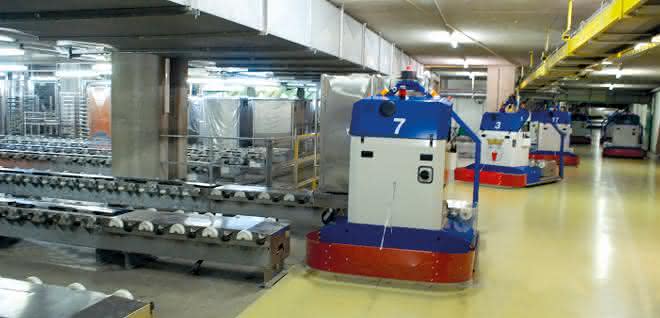
Patients at the University Hospital Basel (USB) and the University Children's Hospital Basel (UKBB) are hardly aware that important goods are transported via the underground basement facilities in wheeled containers on a medium transport system or in containers on a spontaneous transport system.
Horizontal conveyors and automated guided vehicles (AGVs) as well as multi-storey elevators and paternosters (circulating conveyors) are used to supply the various hospital departments with the required medication, meals, consumables or fresh bed linen. It is clear from this that the well-being and recovery process of patients not only requires medical care, but also a modern environment with appropriate intralogistics and infrastructure.
Retrofit of the spontaneous transport system for containers
The definition of the goods loading process was designed to be weight-dependent on the one hand and process-dependent on the other. With the spontaneous transport system (STA), goods can be loaded and dispatched at any time. It is designed to transport goods weighing up to 20 kilograms per plastic container. These can be mail, medical records, pharmacy supplies, laundry or laboratory utensils, for example. The STA was originally built and maintained by Schindler in 1977. At that time, control systems using transistor technology were still in use. After the end of their "life cycle", the skilled workers had to improvise for some time in order to keep operations going. Over time, only a few "insiders" had the necessary knowledge of the functionality of these automation components. This situation could no longer be tolerated.
Multi-million euro retrofit and years of refurbishment
The Swiss intralogistics contractor Gilgen Logistics was commissioned to carry out future plant expansions and conversions as well as urgently needed refurbishments and modernizations. The container transport system (STA) has grown continuously and the throughput has increased accordingly. Up to 3,000 consignments are now handled per day at around 140 receiving and dispatch stations. The STA comprises over 50 small goods elevators and continuous circulation conveyors and around five kilometers of horizontal lines. From 2004 to the end of 2012, Gilgen Logistics carried out a multi-million euro retrofit. This included 28 new small goods elevators to replace existing elevators. In the same project, five new container storage facilities were built for empty container management, and a container storage facility from 1998 was modernized and the direction of travel of the storage facility reversed.
With the old control system, it was not possible to track containers, which was very problematic in the event of a "loss", as the STA network runs across many buildings and floors. For this reason, the aim of the control system modernization was also to enable system-wide container tracking using RFID technology. The control and visualization system based on Simatic WinCC, which was newly implemented by Gilgen as part of this comprehensive retrofit, is linked via Ethernet. A separate network was set up via which the decentralized plant control systems communicate with each other. This, in combination with the central visualization in the control station and container tracking using RFID technology, resulted in a very good system overview. A particular advantage of the new network architecture chosen is that the hospital communication network has been separated from the system network. The STA, MTA, pneumatic tube system and building automation are connected to the network separately via "hubs" in the control cabinets.
Conversion and expansion of the mid-transport system
The medium transport system (MTA) has certain time windows in which goods or merchandise can be dispatched. The MTA transports roll containers with a maximum weight of 500 kilograms for meals, drinks bottles, pharmaceutical products, surgical instruments, laundry, magazine products or waste back and forth between the various buildings and floors in the University Hospital and the Children's Hospital of Basel. Ordered goods are loaded into the MTA containers and placed on the stowage routes at the supply stations. The 25 AGVs drive to the supply stations and the roll containers are taken from the stowage routes. The AGVs transport the roll containers to the nearest MTA elevator and unload them onto the loading and unloading stations - with accumulation sections in front of the elevator - for onward transport to the relevant floors. At the more than 60 stations, the containers are taken over and unloaded by hospital staff. In 2008, both the central and the spontaneous transport system were extended for the new building of the Basel Children's Hospital (UKBB); the two automatic transport systems of the STA and the MTA were connected in tunnels under the road between USB and UKBB.
Due to the complete redesign of the kitchen concept, the University Hospital Basel commissioned Gilgen Logistics with the renewal and conversion of the "MTA Kitchen" container transport system in 2017. From autumn 2018, the food will be pre-cooked and pasteurized in order to preserve it for several days. The picking of the boxed food onto the roll containers will take place in the future "cold room" at two to four degrees Celsius. The ready-picked containers are then sent directly via the AGV and the MTA to the relevant hospital buildings or departments, where they are reheated decentrally for patients to eat. The MTA lanes had to be redesigned for this, now with a multi-lane buffer and cold store. An RFID reader and a data light barrier were installed at the transfer points to the AGV vehicles. The staged conversion of the "MTA kitchen" will continue until mid-2019. The ongoing refurbishment and renewal as well as adaptation through conversions and expansions of the entire intralogistics system will enable the
future service mandate of the University Hospital and the Children's Hospital in Basel can be fulfilled.


You might also be interested in
HTEC and Embotech Expand Autonomous Industrial Logistics
HTEC and Embotech aim to accelerate the adoption of autonomous driving solutions in industrial logistics. The strategic partnership is intended to facilitate the rollout to additional vehicle platforms, customer projects, and locations.
 read more...
Standardized in design, flexible in use
Automated guided vehicles are increasingly in demand in production and logistics as they automate processes efficiently - but in addition to the vehicle, the right peripherals are also crucial for safe operation. A new solution consisting of a...
read more...Outdoor AGV networks production and logistics
An international company in the plastics industry is automating its intralogistics at its German site with a solution from ek robotics. A specially developed vehicle model from the Out Move series, an outdoor AGV, is being used.
read more...Transport systems for automated material flow
The Leo transporters from Bito make it easier for users to get started with the automation of material processes, which is possible from 20,000 euros. The system is a flexible all-in-one complete solution that is ready for immediate use and can be...
read more...Automated logistics for the university hospital
As part of the new construction of the University Hospital of Reims (CHU), France, the hospital has taken a number of steps to improve the needs of its patients and the working environment of its employees.
read more...K.Hartwall: Topping-out ceremony for the German site
The topping-out wreath was raised at the new building in the TIP Innovationspark Nordheide in Buchholz near Hamburg on February 27: The new K.Hartwall plant will comprise approx. 3,500 m² of hall space and around 2,000 m² of office and social areas.
read more...Noerpel Group tests driverless high lift trucks
The Noerpel Group has tested driverless pallet trucks in one of its two logistics facilities in Giengen. During a four-week trial, two autonomous systems were used to transport goods within the warehouse.
read more...Supply and disposal of printing machines by AGV
Numerous companies rely on AGVs in intralogistics to increase efficiency and meet challenges such as the shortage of skilled workers. One such company is GGP Media GmbH in Pößneck, Thuringia.
read more...Sophisticated automation: AGV and cobot combined
On behalf of Krefeld-based Saurer Technologies, the engineering team from Project Automation & Consulting developed a solution for production logistics that combines AGVs and cobots.
read more...