
Mobile transport robots
Autonomy is not a panacea
Autonomous mobile robot (AMR) or driverless transport system (AGV) - if you want to automate your intralogistics transport processes, you seem to be faced with a choice between two different technologies.
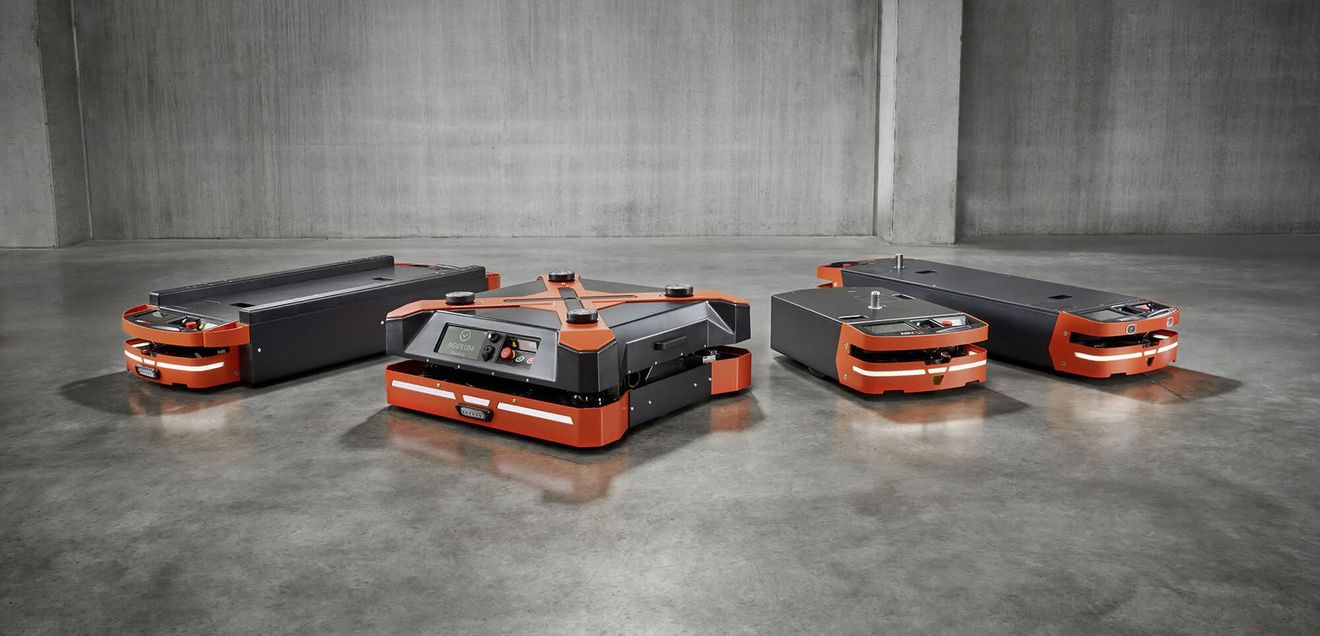
AMR is more of a marketing term than an actual distinguishing feature. There are hardly any technological differences between AMR and AGVs. And in practice, a high degree of autonomy often doesn't make sense either, argues our author Alexander Strunz.
For some years now, numerous providers of so-called autonomous mobile robots have been springing up. They are all united by the promise of being able to automate intralogistics processes quickly and easily through autonomous robot navigation. The term AMR is often used to distinguish them from established driverless transport systems. There is no technological justification for this distinction. Whether in terms of drive, battery, control or safety technology - the hardware of the robots is almost identical. And the often cited superior sensor technology, such as 3D cameras for capturing the environment, can be used in almost all mobile robots if necessary.
They even have a lot in common when it comes to navigation. For example, many modern AGVs have the ability to navigate freely - which is why they should be called AGVs and AMRs at the same time. It therefore makes no sense to differentiate between AMRs and AGVs. Both are mobile transport robots (MTR) that take on specific transport tasks and may or may not have to perform certain autonomous functions depending on the application at hand.
Lots of autonomy: only useful in niche applications
AMR is often used to describe mobile robots that have a high degree of autonomy, can move freely in space, adapt their route to the current spatial conditions and can independently avoid obstacles - or because the manufacturer simply calls them that for marketing reasons. However, this often leads to problems. Autonomous navigation and the resulting unpredictable driving behavior of the robots endanger process reliability, especially in production environments where high temporal precision is required due to a just-in-time cycle. This is because an evasive movement causes a time delay or obstructs other process participants. If there are other (manual) vehicles on the store floor or complex traffic regulations to be observed, it is difficult to guarantee a predictable workflow with autonomous systems. The devices may even overtake each other, causing the delivery sequence to be disrupted according to the bead chain principle.
If, on the other hand, a robot navigates a defined route with little autonomy, it performs its tasks efficiently, safely and reliably. This is a decisive advantage when many transport robots have to interact with each other as well as with other vehicles or peripheral systems. When automating with mobile robots on the classic assembly line, when linking sources and sinks in production logistics or line supply from the warehouses, too much autonomy, on the other hand, jeopardizes the achievement of the required goals.
The situation is different in applications where delivery time and sequence play only a minor role or no role at all. A high degree of autonomy also makes sense when interaction or even collaboration with employees is required. In a picking warehouse, for example, it can be an advantage if the robot has to avoid other vehicles in mixed traffic or has to react to many employees, such as order pickers, in the area.
In principle, autonomous navigation is not a panacea for faulty processes. If it is common practice in a company for pallets, bicycles or other obstacles to be placed anywhere and disrupt processes, these are structural problems that cannot be solved by automation with transport robots.
Availability and cost efficiency are more important than autonomy
Ultimately, the success of a project is not determined by the degree of autonomy, but by cost efficiency and stable, high technical availability. And, in particular, that the company's own personnel are able to get the system up and running again in the event of a malfunction. The less technology is installed in a robot, the fewer potential sources of error and technological dependencies there are. This makes the system very robust.
Another sticking point is that the systems usually require a control station to control the robots. This is cost-intensive to purchase, program and maintain and is particularly uneconomical for smaller automation projects with just a few robots. In addition, if the control station malfunctions, the entire fleet is out of action. Modern mobile transport robots therefore have an agent-based control system. The robots communicate decentrally with each other in a swarm, inform each other of their position and speed and exchange information about disruptions on the route. Route planning and approvals for route sections are also based on the swarm's internal communication. The agent-based control system enables efficient operation of a few robots up to several hundred vehicles, without increasing costs as the number of robots increases. This makes it possible to implement profitable automation for small companies, even with a small number of robots.
Decentralized control not only increases efficiency, but also process reliability. In the event of a malfunction, only the affected vehicle comes to a standstill while the swarm continues to carry out its tasks. The cost-intensive standstill of entire fleets, as with the control center approach, is therefore ruled out. The technical availability of the solution can reach a value of over 99 percent.
The distinction between AMR and AGV is irrelevant. Both terms describe mobile transport robots with more or less autonomous functions. Whether autonomous navigation makes sense depends on the respective application. The decisive factors for the success of automation with transport robots are the stability of the system, cost efficiency and the availability of the fleet. Agent-based robots have a clear advantage here.


You might also be interested in
Standardized in design, flexible in use
Automated guided vehicles are increasingly in demand in production and logistics as they automate processes efficiently - but in addition to the vehicle, the right peripherals are also crucial for safe operation. A new solution consisting of a...
 read more...
Outdoor AGV networks production and logistics
An international company in the plastics industry is automating its intralogistics at its German site with a solution from ek robotics. A specially developed vehicle model from the Out Move series, an outdoor AGV, is being used.
read more...Transport systems for automated material flow
The Leo transporters from Bito make it easier for users to get started with the automation of material processes, which is possible from 20,000 euros. The system is a flexible all-in-one complete solution that is ready for immediate use and can be...
read more...Automated logistics for the university hospital
As part of the new construction of the University Hospital of Reims (CHU), France, the hospital has taken a number of steps to improve the needs of its patients and the working environment of its employees.
read more...K.Hartwall: Topping-out ceremony for the German site
The topping-out wreath was raised at the new building in the TIP Innovationspark Nordheide in Buchholz near Hamburg on February 27: The new K.Hartwall plant will comprise approx. 3,500 m² of hall space and around 2,000 m² of office and social areas.
read more...Noerpel Group tests driverless high lift trucks
The Noerpel Group has tested driverless pallet trucks in one of its two logistics facilities in Giengen. During a four-week trial, two autonomous systems were used to transport goods within the warehouse.
read more...Supply and disposal of printing machines by AGV
Numerous companies rely on AGVs in intralogistics to increase efficiency and meet challenges such as the shortage of skilled workers. One such company is GGP Media GmbH in Pößneck, Thuringia.
read more...Sophisticated automation: AGV and cobot combined
On behalf of Krefeld-based Saurer Technologies, the engineering team from Project Automation & Consulting developed a solution for production logistics that combines AGVs and cobots.
read more..."Herbie" robot in the Körber portfolio
Carrybots, a specialist in mobile robotics, is a new partner in the Körber supply chain ecosystem. The aim of this collaboration is to strengthen the position of both companies in intralogistics. Herbie" enables robot-based goods-to-person processes.
read more...