
AR for AGV projects
Analyze problems in detail with AR
Augmented reality creates high added value in international AGV projects, says Dr. Stefan Rehling, Technical Managing Director of Strothmann. In this guest article, he reports on the practical application of this modern method of digitalization.
Strothmann is a global supplier of automated guided vehicles (AGVs), specializing in loads over one tonne and complex automation systems for handling large parts. These systems are often highly customized and require a correspondingly high level of expertise for on-site commissioning. In order to meet these requirements, a flexible concept is needed to use the scarce resources of "commissioning specialists" and "service technicians" sparingly and intelligently. Travel costs also play a significant role, as do travel restrictions at the moment.
In mastering this balancing act, Strothmann consistently relies on digitalization methods in service and commissioning, as in many other areas. What was ridiculed five years ago is now a professional reality at Strothmann: the use of augmented reality, or "AR" for short. Augmented reality generally refers to a computer-supported extension of human perception of reality. In many cases, additional information is superimposed or superimposed as a supplement to real camera images.
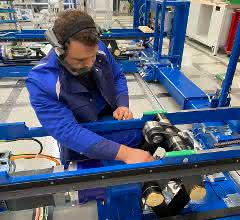
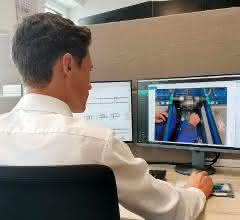
In Strothmann's specific application example, the aim is to apply the commissioning engineer's expertise at several locations worldwide at the same time. This is achieved through the use of AR data goggles, which are worn by a fitter who has been trained in the basics of system technology during commissioning. The data goggles are equipped with a camera, microphone and a miniature display that can be folded in front of the eye. The wearer of the glasses sees data on the miniature display, which is fed directly to him by the specialist at the company's headquarters in Schloß-Holte Stukenbrock. The specialist at home continuously sees the image from the smart glasses camera and can comment on it using annotations such as circles or arrows and mirror it back to the wearer on site. This enables precise analysis and guidance of the fitter on site, even in very difficult technical situations.
The HMT-1 goggles from the manufacturer RealWare are specially designed for use in harsh industrial environments. They are waterproof and can be dropped from a height of two meters onto the floor without being damaged. They can be voice-controlled in several languages and therefore allow completely contact-free operation, leaving the operator's hands free for their actual task. Strothmann uses the Oculavis Share software platform from Aachen-based Oculavis GmbH for communication between the data glasses and the expert's workstation. Oculavis Share integrates very well with the RealWare data glasses and offers various functions to be able to work in sufficient detail even with low transmission bandwidth. This means that even if the connection is poor and the resolution of the video image is low as a result, it is always possible to take individual shots in high resolution, which can be used to analyze the situation in detail. Strothmann sees great potential in this technology and will continue to pursue this path in the future and align its service and commissioning processes accordingly.


You might also be interested in
HTEC and Embotech Expand Autonomous Industrial Logistics
HTEC and Embotech aim to accelerate the adoption of autonomous driving solutions in industrial logistics. The strategic partnership is intended to facilitate the rollout to additional vehicle platforms, customer projects, and locations.
 read more...
Standardized in design, flexible in use
Automated guided vehicles are increasingly in demand in production and logistics as they automate processes efficiently - but in addition to the vehicle, the right peripherals are also crucial for safe operation. A new solution consisting of a...
read more...Outdoor AGV networks production and logistics
An international company in the plastics industry is automating its intralogistics at its German site with a solution from ek robotics. A specially developed vehicle model from the Out Move series, an outdoor AGV, is being used.
read more...Transport systems for automated material flow
The Leo transporters from Bito make it easier for users to get started with the automation of material processes, which is possible from 20,000 euros. The system is a flexible all-in-one complete solution that is ready for immediate use and can be...
read more...Automated logistics for the university hospital
As part of the new construction of the University Hospital of Reims (CHU), France, the hospital has taken a number of steps to improve the needs of its patients and the working environment of its employees.
read more...K.Hartwall: Topping-out ceremony for the German site
The topping-out wreath was raised at the new building in the TIP Innovationspark Nordheide in Buchholz near Hamburg on February 27: The new K.Hartwall plant will comprise approx. 3,500 m² of hall space and around 2,000 m² of office and social areas.
read more...Noerpel Group tests driverless high lift trucks
The Noerpel Group has tested driverless pallet trucks in one of its two logistics facilities in Giengen. During a four-week trial, two autonomous systems were used to transport goods within the warehouse.
read more...Supply and disposal of printing machines by AGV
Numerous companies rely on AGVs in intralogistics to increase efficiency and meet challenges such as the shortage of skilled workers. One such company is GGP Media GmbH in Pößneck, Thuringia.
read more...Sophisticated automation: AGV and cobot combined
On behalf of Krefeld-based Saurer Technologies, the engineering team from Project Automation & Consulting developed a solution for production logistics that combines AGVs and cobots.
read more...