
Warehouse-/Picking technology
Market study: material flow user statistics high-bay warehouse under the microscope
The TU Munich analyzed and evaluated the system data of high-bay warehouse operations from the Materialfluss Markt issues from 2001 to 2017. A few selected correlations obtained in the study are surprising.
In recent years, the special edition "materialfluss MARKT" has been published every year. This contains market overviews of intralogistics conveyors and systems. The so-called user statistics for newly built automated warehouses and order picking systems were also published in this issue. Retrofits are also included. These statistics are still one of the few points of reference in German-speaking countries on the question of "who built what, when, where and how in intralogistics".
This data, collected exclusively by materialfluss, was recently thoroughly analyzed and evaluated as part of the research project on energy efficiency classes for storage and retrieval machines at the Chair of Materials Handling Material Flow Logistics (fml) at the Technical University of Munich. Parts of the study results are presented in the following article.
1,100 data records evaluated
The source data consists of the commissioning data in the user statistics for high-bay warehouses. The data was provided to the magazine by manufacturers and general contractors. Around 1,100 data records of commissioning in Germany from the years 2000 to 2016 were obtained from the previous issues and the data was then assigned to 19 sectors. Finally, eleven top sectors were selected, which contain the majority of commissioning projects. Data records with insufficient content for the analysis were deleted.
Storage and retrieval machines used much more frequently than shuttles
The following findings relate to the existing, adjusted and summarized database. The evaluation focused on the distinction between warehouses with stacker cranes or shuttles. Furthermore, the relationship between large load carriers (GLT) and small load carriers (KLT) was examined and which load carriers are used within these groups.
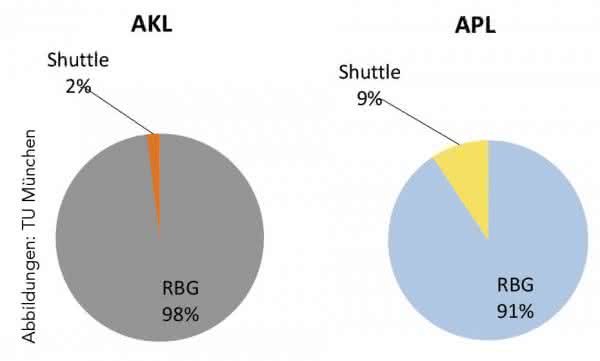
40 percent of the warehouses were used to store KLT and 60 percent for GLT. It was also found that containers and pallets are clearly used more frequently than trays and pallet cages. Of all warehouses operated with storage and retrieval machines (SRMs) or as shuttle warehouses (shuttles), 42 percent are automated small parts warehouses (AS/RS) and 58 percent are automated pallet warehouses (APL). The distribution between warehouses equipped with storage and retrieval machines and those equipped with shuttle systems within the load carriers is shown in Figure 1.
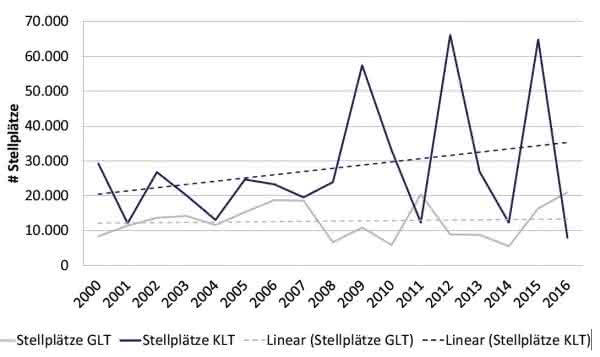
It turns out that storage and retrieval machines are clearly used more frequently than shuttles. Shuttles are currently used more frequently for large load carriers than for small load carriers. However, the shuttle data for large load carriers also includes channel storage. Figure 2 shows the average number of storage locations per warehouse over the years, as well as linear trend lines.

Intra says:
Once a year,the collector in me awakens. Whenever the editorial team sends out the enquiries to the general contractors and asks them to fill in the user statistics. Every data record that comes in makes me happy. But there could be more. In this respect: Take courage, you big intralogistics companies, you've done good things, so you can talk about it. And the competition already knows that too!
The average number of storage spaces per warehouse has remained constant in the GLT sector in recent years, while an upward trend can be seen in the KLT sector.
Distribution of start-ups by sector
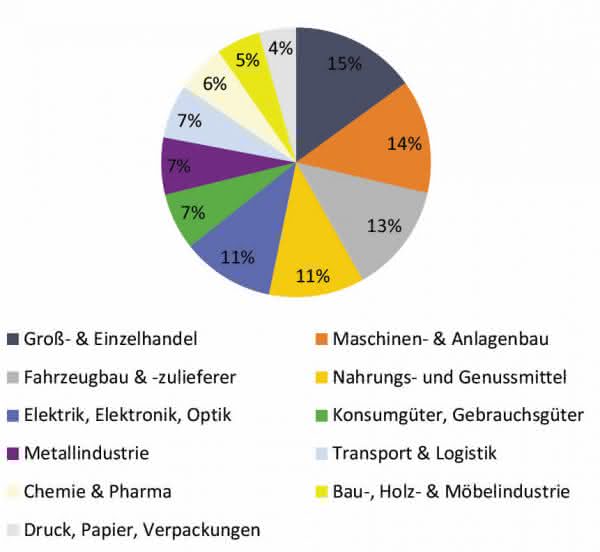
The eleven top sectors and their percentage shares of start-ups are shown in Figure 3.
Wholesale and retail lead this distribution. It is clear which sectors have put the most warehouses into operation. Around two thirds of start-ups are attributable to the five leading sectors.
Conclusion: Indications, but no general validity
A condensed, standardized database was created from the available data and used to show some correlations. Due to the data situation, it is not possible to say conclusively to what extent these are generally valid. Although many companies do not publish information about who has built or modernized their warehouse, the data collected is of some significance.
About the authors: Andreas Rücker, M.Sc. is a research assistant at the Chair of Materials Handling Material Flow Logistics (fml) at the Technical University of Munich (TUM).
Philipp Gauß, B.Sc. is a Master's student at TUM and research assistant at the fml chair. Prof. Dr.-Ing. Johannes Fottner has been head of the fml chair at TUM since 2016.


You might also be interested in
Arvato implements shuttle system for H&M in Poland
H&M will be able to handle its logistics in Central and Eastern Europe faster and more agile in future: Arvato has expanded its e-commerce distribution center in Stryków, Poland, and installed an automated shuttle warehouse with a capacity of up...
 read more...
Automation using shuttle technology and SAP
GC Corporation develops, produces and distributes dental products. In order to make the European subsidiary, GC Europe, fit for the future to meet increasing logistical requirements, the company expanded its storage and picking capacities at the...
read more...Intralogistics for steel wholesalers
Lemvigh-Müller relies on Knapp
Lemvigh-Müller is making its largest investment in logistics to date and centralizing two warehouses in Odense and Kolding, both in Denmark, into one distribution center in Kolding. This will ensure that Lemvigh-Müller can handle larger volumes of...
read more...New shuttle warehouse for BSH Hausgeräte in Dillingen
The ground-breaking ceremony for a shuttle warehouse for household appliance specialist BSH Hausgeräte recently took place in Dillingen, Bavaria. TGW Logistics will build a highly automated small parts warehouse there by spring 2027.
read more...Combined storage solution with transshipment and pallet warehouse
With the newly founded Faurecia Clarion Electronics (Fengcheng), Faurecia aims to become a global leader in electronics technology for vehicle cockpits. When it comes to intralogistics, the company relies on a combined warehouse solution from...
read more...Storage and order picking technology
SSI Schaefer automates for the market leader in ready-to-eat salads
Fresh Servant maximizes its performance through automation at its logistics center in Edsevö, Finland. The company relies on a complete system from SSI Schaefer, consisting of an SSI Cuby shuttle warehouse, pick-by-light picking and the WAMAS...
read more...30 million spare parts shipped annually
The manufacturer and supplier of automotive spare parts DRiV has put a new automated distribution center for Europe into operation. An automation solution from Knapp forms the heart of the system.
read more...Production and assembly flexibly supplied
Automotive supplier Magna manufactures exterior mirrors at its Assamstadt site in Germany. Magna relies on an automation solution from Knapp to cope with the changes in logistics and to be able to operate flexibly with a high level of vertical...
read more...Novaltia builds new distribution center with Knapp
The Spanish pharmaceutical wholesaler Novaltia is once again relying on a complete solution from Knapp: In the new distribution center at its headquarters in Zaragoza, logistics processes are to be streamlined and sequences made more precise by...
read more...