
Top news
Daimler AG saves time, energy and water
The Mercedes-Benz plant in Bremen is the second largest Mercedes car plant in Europe. For its new production hall, the car manufacturer wanted to install decentralized battery charging stations in the immediate vicinity of production. This meant preventing charging gases and acid aerosols from escaping. Daimler AG therefore opted for NexSys batteries in Thin Plate Pure Lead (TPPL) technology from EnerSys.
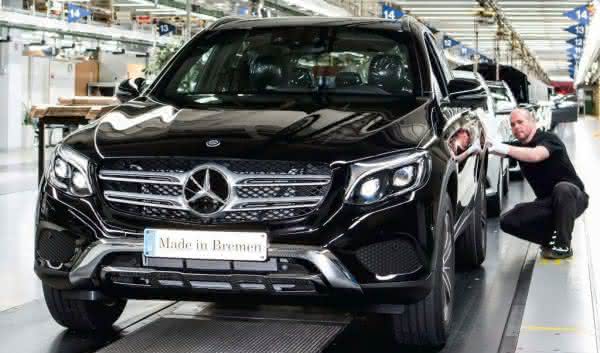
The Mercedes-Benz plant in Bremen produces more than 300,000 vehicles per year. A new production hall was recently built. The aim was to reduce the frequency of battery changes for the existing fleet of forklift trucks and at the same time to close the central charging rooms in favor of decentralized charging stations in the immediate vicinity of the production line. However, this presented the company with problems, as it was necessary to prevent charging gases and acid aerosols from escaping into the production environment. It was therefore not possible to use conventional wet batteries.
A newly developed type of lead-acid battery with TPPL technology offers a cost-effective, practical and environmentally friendly alternative to conventional and lithium-ion batteries. With this new type of battery, the battery can be recharged repeatedly from any state of discharge without affecting the battery condition. Thanks to greater reliability and the avoidance of water loss, TPPL batteries are also very low-maintenance and cost-effective. The batteries from the NexSys series are suitable for a wide range of vehicles, such as forklift trucks, order pickers, pallet trucks, driverless or laser-controlled transport vehicles and cleaning machines.
No leakage of gases and acid aerosols
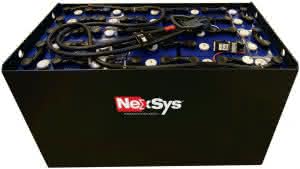
EnerSys offered its NexSys TPPL batteries with bound electrolyte as a virtually maintenance-free solution. As the batteries are completely sealed, the formation of oxyhydrogen gas is reduced to a minimum and the formation of acid aerosols is completely avoided. NexSys batteries are not only more cost-effective than conventional batteries, they are also environmentally friendly. Up to 90 percent of the materials used in the construction of lead-acid batteries can be recycled. At Daimler, it was found that the use of TPPL technology reduced water consumption by 21,750 liters and electricity consumption by 247,500 kWh.
Charging during the break
The advantage of modern technology is that replacing a battery with a fully charged spare battery at the end of a shift can often be avoided. "In automotive production, changing batteries is always a problem because it takes time and is potentially dangerous for the operators," says Christian Wessolowski, Sales Area Manager at EnerSys Motive Power.
TPPL batteries can be recharged at short notice whenever the opportunity arises - for example when the employee is taking a break. "These batteries combine the performance of a conventional lead-acid wet-cell battery with the advantages of a gel battery in terms of ease of maintenance. In addition, a quick-charging system ensures that the batteries can be fully recharged in the shortest possible time," continues Wessolowski. "By switching to the new battery technology, Daimler is saving more than 24,000 battery changes per year."
www.daimler.com/dewww.enersys-emea.com


You might also be interested in
Winner material flow PRODUCTS OF THE YEAR 2023
Conductix-Wampfler: ChargeLine 0865
Two-pole conductor rail segments for efficient opportunity charging of shuttles, suitable for thousands of cycles per day.
 read more...
Hermann Grewer celebrates his 80th birthday
Hermann Grewer, Honorary Chairman of the North Rhine-Westphalia Transport and Logistics Association (VVWL) and Honorary President of the German Road Haulage, Logistics and Disposal Association (BGL), celebrated his 80th birthday on June 6.
read more...Well chilled for sure
V-Zug Kühltechnik AG, developer and manufacturer of refrigeration appliances and part of the successful V-Zug Group, has set up a new production facility for refrigerators of all heights and dimensions at its Swiss site in Sulgen.
read more...Advantageous automation of small parts warehouses
The RSX1 shuttle system will be at the center of Rocketsolution's presence at this year's Logimat trade fair.
read more...Reduced energy requirements in the high-bay warehouse
One of Germany's leading premium car manufacturers is already focusing on energy efficiency in the production of its new SUV model with electric drive. The storage and retrieval machines in a high-bay warehouse at the production site have been...
read more...Low lift pallet truck for light duty applications
Clark has launched a new low lift pallet truck with the model designation LWio15 for light transport tasks. The truck has a load capacity of 1500 kg and is suitable for short distances in goods distribution, production or warehousing.
read more...Internationalization as an opportunity
E-commerce is in a state of flux. Changes in purchasing behavior and procurement problems are keeping e-commerce retailers busy. Logistics plays a decisive role in the overall online shopping experience.
read more...Fulfillment Center for Frisco.pl
Polish eGrocery specialist and TGW deepen partnership
TGW is building a highly automated fulfillment center for Frisco.pl in the Polish capital Warsaw. This is the second project in a row that the two companies have implemented together.
read more...Which world will it be in 2023?
Michael Schreckenberg teaches at the University of Duisburg-Essen as Professor of Physics of Transport and Traffic. Once a year, he addresses the readers of materialfluss, formerly LT-manager, with a critical and humorous expert article on transport...
read more...