

Warehouse automation
15 Steel construction components and 3D shuttle technology combined
The Escala is a 3D shuttle-based goods-to-person warehouse automation system. Compared to conventional shuttle systems, the basic principle is greatly simplified and the entire system is highly standardized.
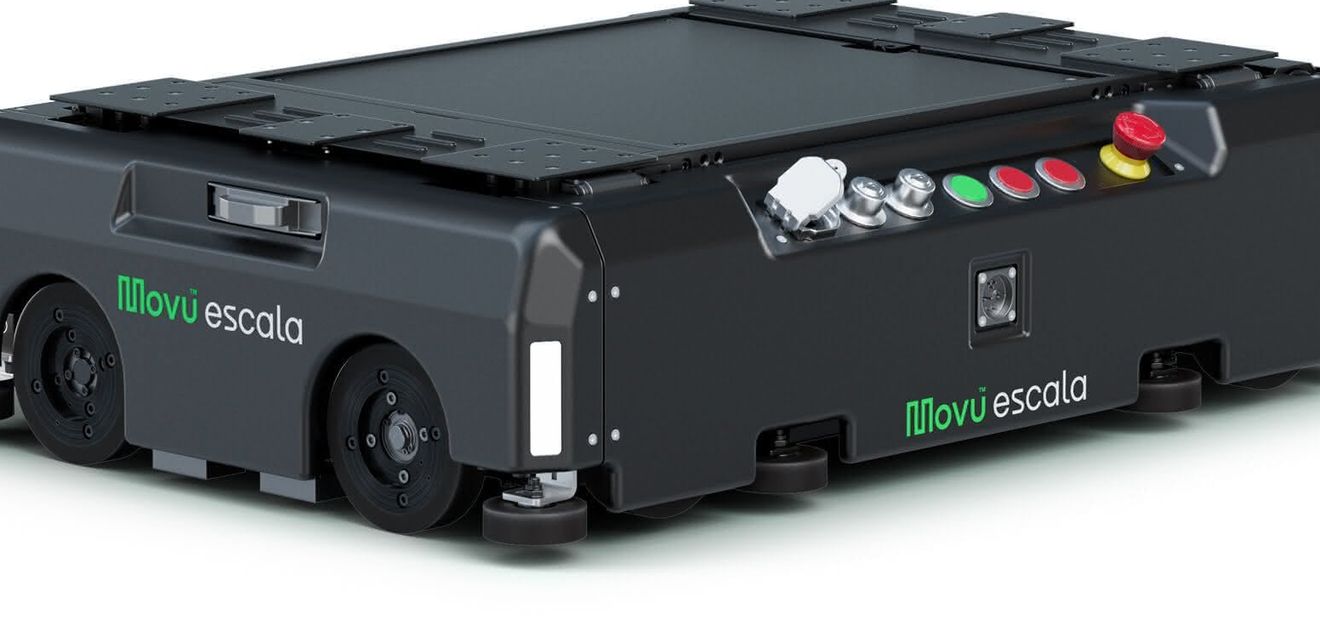
The Escala consists of just 15 structural steel components and the 3D shuttles as the only automated component. To change levels in the storage cube, the 3D shuttles use ramps instead of lifts.
The Escala is divided into two areas: the ramp towers, which allow the 3D shuttles to change levels, and the storage areas, where containers are stored. The basic principle is based on a parking garage. Due to the one-way traffic in the ramps and the possibility of reaching every point in the storage cube via different routes, the Escala competes with the performance of a single-level shuttle, but with significantly better scalability and higher redundancy.
Performance indicators include the number of ramp towers next to each other, whereby the width of the system should correspond to the height in order to achieve the best possible performance utilization. By linking several ramp towers next to each other, it is possible to travel over several levels without changing direction, which increases the performance of each 3D shuttle. On the other hand, the configuration of the storage areas is crucial: the storage areas can be designed to be one to six times deep at any level. This makes it possible to create fast-moving and slow-moving or replenishment areas within the same system.
In a single-depth configuration, the 3D shuttle can remove the required container directly. In a multi-deep configuration, the required container may have to be "dug out". As a high degree of compaction of the stored goods is possible with multi-deep storage, a combination of both areas usually makes sense in order to achieve a good performance and compaction ratio on the one hand and to ensure sufficient flexibility for changes to the ABC curve in the long term. Compared to other 3D AS/RS, a free combination of multi-deep and single-deep storage areas is possible. This makes it possible to map a wide variety of ABC profiles and leads to a high degree of flexibility when changing the ABC profile.
It also enables functions such as order buffering and one hundred percent sequencing to be carried out without changing the hardware. The decoupling of storage location and container means that different container heights can be mixed as required and changed at any time. Lower containers are stacked on top of each other and stored together in a storage compartment. On the way to the workstation, the required container is "turned" upwards by a re-stacker. This enables, for example, the use of 120 millimetre high containers with a significantly higher subdivision than with 320 millimetre high containers.
The Escala therefore achieves better compaction than cubic AS/RS solutions for small SKUs with low quantities. Compared to other 3D AS/RSs, the Escala uses standard containers from any manufacturer in two basic sizes - 600 x 400 or 650 x 450 millimeters and can carry weights of up to 50 kilograms. The container holder allows existing storage containers to be used as long as they have a reinforced base. This means that the existing container pool can be used, resulting in process-related benefits and significant cost reductions. The high level of standardization greatly reduces the planning effort in the project and all components can be produced in large quantities. This leads to a reduction in costs and enables full automation from 250,000 euros. Depending on the ratio of output to storage space, Escala achieves a return on investment of two to three years.


You might also be interested in
Arvato implements shuttle system for H&M in Poland
H&M will be able to handle its logistics in Central and Eastern Europe faster and more agile in future: Arvato has expanded its e-commerce distribution center in Stryków, Poland, and installed an automated shuttle warehouse with a capacity of up...
 read more...
Automation using shuttle technology and SAP
GC Corporation develops, produces and distributes dental products. In order to make the European subsidiary, GC Europe, fit for the future to meet increasing logistical requirements, the company expanded its storage and picking capacities at the...
read more...Intralogistics for steel wholesalers
Lemvigh-Müller relies on Knapp
Lemvigh-Müller is making its largest investment in logistics to date and centralizing two warehouses in Odense and Kolding, both in Denmark, into one distribution center in Kolding. This will ensure that Lemvigh-Müller can handle larger volumes of...
read more...New shuttle warehouse for BSH Hausgeräte in Dillingen
The ground-breaking ceremony for a shuttle warehouse for household appliance specialist BSH Hausgeräte recently took place in Dillingen, Bavaria. TGW Logistics will build a highly automated small parts warehouse there by spring 2027.
read more...Combined storage solution with transshipment and pallet warehouse
With the newly founded Faurecia Clarion Electronics (Fengcheng), Faurecia aims to become a global leader in electronics technology for vehicle cockpits. When it comes to intralogistics, the company relies on a combined warehouse solution from...
read more...Storage and order picking technology
SSI Schaefer automates for the market leader in ready-to-eat salads
Fresh Servant maximizes its performance through automation at its logistics center in Edsevö, Finland. The company relies on a complete system from SSI Schaefer, consisting of an SSI Cuby shuttle warehouse, pick-by-light picking and the WAMAS...
read more...30 million spare parts shipped annually
The manufacturer and supplier of automotive spare parts DRiV has put a new automated distribution center for Europe into operation. An automation solution from Knapp forms the heart of the system.
read more...Production and assembly flexibly supplied
Automotive supplier Magna manufactures exterior mirrors at its Assamstadt site in Germany. Magna relies on an automation solution from Knapp to cope with the changes in logistics and to be able to operate flexibly with a high level of vertical...
read more...Novaltia builds new distribution center with Knapp
The Spanish pharmaceutical wholesaler Novaltia is once again relying on a complete solution from Knapp: In the new distribution center at its headquarters in Zaragoza, logistics processes are to be streamlined and sequences made more precise by...
read more...