

Interview
Sophisticated interaction thanks to Dambach
Dambach Lagersysteme also had a successful LogiMAT. materialfluss spoke to Benjamin Thumm and Dirk Lorenz about the limits of what is technically possible and the special requirements for deep-freeze warehouses.
materialfluss: What conclusions do you draw after LogiMAT? What do you take away from the three days of hustle and bustle?
Benjamin Thumm: The LogiMAT trade fair is becoming increasingly international. At the same time, there are no longer just warehouse technology manufacturers but also suppliers of complementary products for warehouse operations. This naturally attracts more visitors, but it forces us to differentiate our services and product portfolio more clearly for the customer. The trade fair was very successful for us and we were able to make many new contacts. We are already looking forward to LogiMAT 2020, where we will be back with new products and ideas.
mfl: The RBG vs. shuttle system discussion still doesn't seem to be over. How are you observing the course of this long-standing discussion? Which arguments are decisive for the system decision today?
Dirk Lorenz: The "Versus" has now become superfluous. Instead, it has become clear that the solutions are not necessarily in competition with each other, but are dependent on requirements. In some cases, they can even be used to complement each other in a warehouse solution. We are observing that shuttle technology is also increasingly finding its way into high-bay warehouses. Storage density and handling capacity no longer have to be a contradiction in terms, even in pallet storage. We are ideally equipped with our various products.
mfl: The handling capacities of modern SRMs are often at the limits of what is feasible - where can improvements still be made? The keywords here are approach dimensions, energy consumption and speed...
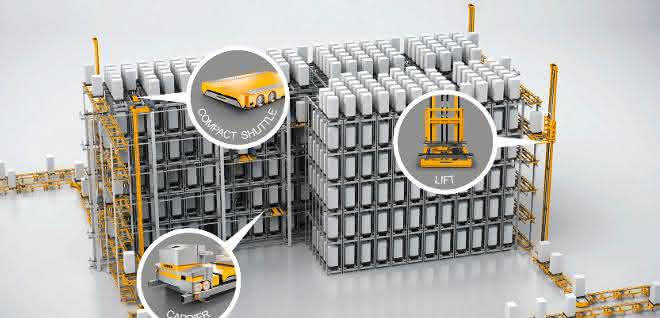
Thumm: With solutions based on storage and retrieval machines, the limits have been pushed further and further. We have already implemented stacker cranes with up to three shuttles. However, with higher performance requirements, you have to break new ground. For this purpose, we have developed a flexible pallet shuttle system which is not only extremely scalable but also powerful thanks to the interaction of shuttles, transfer cars and vertical conveyors. Better space utilization can be achieved thanks to more compact approach dimensions. In addition, a higher handling capacity is possible with comparatively lower energy consumption. Thanks to the modular design, improvements can be carried out independently on each product individually - without changing a system interface. For example, we were able to increase the storage depth of our Compact Shuttle to up to 40 meters.
mfl: During a presentation at LogiMAT, Dambach referred to its expertise in deep-freeze storage - is the company specializing in this area?
Thumm: As a partner to system integrators and general contractors, we are driven by the various requirements of our customers. Over the last 25 years, this has enabled us to gather a great deal of expertise in storage and conveyor technology in the deep-freeze sector. In addition, the demand for automated frozen food storage systems has increased. However, we are not a specialist but react quickly to current market requirements. Dambach Lagersysteme is at home in many different sectors, from automotive, paper and production warehouses to food warehouses.
mfl: To summarize in a few sentences, what is Dambach particularly good at in the cold?
Lorenz: The extensively tested and coordinated interaction between mechanical engineering and control technology is what distinguishes all our products. Particularly in cold ambient conditions, possible sources of error can be reduced to a minimum.
mfl: What else can intralogistics specialists expect between now and the end of the year? Will there be any new products by then? Where is the journey heading for Dambach Lagersysteme?
Lorenz: As a reliable partner for system integrators, we want to offer our customers a large portfolio of easy-to-integrate warehouse components. Thanks to the symbiosis of mechanical engineering and control technology, we offer many plug & play ready-made solutions. These range from the standard telescope to the turnkey Monoflex electric floor conveyor. Which, by the way, is the latest product in our family.
mfl: Jungheinrich presented the STC small parts stacker crane at the trade fair with the words: "In terms of handling performance, energy efficiency, space utilization and flexibility, the STC is a real high-performance device and currently the best stacker crane for small parts on the market. No stacker crane in its class comes close to its handling performance." As an established manufacturer of SRMs, can you leave it at that?
Thumm: We observe the market and our competitors very closely. Everyone has to decide for themselves whether it makes sense to push the technical limits of a conventional small parts stacker crane in times of high-performance small parts shuttle warehouses.


You might also be interested in
Arvato implements shuttle system for H&M in Poland
H&M will be able to handle its logistics in Central and Eastern Europe faster and more agile in future: Arvato has expanded its e-commerce distribution center in Stryków, Poland, and installed an automated shuttle warehouse with a capacity of up...
 read more...
Automation using shuttle technology and SAP
GC Corporation develops, produces and distributes dental products. In order to make the European subsidiary, GC Europe, fit for the future to meet increasing logistical requirements, the company expanded its storage and picking capacities at the...
read more...Intralogistics for steel wholesalers
Lemvigh-Müller relies on Knapp
Lemvigh-Müller is making its largest investment in logistics to date and centralizing two warehouses in Odense and Kolding, both in Denmark, into one distribution center in Kolding. This will ensure that Lemvigh-Müller can handle larger volumes of...
read more...New shuttle warehouse for BSH Hausgeräte in Dillingen
The ground-breaking ceremony for a shuttle warehouse for household appliance specialist BSH Hausgeräte recently took place in Dillingen, Bavaria. TGW Logistics will build a highly automated small parts warehouse there by spring 2027.
read more...Combined storage solution with transshipment and pallet warehouse
With the newly founded Faurecia Clarion Electronics (Fengcheng), Faurecia aims to become a global leader in electronics technology for vehicle cockpits. When it comes to intralogistics, the company relies on a combined warehouse solution from...
read more...Storage and order picking technology
SSI Schaefer automates for the market leader in ready-to-eat salads
Fresh Servant maximizes its performance through automation at its logistics center in Edsevö, Finland. The company relies on a complete system from SSI Schaefer, consisting of an SSI Cuby shuttle warehouse, pick-by-light picking and the WAMAS...
read more...30 million spare parts shipped annually
The manufacturer and supplier of automotive spare parts DRiV has put a new automated distribution center for Europe into operation. An automation solution from Knapp forms the heart of the system.
read more...Production and assembly flexibly supplied
Automotive supplier Magna manufactures exterior mirrors at its Assamstadt site in Germany. Magna relies on an automation solution from Knapp to cope with the changes in logistics and to be able to operate flexibly with a high level of vertical...
read more...Novaltia builds new distribution center with Knapp
The Spanish pharmaceutical wholesaler Novaltia is once again relying on a complete solution from Knapp: In the new distribution center at its headquarters in Zaragoza, logistics processes are to be streamlined and sequences made more precise by...
read more...