

Fraunhofer IML
Starting signal for open source: SKALA provides first components
The Fraunhofer Institute for Material Flow and Logistics IML has published open source components for logistics for the first time as part of the SKALA innovation project.
The aim of SKALA (scalable AI and blockchain solutions for automation and autonomization in value networks) is to combine the advantages of blockchain and AI technologies and put them into practice. The focus is on the needs of SMEs in order to provide them with high-tech for profitable, digital and sustainable logistics. Open source availability ensures that companies can access the technologies independently and develop their own use cases.
SKALA also focuses on targeted knowledge transfer: The competence platform and project-accompanying training formats support SMEs in particular in getting started with the digitalization of their core logistics processes.
"New quality of collaboration in digital logistics"
The applications were already presented at transport logistic in Munich from June 2 to 5, 2025. The components are now also freely available online. "With SKALA, we are demonstrating how artificial intelligence and blockchain can be intelligently combined in an open, modular ecosystem. The publication of the first open source components underlines our goal of providing practical tools for resilient and sustainable value creation networks. We are thus not only creating technological progress, but also a new quality of collaboration in digital logistics," explains Prof. Michael Henke, Institute Director at Fraunhofer IML.
The following application solutions are now available as open source:
- GreenComplAI - AI assistance for circularity management
GreenComplAI uses AI-supported plausibility checks to support companies in the sustainable transformation of their supply chains. Sustainability data is recorded digitally and checked automatically. A dashboard provides real-time insights, for example on resource flows and product-specific circularity data such as recycling rates.
- SiMBA - Dynamic resource utilization
SiMBA is an AI-based pricing and billing system that supports companies in the dynamic pricing of their products and services. The algorithm in SiMBA reacts in real time to fluctuations in demand and capacity utilization and enables the optimization of resource allocation and cost efficiency through elastic pricing.
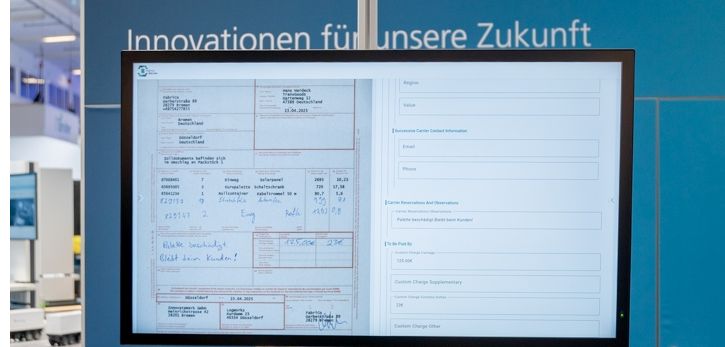
- InstaSCAN - Intelligent digitization of documents
InstaSCAN is a web-based service and is used for the low-threshold and flexible digitization of paper-based transport documents. Using large language models, information is automatically extracted and provided as structured data - including an ERP interface for system integration. This represents a further step towards a fully digital transport chain.
In future, Fraunhofer IML will offer a platform as a central point of contact for anyone who wants to work with SCALA technologies, providing all the necessary skills: From open source documentation to instructions and training courses, all relevant information on the use of AI and blockchain technology in value creation networks will be made available in a bundled form.


You might also be interested in
AI robotics program: Sereact and Rohlik Group cooperate
Sereact and the Rohlik Group want to work together to drive forward the industrial scaling of AI-controlled robotics in the e-grocery sector. With the launch of an AI robotics program at several locations in Germany and Austria, the two companies...
 read more...
Logistics AI with spatial intelligence
The Bavarian deep-tech company The Green Bridge is developing a technology that embeds spatial data in time horizons and automatically recognizes dynamics. This enables logistics companies to improve delivery times, increase transport efficiency,...
read more...Automatic scheduling in office supplies wholesale
Around 250,000 articles in five countries for wholesale, B2B and B2C in the office supplies sector are represented in the system and make up PBS Holding AG's broad product range. The replenishment effort is therefore enormous. The Austrian company...
read more...Efficient material flow design with AI in three steps
The material flow of raw materials, parts and semi-finished products in production and warehouses is often complex and can often be expanded in terms of efficiency. Machine learning, generative AI and the like can help with optimization.
read more...CO₂ management: Europa Worldwide Group relies on Blue Yonder
To achieve its environmental goals and to meet the growing sustainability awareness of its customers, the Europa Worldwide Group, an international logistics service provider, relies on Blue Yonder's Logistics Emissions Calculator, a component of the...
read more...AI-based scanning system ensures speed in the net warehouse
The start-up Invisium has developed a solution for the fully automated recording of reusable load carriers, which aims to eliminate the need for costly and time-consuming stocktaking. The application at the food retailer Netto Marken-Discount is its...
read more...MIT and Mecalux launch research project
The Center for Transportation & Logistics at the Massachusetts Institute of Technology (MIT) and Mecalux have launched a five-year cooperation project. The aim of the project is to accelerate the integration of self-learning artificial...
read more...RoX research project: Fiege involved as a partner
The aim of the RoX research program is to promote the use of AI-based robotics solutions in practical applications and industries. The logistics service provider Fiege is one of the consortium partners of the joint project funded by the Federal...
read more...Future Logistics Congress - 43rd Dortmund...
Simplifying logistics with AI
More than 350 participants will come together in Dortmund on September 9 and 10, 2025 for the 43rd Future Logistics Congress. This year, everything revolves around artificial intelligence (AI), resilience and sustainability. Speakers from science...
read more...