

Optimize logistics processes
AI-based scanning system ensures speed in the net warehouse
The start-up Invisium has developed a solution for the fully automated recording of reusable load carriers, which aims to eliminate the need for costly and time-consuming stocktaking. The application at the food retailer Netto Marken-Discount is its first project on the German market.
As in many other sectors of the economy, the use of artificial intelligence has become an integral part of logistics. This is particularly true for applications and tasks in the warehouse. Regardless of whether the aim is to optimize processes, increase efficiency, reduce the workload of employees or cut costs. The focus is almost always and exclusively on the question of which AI services, which far exceed human capacities in terms of computing power in particular, have enabled processes and tasks to be optimized.
Solutions for tasks that could not be solved before
"However, one potential of AI that has been little or not at all discussed to date is the collaboration between artificial intelligence and conventional image processing. By combining the best of both worlds, solutions can be found for tasks in logistics that were previously impossible to solve," says Stefan Zweigler, founder and CEO of Invisium.
Thanks to the fully automated operation, warehouse employees can concentrate fully on their actual activities and are not impaired in their work steps. This is achieved, among other things, by the fact that neither manual interaction nor maintenance work is associated with the use of the solution, meaning that all manual process interruptions due to precisely defined stops or stock transfer processes are simply eliminated. This also makes the installation of complex conveyor technology, which was often necessary with conventional systems, obsolete.
Another advantage: the solution generates data in real time for the first time during transit for tasks and processes in which companies previously had to rely almost blindly on everything being correct - that transport documents are correct and that all load carriers that leave the warehouse will return at some point. By scanning, the VisionPort creates a basis for digitizing these tasks and processes, giving companies greater transparency and control.
Precision and flexibility
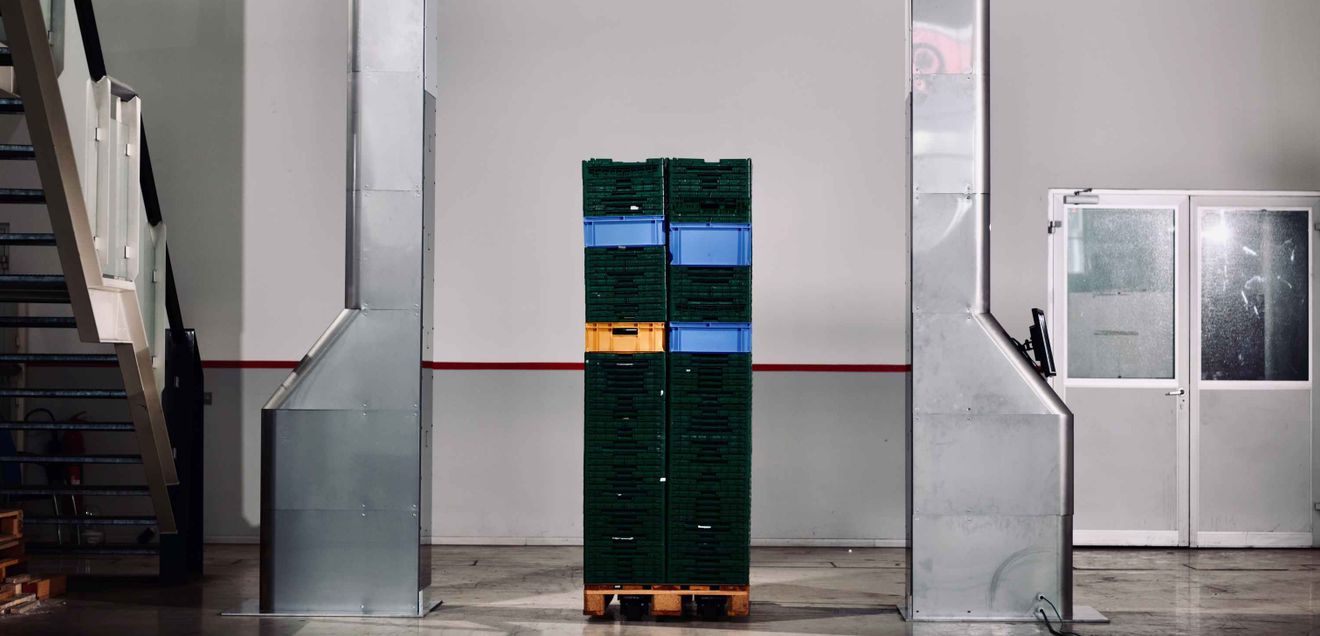
The man-sized system is implemented in the form of a door frame directly behind a warehouse door, through which drivers or warehouse employees transport load carriers on an industrial truck. And this is precisely where the combination of artificial intelligence and conventional image processing comes in. After all, a key challenge for any system for detecting reusable load carriers is the question of whether it will leave established logistics processes untouched, for example at goods inwards and outwards.
"The processes in the warehouse are characterized by a high level of dynamism; the aim is to complete tasks quickly in order to save time and resources and cut costs. A system that requires employees to pause for long periods of time to scan load carriers or only approach the system at a certain angle is not attractive or economically viable. At the same time, the time factor must not be at the expense of the accuracy of the scan. Otherwise, there is a risk of inaccurate stock figures and, in the worst case scenario, employees will have to recount manually," explains Stefan Zweigler.

The Visionport solves this problem with a range of technical solutions. With the help of AI, the system has the flexibility to detect objects under different scanning conditions (such as the approach angle of the Visionport) and also ensures a high degree of precision through the use of classic image processing.
Specifically, this means that in a first step, the AI detects what type of object is approaching the Visionport in order to only trigger the recording when load carriers such as pallets or pallet cages pass through the system. People or industrial trucks are not recorded. Several high-performance cameras are installed on the side and top of the VisionPort, which take several dozen images in just a few milliseconds and transmit them to a computer. At the end of the scanning process, software developed in-house compares the results of AI and conventional image processing. As a result, the Visionport achieves an image reliability of over 99.8 percent, while alternative systems (for example in the form of a handheld scanner or tablet) are around 85 percent. With this level of accuracy, it is able to recognize all standard load carriers in use, which means that the solution can be used across companies.
Fully automated load carrier inspection at Netto Marken-Discount
The food discounter Netto Marken-Discount is also impressed by the scanning system, which was named one of ten Invision Top Innovations in 2024, and has been relying on Invisium as a partner for fully automated load carrier inspection since spring 2025 following a successful test phase lasting several months. The start-up is initially equipping two Netto Marken-Discount central warehouses with a total of three Visionports, which will count the load carriers at several stations. This is invisium's first project on the German market.
In further, already planned project phases, the solution is to implement additional use cases with more complex application profiles, for which invisium is already carrying out corresponding test runs in a net central warehouse.


You might also be interested in
Robotics ecosystem integrates Nvidia
More power for industrial transformation
Idealworks' robotics portfolio will integrate Nvidia AI, Nvidia Omniverse and Nvidia Isaac technologies to drive the development and adoption of vision AI robots.
 read more...
Productivity guaranteed all day long
Rugged tablets for a wide range of applications
With the new 8-inch ZX80W and ZX80W-EX tablets, Getac is launching two rugged Windows 11 devices based on ARM architecture. The tablets are designed for mobile use in logistics, warehousing, and transportation.
read more...Datalogic: Gryphon GD4600 Series
High performance 2D handheld scanner
The Gryphon GD4600 series from Datalogic offers professional 2D handheld scanners for retail, industry, logistics and healthcare.
read more...Logimat 2025: Data capture and printing...
Reliable from the warehouse to the front door
TSC Auto ID will be showcasing technologies for three key areas. These include mobile computing and data capture solutions from Bluebird, the newest member of the TSC Auto ID family.
read more...Convenient measurements even in harsh environments
Hexagon Manufacturing Intelligence introduces a new handheld 3D scanning technology that adds convenient new functionality for flexible measurement to its wide range of manufacturing inspection devices.
read more...Pick-by-voice solution with wearable scanners
Proglove is cooperating with Topsystem, a division of the Ehrhardt Partner Group (EPG), to meet the industry's high demand for mobile logistics solutions.
read more...TSC Printronix Auto ID introduces new direct thermal printer
TSC Printronix Auto ID has launched a new mobile direct thermal printer - adding another basic and premium model to its Alpha series in the 3-inch segment.
read more...TSC Printronix Auto ID expands on-site services
Both the "On-Site Service Program" and the "Extended Warranty Program" are now available for TSC brand industrial printers and Printronix Auto ID brand industrial enterprise printers.
read more...Mobile data capture with Mediaform
Mediaform has added another product area to its portfolio. A range of handheld MDE terminals with Android operating systems from manufacturers Datalogic, Honeywell, Unitech and Zebra has been online in the webshop since September 2021.
read more...