
Digitization
Desire, reality and quiet despair
Consultant, speaker and digital expert Ömer Atiker takes a look at the digital resolutions for 2019 for LT-manager with a smile on his face. In a nutshell: what can we do to make it work better this time?

So, have you had a good start to the new year? Recovered from the holidays? Now is the time when you look at your stomach, slightly regret the binges of the holidays (but it was delicious, wasn't it?) and make good resolutions. Less food, more sport, more time with the family. And we're going digital too! But hello!
Forgive me for being skeptical, but weren't these the resolutions for last year and the year before? Just as it is hardly noticeable if the New Year's speech is from last time, the resolutions are always the same. Despite all intentions and assurances, not much has been achieved. What a shame, isn't it? Why is that? And what can we do to do better this year? Well, I can't help you with your stomach. But we should have a chat about the digital world.
What is that?
What does digital transformation actually mean? One person thinks of apps and social media, the next of AI and blockchain, the third of Terminator and Big Brother. Somehow they're all right. Someone once said, and I think this is fitting, that digitalization for adults is like sex for teenagers. Everyone talks about it, but nobody knows how it's done. In theory, yes, but in everyday life? And because everyone talks about it, everyone you ask says that they are digitalizing a lot. In the morning! At lunchtime! And twice every evening! Yes, of course. What actually happened - well, a little less impressive.
Hand on heart: Did you digitally transform last week? Exactly. Who does that? There's already a parallel with sport and healthy eating. Most of it will happen "tomorrow", not today. But it starts with the fact that nobody knows what exactly is meant by that. In other words: what are you actually digitizing? And why? Let's start with the basics. Digital transformation of companies means that we use the digital opportunities and possibilities to deliver more value. And that we have to change our organization and possibly turn it completely upside down to do so. Digital is therefore not an end in itself; the focus should always be on the customer and their sense of value.
Trees in the forest and the question of value
The question of value is a good place to start. Where else should I start? A little logic puzzle: 1. the customer determines what your offer is worth. 2. you digitize, but something internal that the customer doesn't know about. Price question: Does your project then have a value? It's like the old philosophical question: If a tree falls in the forest and nobody is there to hear it - does it make a noise? (What solipsism and the filter bubble have to do with it, we'll discuss another time over a bottle of red wine).
But the question is a valid one. I think that far too many companies make three mistakes:
- You go "digital" because it's trendy at the moment.
- You simply stick the label "transformation" on all computer projects and then you're already way ahead without any effort.
- And IT takes care of the rest of the digitalization.
You can do that. But it's stupid. The first two points are window dressing, it's childish. And the third point is simply wrong.
Ah, the role of IT!
Yes, but IT has been digital for decades. Why shouldn't they do it? Well, IT certainly has better things to do. No, seriously. They have to keep the systems running, that's exhausting enough. And it's a thankless job. When it's running, nobody cares. And when it's not working, everyone comes running and insults you. The IT motto is quite rightly "Never Change a Running System". But that's not exactly the wake-up call of innovation (more like Mikado - whoever moves first loses). Expecting IT to come up with new product concepts, bring them to market and also turn the organization upside down (because that's what "transformation" means) is really asking too much.
So once again: transformation, value and fried egg
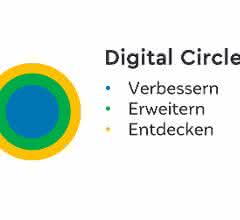
The idea of starting transformation with the customer and value is not a bad one. Above all, we should think further than just the edge of the plate, the edge of the table or the neighbor's desk. There is a wonderful thinking tool for this, the digital fried egg. Well, formally I call it the digital circle, but when we're among ourselves, "fried egg" is much easier to remember. A digital circle like this has a core. That's what we're doing today. Around it is the first circle, that's the improvements. That's what we've always been excellent at: Optimizing down to the second and gram. The big Internet companies do this to excess. How long does it take you to update the software in your company? And how many tests do you run? And now guess how often a (still pretty ugly) website like Amazon's is updated. I mean, it looks almost exactly the same as it did ten or 20 years ago. Well, how often?
Well, Amazon makes around 50 million deployments a year, i.e. live switching of customized software. That's one update per second! The ugly side is built by around 100 different processes, each contributing a tiny detail. Each process is optimized to the max. Have you been on Facebook? Depending on the source, there are between 1,000 and 10,000 different versions of "Facebook" at any given time, depending on the user, location, device and so on. Oh yes, what about you, how often do you update? And how many tests do you run? So even in our very own field, perfectionism, others are much more obsessive than we are.
Beyond the horizon
But it gets more exciting beyond the inner circle. The second circle is the extensions. This is where you combine products and services to create new possibilities. For example, the Amazon dash button or the Kindle eBook. This is what happens when you understand the customer's world and think ahead. Because I don't want to go to this online store, no matter how optimized it is. I want what's missing to be there again. Detergent, toilet paper, potato chips, beer, condoms - whatever you need to live. And it's great when it works at the touch of a button. Or just by shouting "I wish for...", like in a fairy tale. It works! You just have to say the magic word first: "Alexa" - it's like "Abracadabra", but easier. Or let's take another logistics company, Netflix. They used to ship up to 1.5 million DVDs a day! And then they saw the internet coming and started a streaming service. Why send DVDs when I can send the movie digitally? It was a small step for the customer. For the company, it was a huge upheaval. They went from being a logistics company to a service provider, which is a completely different business.
That is transformation! And now let's move on to the third circle. That is discovery. What else can we do that is of value to anyone out there? And how can we earn money with it? For Amazon, that was web services. They know how to efficiently manage large data centers (50 million updates per year!), and others can use that too. Netflix also thought ahead. They had something that nobody else had: an extremely detailed database of who likes to watch what and when. So why wait until the studios deliver something (hopefully) suitable? That's why Netflix has been producing its own series for a few years now.
The hole in the wall
Now, dear reader, you don't have to set up your own film studio, but thinking ahead is a good thing. Car manufacturers are doing the same, moving away from the idea of "money for a car" and wanting to become mobility providers. Because I don't necessarily want to have a car, I just want to get from A to B as comfortably, quickly and cheaply as possible. And then on to C and through the whole alphabet. That, in turn, is like the drill. The customer doesn't buy a drill, but a hole in the wall. Right, but only one piece, because I personally don't need a hole in the wall at all. I want the picture to stay on the wall. If you can do it another way, that's fine with me, as long as it holds.
For us, it means that we have to think in terms of solutions. Solutions that represent a value that our customers appreciate. Digital offers many more opportunities than we think. Platforms and shared resources to become more efficient and environmentally friendly as a network. "Living" warehouses that are set up differently every day. Fashion manufacturers such as Zozo measure their customers precisely and only deliver made-to-measure. This makes many shipments superfluous (and also makes customers happier).
As a little treat, a bit of creative IoT, once again from Netflix. Do you know the Netflix sock? It has a motion sensor and a small LED. You put it on when you go to watch a series on the couch. If you don't move for a long time, the LED comes on and checks to see if you react. Because if you are lounging on the sofa, your feet and socks are usually at the bottom of the screen and you can see this light. If you don't react, the series is paused so that you literally don't miss anything important. Now that's progress! On that note, have a successful digital year!
About the author: Ömer Atiker (atiker.com) is an expert in digital transformation and has been online "since the Stone Age". He has been supporting companies with digitalization and strategy for three decades. Under the motto "Hello, future!", he brings his experience to the stage as a keynote speaker and to companies as a consultant.
The book on the subject
Ömer Atiker: The digital transformation survival handbook
How to stand up to the madness, shape everyday life and make your company fit for the future. 296 pages, hardcover, ISBN 978-3-593-50921-1, € 34.95 (D), € 36.00 (A), Campus Verlag, published on September 7, 2018.
Everyone is talking about digitalization - but how exactly does it actually work? Between professors, hipsters and prophets of doom, there are few answers as to how an established company can really take advantage of the opportunities offered by digitalization. What is missing above all are concrete instructions: How do I tackle the issue, what do I need to pay attention to, what is the right sequence? Companies can find the answers in the digital transformation survival handbook.


You might also be interested in
e2open bonded warehouse solution for several European countries
e2open, a provider of networked supply chain platforms, has expanded its customs warehouse management in Europe. Companies that import goods to Europe now have the option of using various customs warehouse programs.
 read more...
New start-up aims to facilitate access to robotics
Pssbl.Robotics, a start-up founded jointly by Schubert and Weiss, aims to simplify the introduction of robotics in mechanical and plant engineering.
read more...Test shipment with RoRo Car Carrier via Bremerhaven
Last August, the RoRo Car Carrier MV Cosco Shengshi moored in the northern port of Bremerhaven and started its first test shipment in order to expand the service to Europe.
read more...Rhenus grows at sea and on the road
At the northern tip of Lower Saxony, the logistics service provider is preparing for the growing import of cars via Cuxhaven; in Nuremberg, Rhenus is building a new logistics center next to the existing high-bay warehouse; in Dietzenbach, Hesse, the...
read more...Hermann Grewer celebrates his 80th birthday
Hermann Grewer, Honorary Chairman of the North Rhine-Westphalia Transport and Logistics Association (VVWL) and Honorary President of the German Road Haulage, Logistics and Disposal Association (BGL), celebrated his 80th birthday on June 6.
read more...Group7 expands corporate headquarters
The logistics service provider is planning 60,000 square meters of service and logistics center and an administration building with 5,000 square meters of floor space near Munich Airport.
read more...Cross-channel logistics: overcoming hurdles after Brexit
Hardly any other event has presented European road freight transport with such enormous challenges as Brexit. But there are solutions.
read more...Transport Logistic 2023
After a four-year break with a virtual interlude in 2021, Transport Logistic will return to the Munich exhibition grounds from May 9 to 12, 2023.
read more...Focus on internationalization
L.I.T. will be represented twice at Transport Logistic. The Brake-based logistics service provider's service portfolio ranges from warehousing and transportation using various modes of transport to contract logistics and comprehensive value-added...
read more...