

HHLA rail subsidiary
Metrans doubles the number of container trains on the New Silk Road
The HHLA rail subsidiary Metrans is one of the pioneers in the rapidly growing rail traffic on the New Silk Road. Last year, Metrans increased the number of container trains between Europe and China by 114 percent.
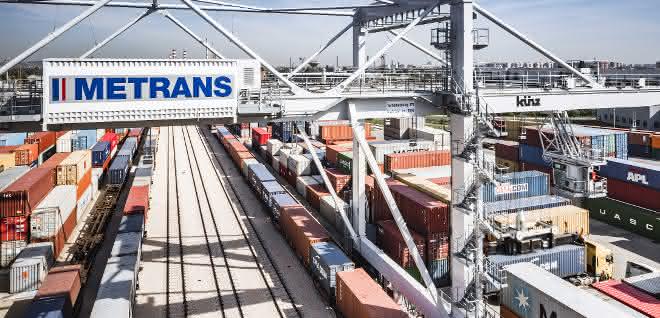
Rail freight traffic between Asia and Europe has increased significantly in volume and frequency in recent years. The coronavirus pandemic and the resulting capacity bottlenecks in shipping have given rail-based transport connections an additional boost. According to estimates by management consultants Roland Berger, around 878,000 standard containers (TEU) were transported on the various rail corridors of the New Silk Road in 2020. The International Union of Railways (UIC) assumes that this figure could double by 2025.
HHLA subsidiary Metrans is also benefiting from this trend. In 2020, the intermodal company handled a total of 913 trains (2019: 426 trains) that came from or went to China. This is an increase of 114%, with the largest growth (+131%) being recorded for imports. Metrans' transport volume on the New Silk Road was therefore around 30,000 TEU.
Metrans CEO Peter Kiss: "We started transporting sea freight containers to the European hinterland 30 years ago. Metrans offered the first regular shuttle train connection between Hamburg and Prague. Since then, our network between European ports and the hinterland has grown every year. We are also one of the largest providers in what is currently the fastest growing market, rail transport between Europe and China."
Today, customers are offered numerous destinations in China as start and end points. Currently, 60 to 80 Metrans trains a month run between Europe and important economic centers in the People's Republic, including Zhengzhou, Xi'an and Jinhua. Metrans works with partners in China to put together the block trains, which are taken over by or handed over to a traction company at various hubs along the Eurasian rail corridor. These hubs are the Polish border terminal Malaszewicze (near the Belarusian city of Brest) and the terminal in Dobra, Slovakia (near the Ukrainian border). The containers are then distributed throughout the Metrans network. The most important hubs for Metrans' European China transports are its hub terminals in Budapest, Prague, Ceska Trebova, Poznań and Dunajska Streda.
The Port of Hamburg is the central hub of German trade with China, both for the continental and the maritime Silk Road. More than half of German-Chinese foreign trade is handled via the Hanseatic city. The majority is transported by sea. In 2020 alone, more than 2.4 million TEU were handled at the quays in Germany's largest seaport. 15 liner services connect the Hanseatic city with Chinese ports. Quay and rail facilities are close together in Hamburg. As Europe's largest rail port, Hamburg also offers a dense network of wagonload, shuttle and block train services. Every week, almost 1,960 train departures are offered to and from Hamburg - including over 230 weekly connections with China.


You might also be interested in
Arvato implements shuttle system for H&M in Poland
H&M will be able to handle its logistics in Central and Eastern Europe faster and more agile in future: Arvato has expanded its e-commerce distribution center in Stryków, Poland, and installed an automated shuttle warehouse with a capacity of up...
 read more...
Automation using shuttle technology and SAP
GC Corporation develops, produces and distributes dental products. In order to make the European subsidiary, GC Europe, fit for the future to meet increasing logistical requirements, the company expanded its storage and picking capacities at the...
read more...Intralogistics for steel wholesalers
Lemvigh-Müller relies on Knapp
Lemvigh-Müller is making its largest investment in logistics to date and centralizing two warehouses in Odense and Kolding, both in Denmark, into one distribution center in Kolding. This will ensure that Lemvigh-Müller can handle larger volumes of...
read more...New shuttle warehouse for BSH Hausgeräte in Dillingen
The ground-breaking ceremony for a shuttle warehouse for household appliance specialist BSH Hausgeräte recently took place in Dillingen, Bavaria. TGW Logistics will build a highly automated small parts warehouse there by spring 2027.
read more...Combined storage solution with transshipment and pallet warehouse
With the newly founded Faurecia Clarion Electronics (Fengcheng), Faurecia aims to become a global leader in electronics technology for vehicle cockpits. When it comes to intralogistics, the company relies on a combined warehouse solution from...
read more...Storage and order picking technology
SSI Schaefer automates for the market leader in ready-to-eat salads
Fresh Servant maximizes its performance through automation at its logistics center in Edsevö, Finland. The company relies on a complete system from SSI Schaefer, consisting of an SSI Cuby shuttle warehouse, pick-by-light picking and the WAMAS...
read more...30 million spare parts shipped annually
The manufacturer and supplier of automotive spare parts DRiV has put a new automated distribution center for Europe into operation. An automation solution from Knapp forms the heart of the system.
read more...Production and assembly flexibly supplied
Automotive supplier Magna manufactures exterior mirrors at its Assamstadt site in Germany. Magna relies on an automation solution from Knapp to cope with the changes in logistics and to be able to operate flexibly with a high level of vertical...
read more...Novaltia builds new distribution center with Knapp
The Spanish pharmaceutical wholesaler Novaltia is once again relying on a complete solution from Knapp: In the new distribution center at its headquarters in Zaragoza, logistics processes are to be streamlined and sequences made more precise by...
read more...