

Research project "Industrial Indoor Localization" (IIL)
Automated vehicles will soon receive "hiking maps"
Successful automation of warehouse processes requires large amounts of data. The "Industrial Indoor Localization" (IIL) research project, which ended in February 2021, focused on how this information can be obtained and standardized more easily.
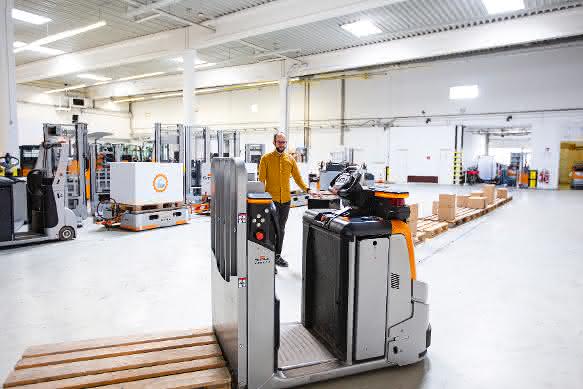
The Hamburg-based intralogistics provider Still has not only incorporated its wealth of experience in the field of vehicle automation and robotics into this project, but has also developed a vehicle for efficient process automation with its autonomous horizontal order picker OPX iGo neo. This is the next step towards further increasing autonomy and flexibility.
Indoor localization offers intralogistics important tools for future-oriented automation solutions. However, only those who know exactly where a forklift truck, robot or pallet is at any given time, for example, can exploit this potential. "To determine this location, we need detailed map material that is as standardized as possible," says Tino Krüger-Basjmeleh, robotics expert at Still GmbH. This standardized reference framework was developed between 2018 and 2021 in the "Industrial Indoor Localization" research project funded by the European Regional Development Fund (ERDF) and the Free and Hanseatic City of Hamburg. This resulted in an open-source reference architecture for indoor localization (RAIL), which simplifies the provision of location-based services. Still was involved in this cooperation between science (Hamburg University of Technology) and industry, as was the sensor manufacturer Pepperl+Fuchs.
Leveraging the potential of the future market
"Today, many automation projects are not realized simply because a great deal of initial effort is required to create maps and commission vehicles each time they are implemented," says Tino Krüger-Basjmeleh, describing the current situation and thus the background to the research project. He adds: "At this point at the latest, there is a risk that customers will turn away and discard budding automation plans." In fact, great potential in an important future market is being wasted. In order to change this, cards are needed that enable humans and machines to serve different needs and decouple complex developments. In addition, these cards should also be quickly and easily adaptable to the respective environment by non-technicians. "If these requirements are met, intelligent localization technologies will reduce costs, increase productivity and improve occupational safety in the near future. The results of the recently completed IIL project have brought us a big step closer to these goals," says the robotics expert with confidence.
An important guarantee for the success of the IIL research project was the autonomous horizontal order picker OPX iGo neo introduced by Still. "With the sensors already installed in series production in the OPX iGo neo, the integrated vehicle robotics system is inherently capable of answering all the questions that an automated vehicle needs to answer," explains Tino Krüger-Basjmeleh. The vehicle has brought these advantages to the research project in a profitable way. However, Still and its customers can also benefit from this fact. "During the course of the project, we have developed many new capabilities for the OPX iGo neo, significantly increasing its autonomy even further. This has resulted in a new prototype of the vehicle, which we can use to demonstrate numerous automation approaches to our customers in the future very clearly and without great effort," says Krüger-Basjmeleh.
For example, during the research project, the autonomous vehicle demonstrated for the first time that it can switch very smoothly and almost unnoticed by the user between manual, fully automatic and autonomous assistance mode. In practice, these processes work like this: The vehicle reaches the picker or order picker in automatic mode with a previously picked pallet and then switches to assistance mode. In this mode, it accompanies the operating personnel during the picking process so that the operators can put goods together individually and the vehicle constantly orients itself to the operator as an "extended arm". At the end of the picking process, the vehicle automatically takes the order to the transfer point. "This really is a first for the entire intralogistics sector. In the course of the research project, we were able to demonstrate for the first time that this process runs so smoothly. The operating personnel are optimally supported by this COBOT (collaborative robot) functionality," says the robotics expert.
Conclusion
All in all, the IIL research project was a complete success. For the further development of warehouse and production logistics - but also for Still. "We at Still have been dealing with the topic of automation for a very long time and can already offer our customers very efficient solutions. We want to further optimize these approaches in the future," says Tino Krüger-Basjmeleh. However, it is always necessary to consider which products actually meet customer requirements and are ready for series production. The results of the IIL project can be used to simplify planning and commissioning processes in future, as the expert explains: "Thanks to the intelligent maps and the new vehicle capabilities, we will be able to install automated vehicles quickly and smoothly at the customer's premises in future and discuss with them whether the proposed solution actually meets their needs. On the one hand, participating in such research projects helps us to increase customer benefits. On the other hand, we can maintain our lead over our market competitors."


You might also be interested in
Dematic and Hai Robotics launch partnership for flexible AMR solutions
Dematic and Hai Robotics have recently agreed a Europe-wide partnership to work together as integration partners in the field of warehouse automation. Through this cooperation, the provider of automation solutions for supply chains and the...
 read more...
The market for service robots
A recent report from IDTechEx analyzes the global market for service robots and examines key applications for delivery and logistics robots, cleaning and disinfection robots, social robots and more.
read more...Application phase for Innovation Award 2026 begins
How can robotics help to make packaging more sustainable? Kuka is looking for creative and innovative ideas in the new round of the Innovation Award.
read more...Exoskeleton with AI power
Robotics company German Bionic presents its most advanced exoskeleton model to date, called 'Exia', which is fully controlled by augmented AI.
read more...Strategic partnership for the promotion of AI
Jungheinrich and Merantix have announced a strategic partnership. The aim of the cooperation is to promote applications based on artificial intelligence (AI) in the industry.
read more...New robotics organization founded
Omron has announced the establishment of a global robotics organization effective April 1, 2025. It will operate in parallel with Omron's automation business so that both areas can complement and support each other.
read more...No-code tool for programming robot user interfaces
ABB provides 'AppStudio', a software tool that allows users of all skill levels to quickly and easily create customized, graphical user interfaces for robots.
read more...SLAM navigation in real time
'Freestyle Localize', 'Trailer Find' and 'Scanner Switch' are three new features of Sigmatek's real-time location software forcontour-based navigation 'SlamLoc'.
read more...Robotic solution: Aiming high under your own steam
The Skypod system is now used in more than 100 order picking warehouses worldwide by companies in all kinds of industries. The autonomous Skypod robots are able to overcome height differences of up to 12 meters.
read more...