
Cranes & Components
Paper industry: Automated material flow in XXL dimensions
Along with a new paper machine, the Schoellershammer paper mill in Düren has also put a new automated storage system into operation. The company relies on Demag process crane technology and was also supported by Demag experts in optimizing internal logistics - including yard management, i.e. the organization of truck traffic on the company premises.
250,000 tons of annual production and a total investment of around 100 million euros: These are two striking key figures for the PM 6 paper machine that Papierfabrik Schoellershammer in Düren commissioned at the end of 2016, thus doubling its production capacity. The new machine, which is housed in a hall measuring 180 x 35 x 22 meters, complements the PM 5 and enables the daily production of 1,500 kilometers of corrugated base paper.
Target market packaging for online retail
The two systems complement each other well, as the PM 5 produces base paper with a basis weight of 120 to 180 g/m2, while the PM 6 produces lighter papers of 80 to 120 g/m2, which are well suited to smaller packaging units. At the same time, the medium-sized company is supporting the circular economy with this investment. This is because the packaging paper is made from 100% recycled paper, and Schoellershammer recycles the waste paper from more than three million people in the border triangle around Aachen.
Ten years of experience with automatic bearings
One of the aims of the family business, which was founded in 1764, is not only to supply paper of the highest quality, but also to enable smooth processes and deliveries. Logistics plays an important role in this. "Inbound" deliveries of waste paper must be managed around the clock. "Outbound", forwarders and customers want short waiting times and prompt, reliable loading.
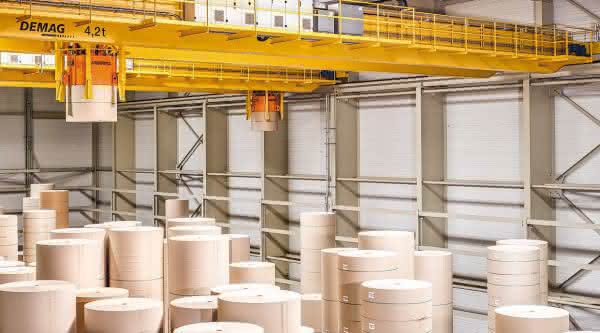
To ensure this, Schoellershammer put its first fully automated crane storage system for the PM 5 into operation almost fifteen years ago. It can accommodate paper rolls with a maximum total weight of around 9,200 tons at 100% filling level. Several rolls are stacked on top of each other like towers up to a height of 15 meters. The cranes are controlled by a Demag warehouse management system (WMS), which is installed in a virtual environment and integrated into Schoellershammer's IT infrastructure. A vacuum lifter is used as a load handling device.
Process cranes in 24/7 operation
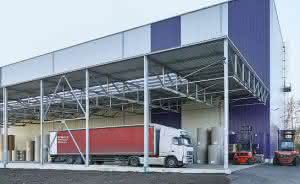
Handling in this dispatch warehouse - the AL 5 automated warehouse, which is assigned to PM - was initially carried out by a single Demag process crane. In 2011, the warehouse was equipped with a second Demag automatic crane, which travels on the same crane runway. This expansion had already been prepared when the warehouse was built. The storage capacity of 8,000 tons corresponds to the output of around ten daily production runs of the PM 5, which means that the turnover rate is high and the (fully automated) crane operation is intensive, especially as the installations work around the clock and retrievals also take place in a comparatively large time window of 12 to 16 hours per day.
Schoellershammer had a new dispatch store with a capacity of 12,270 tons built for the new PM 6 paper machine, in which two Demag ZKKW 4.2t x 30.42 m process cranes also ensure fully automated handling of the paper rolls. The rolls with a maximum diameter of 1500 mm and a maximum weight of 4.2 tons are automatically transported to the storage location assigned to them by the higher-level WMS. The warehouse has a floor area of approx. 66 x 30 meters. Here too, the maximum stacking height of the rolls is 15 meters.
58 rolls per hour stored and retrieved
Frequency-controlled travel drives were used to achieve the necessary transport cycles. Speeds of up to 100 m/min are achieved during crane and trolley travel. A speed of 120 m/min is achieved for lifting and lowering movements without load. Demag MPW winch units were used for the hoists. The system handling capacity of the AL 6 was calculated at 54 rolls per hour for storage and retrieval only. With combined storage and retrieval cycles, a total system performance of 58 rolls is achieved. These theoretically determined values were verified in a performance test.
The second warehouse makes the internal material flow on the finished goods side much more complex. There are now two warehouses for different product groups, i.e. for corrugated base paper with a low and higher grammage. As many customers order both qualities, the logistics experts at Schoellershammer were quickly faced with the question of how best to organize the material flow and truck traffic at the depot. This question is not trivial. Andreas Penner, Head of Shipping at Schoellershammer: "In a commodity market like ours, service is the key to customer satisfaction. That's why we attach great importance to optimal processes right up to delivery to our customers and continuously improve the level of service by using modern tools."
Simulation of the complete material flow
These tools have recently included a so-called "yard management system". As soon as the freight forwarder has booked a time slot and the truck has been weighed on arrival, the truck driver logs on to a terminal. The system then guides the vehicle through the plant and assigns it a place at the goods issue area, for example.
The processes specified by the yard management system were examined in detail in advance. This task was also carried out by the experts from Terex MHPS. Dr. Thomas Bönker, Senior Vice President of the Process Solutions business unit at Terex MHPS GmbH: "We generated a full-scale simulation model for Schoellershammer's outbound logistics. We first optimized the control strategies for storage, retrieval and reorganization in the two automated warehouses and, in a second step, simulated the entire plant traffic - with all trucks and forklifts - under real load scenarios."
The simulation also examined several variants for double loading: Is it more efficient if the trucks only dock at the ramp of one warehouse and forklifts transport the rolls there from the other warehouse? Or is it better for the trucks to drive to two loading points one after the other? Dr. Thomas Bönker: "The result was clear. It is much more economical if the trucks drive to both loading points one after the other"
Truck waiting times drastically reduced
The results of the simulation were consistently put into practice. In the case of double loading, the trucks now drive to the respective loading points of the two dispatch warehouses AL5 and AL6. As a result of these and other optimization measures, the trucks can now expect shorter waiting times. Dr. Thomas Bönker: "The average truck waiting times have been significantly reduced and the maximum number of trucks in the waiting zone has also been significantly optimized." This also proves the efficiency and practicality of the simulation tools - and Demag's expertise in improving overall intralogistics processes beyond crane technology and the warehouse.
www.schoellershammer.dewww.demagcranes.de


You might also be interested in
Crane retrofit in Emmerich
In the inland port of Emmerich, Tsubaki Kabelschlepp has overhauled the cable routing of a container gantry crane belonging to Contargo Rhein-Waal-Lippe. A pre-assembled Totaltrax solution was used, which the experts for energy chain systems...
 read more...
For drumming and towing - cables that pull along
With the Reeltec and Festoontec product series, TKD Kabel offers a portfolio of robust cable solutions for cranes and hoists. The specialist for application-oriented cable solutions thus also supports the increasing digitalization and automation of...
read more...Crane retrofit in Emmerich
In the inland port of Emmerich, Tsubaki Kabelschlepp has overhauled the cable routing of a container gantry crane belonging to Contargo Rhein-Waal-Lippe. A pre-assembled Totaltrax solution was used, which the experts for energy chain systems...
read more..."Customer awareness of environmental issues is increasing"
What trends and developments are there in the industry when it comes to green logistics? Experts provide insights: Christian Heid is Managing Director, SWF Krantechnik.
read more...New standards in lifting technology and material handling
Crane technology manufacturer SWF is now embracing digitalization and networking with a vengeance. Intelligent control aids make work safer and easier.
read more...Next generation electric wire rope hoist
SWF Krantechnik, supplier of components for industrial cranes and hoists, presented its new product innovationsto a broad specialist audience for the first timeat LogiMAT.
read more...Premieres for wire rope hoist and chain hoist
Rope hoist, chain hoist, Demag KBK light crane system: Demag will be presenting new products in each of the three product areas at Logimat.
read more...Crane technology: Konecranes presents solutions for material handling
Konecranes will present its latest Industrial Service and Equipment products at Logimat. Konecranes has pioneered safer, more productive and more sustainable material handling equipment.
read more...Starting signal for the intralogistics trade fair
The annual event opened its doors to trade visitors at 9 a.m. today. By midday, it was clear that there was a high level of interest from visitors, which corresponds to the fully booked halls.
read more...