
Fast automatic crane and self-supporting frames
Flexible crane logistics for a press shop
In production plants whose systems have to cope with frequent product changes, the changeover flexibility of the equipment plays a key role. For a press shop that primarily manufactures automotive parts, the focus was on quickly supplying the presses with tools weighing up to seven tons. The solution chosen was a fully automatic crane in combination with self-supporting frames and shuttles.
We are a sheet metal parts manufacturer and supply the automotive industry and other sectors with high-quality stamped and bent parts as well as finished assemblies made of steel, aluminum, brass or copper," says Hans-Martin Tekeser, Managing Director of Alzner Automotive in Grafenau. In addition to stamping technology, there are numerous other processes such as bending, laser cutting, welding, clinching and toxing as well as the completion with additional components made of metal, rubber, foils or adhesive pads. The company assumes responsibility for the production of ready-to-install assemblies that customers can integrate directly into their own production process. Additional skills in the areas of design, toolmaking, quality control and logistics are of great importance to Alzner. The most complete possible networking of all processes from development to production with the help of modern IT-supported processes therefore also plays a special role. The Schuler presses mainly used are therefore equipped with the IloT-Connector, with which the operating status of the systems can be called up at any time. This also includes all information about the current die, the number of strokes, the press force and the lubrication and cooling circuits.
High flexibility in terms of quantities
"As we manufacture a wide range of different products in the press area in quantities that vary greatly per call-off, from several 10,000 parts down to individual prototypes, we often have to retool our systems," adds H.-M. Tekeser. Flexibility in responding to customer requirements is a priority here. Most of the tools are so-called progressive tools. In principle, these are themselves complex systems in which the desired parts are first punched out of a continuous strip in several successive steps and then formed step by step. They consist of upper and lower parts with numerous moving parts, are up to six meters long and weigh up to seven tons. After use, they are checked and serviced and then put back into storage. The speed and efficiency of replacing, storing and retrieving these tools has a major impact on the productivity of the systems and therefore on the cost-effectiveness of production.
"At the end of 2018, Alzner asked us for suggestions for a suitable solution," recalls Jan Guthmann, Managing Director of H+H Herrmann + Hieber in Denkendorf. It involved the transport and fully automated storage of around 100 tools in two halls with a covered cold section in between for truck transports. In addition to the high speed of the exchange, the requirement was for as little hall space as possible and the best possible use of the existing hall height. In addition, the system had to be suitable not only for storing tools, but also coils and sheet metal stored on Euro pallets. Both the existing indoor cranes and heavy-duty forklift trucks were to be able to be used to transport the tools or materials to and from the presses or to external transfer points. The customer attached particular importance to the greatest possible reliability of the system, as the supply of the presses, which achieve press forces of up to 630 tons, depends on this.
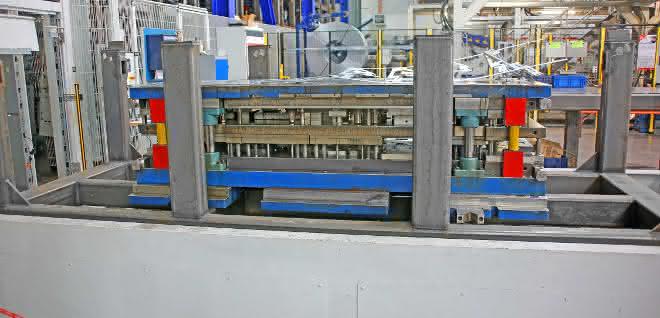
Fast automatic crane and self-supporting racks
"The solution we proposed consists of a fully automatic crane in combination with racks, two ground-level transfer shuttles and a bridge shuttle to a transfer tower in the neighboring hall," explains J. Guthmann. The crane runway was realized self-supporting on its own supports. The crane, which is designed for speed and has a lifting capacity of 8.5 tons, achieves a lifting speed of 0.3 m/s and a linear travel speed of 1.5 m/s. A special feature of the solution is the use of self-supporting stackable frames. Compared to a classic forklift-operated high-bay warehouse, this made it possible to store six instead of just four tools on top of each other within the existing hall height. The use of this automatic block storage system also meant that no additional forklift maneuvering areas had to be kept free. The individual racks are stacked on top of each other by the crane using a gripper beam held by four ropes or placed on transfer shuttles and discharged from the storage area. The connection to the presses in the neighboring hall is made via a high bridge using a separate shuttle. This means that truck and forklift traffic can be handled undisturbed in the intermediate area. In the neighboring hall, the racks are taken over by a vertical conveyor and either stored temporarily in four storage compartments or discharged directly.
Chaotic storage and optimized provision
"The use of a block storage system with storage racks enables optimum capacity utilization of the available storage volume. The warehouse management is organized chaotically," reveals J. Guthmann. In order to access a rack in one of the lower levels, the racks stacked on top of it have to be lifted and placed on other stacks. The respective storage locations therefore change constantly and are only known to the control system. The crane carries out these sorting cycles during the breaks between the supply runs. This allows the stacking sequence in the warehouse to be optimally coordinated with ERP planning. The system works with extensive storage strategies; for example, rarely used racks are stored in the lower and outer storage levels.
"As significant parts of our production depend on this central tool logistics, the decision to use Herrmann+Hieber was preceded by a thorough examination," says H.-M. Tekeser. "In terms of quality, H+H Herrmann + Hieber met our expectations and we expect to work together as partners for many years to come," he concludes.
The article appeared in materialfluss 11-12/20.


You might also be interested in
Arvato implements shuttle system for H&M in Poland
H&M will be able to handle its logistics in Central and Eastern Europe faster and more agile in future: Arvato has expanded its e-commerce distribution center in Stryków, Poland, and installed an automated shuttle warehouse with a capacity of up...
 read more...
Automation using shuttle technology and SAP
GC Corporation develops, produces and distributes dental products. In order to make the European subsidiary, GC Europe, fit for the future to meet increasing logistical requirements, the company expanded its storage and picking capacities at the...
read more...Intralogistics for steel wholesalers
Lemvigh-Müller relies on Knapp
Lemvigh-Müller is making its largest investment in logistics to date and centralizing two warehouses in Odense and Kolding, both in Denmark, into one distribution center in Kolding. This will ensure that Lemvigh-Müller can handle larger volumes of...
read more...New shuttle warehouse for BSH Hausgeräte in Dillingen
The ground-breaking ceremony for a shuttle warehouse for household appliance specialist BSH Hausgeräte recently took place in Dillingen, Bavaria. TGW Logistics will build a highly automated small parts warehouse there by spring 2027.
read more...Combined storage solution with transshipment and pallet warehouse
With the newly founded Faurecia Clarion Electronics (Fengcheng), Faurecia aims to become a global leader in electronics technology for vehicle cockpits. When it comes to intralogistics, the company relies on a combined warehouse solution from...
read more...Storage and order picking technology
SSI Schaefer automates for the market leader in ready-to-eat salads
Fresh Servant maximizes its performance through automation at its logistics center in Edsevö, Finland. The company relies on a complete system from SSI Schaefer, consisting of an SSI Cuby shuttle warehouse, pick-by-light picking and the WAMAS...
read more...30 million spare parts shipped annually
The manufacturer and supplier of automotive spare parts DRiV has put a new automated distribution center for Europe into operation. An automation solution from Knapp forms the heart of the system.
read more...Production and assembly flexibly supplied
Automotive supplier Magna manufactures exterior mirrors at its Assamstadt site in Germany. Magna relies on an automation solution from Knapp to cope with the changes in logistics and to be able to operate flexibly with a high level of vertical...
read more...Novaltia builds new distribution center with Knapp
The Spanish pharmaceutical wholesaler Novaltia is once again relying on a complete solution from Knapp: In the new distribution center at its headquarters in Zaragoza, logistics processes are to be streamlined and sequences made more precise by...
read more...