
AGVs and robotics
Retrofit for guaranteed freshness
The large dairy ELSA in Switzerland is keen to maintain its high level of automation in intralogistics in order to deliver fresh products quickly. This is why AGV specialist MLR is now modernizing an old system while it continues to operate - and according to a sophisticated plan.

According to the Swiss Milk Producers' Organization (SMP), 369 kg of milk and dairy products were consumed per capita in Switzerland in 2016. One of the producers is the ELSA-Mifroma Group. It specializes in the production and packaging of dairy products and the production, refinement and packaging of cheese. ELSA-Mifroma is part of M-Industry, a distribution platform for food products. M-Industry, which belongs to the Swiss Migros Group, produces over 20,000 food and non-food products with its 23 Swiss companies and seven foreign operations. That is one million tons of products per year.
Dairy with a high degree of automation
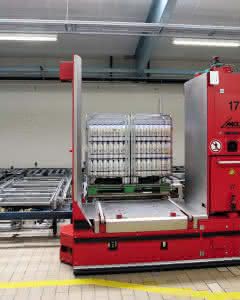
One of the ELSA-Mifroma companies is Estavayer Lait SA, or ELSA for short, based in the historic town of Estavayer-le-Lac in the canton of Fribourg on Lake Neuchâtel. Founded in 1955, the company is the largest dairy in Switzerland on a single site. Every day, the dairy processes up to 750,000 liters of milk. Up to 40 refrigerated trucks deliver the raw material every day.
At ELSA, particular attention is paid to developing a bold corporate culture and foresight when it comes to market changes and trends. For this reason, production operations were optimized and automated at an early stage in order to be able to cope with high demand quickly and work economically in the future. A good example of this was the installation of driverless vehicles with inductive guidance, which the company undertook as early as 1981. When it recently became necessary to replace an old driverless transport system (AGV) from Eisenmann, which had been installed between 2001 and 2005, MLR System GmbH was commissioned to replace the main parts of the system. The automated guided vehicles (AGVs) operating in the plant, which carry out their work around the clock, seven days a week, 365 days a year, were outdated in terms of their navigation, control and communication systems.
The task of the automated vehicles is to pick up incoming empties by rail - plastic containers and roll pallets, which are exclusively on Euro pallets and are only used internally at Migros - and transport them to the 50 or so filling lines. Fully automated depalletizing, filling, packaging and re-palletizing takes place there. The goods are again transported away by the AGVs.
The driverless vehicles are each equipped with two chain conveyors arranged one behind the other, transverse to the direction of travel, with which they independently deposit and pick up the pallets provided on the 600 mm high conveyor sections. The load changes are synchronized by the AGVs directly with the conveyor control system via a data light barrier. ELSA uses 17 vehicles to serve these 50 pick-up stations, each with a pick-up station for pallets with empties, and the 27 transfer stations, each with a delivery station for pallets with packaged goods. The Phoenix K-2.0 Lr six-wheel special vehicles are 3,940 mm long, 1,075 mm wide and 2,479 mm high and have a drive and steering unit at the front and rear. This allows lateral and diagonal movements to be carried out even in confined spaces. Each vehicle, which weighs just over two tons with battery, can carry 2 x 1,000 kg.
Conversion in individual phases
"We had to follow a very specific sequence for the modernization," explains Pierre-Alain Bigler, Head of Automation Projects in the Logistics division in Estavayer-le-Lac. "The first reason: we couldn't simply take some old vehicles out of the system and send them to Germany for conversion. This would have meant that the AGV, as the heart of the intralogistics system, would no longer have been able to provide the required performance, and production would have come to a temporary standstill, leading to delays in delivery." MLR therefore supplied two identical new vehicles for the system in addition to the 17 existing devices in order to prevent transport bottlenecks when removing old devices. Pierre-Alain Bigler: "Eisenmann, which no longer supplies AGVs, was extremely cooperative when it came to rebuilding the two vehicles."
"MLR has mastered the task well."Pierre-Alain Bigler Head of Automation Projects at ELSA
The second reason: the old master computer based on a programmable logic controller (PLC) from Siemens would not have been able to control the modernized AGVs. It was therefore decided to replace the PLC with a new, intelligent transport control system in an initial construction phase. This is the latest generation of PC-based MLR-LogOS-FTS master computer software, which is also able to control and manage the old Eisenmann vehicles, "a fact that we liked very much," says Pierre-Alain Bigler. The converted AGVs are connected to the LogOS control system via WLAN. It turned out that LogOS was able to schedule the old devices more intelligently, for example by reducing the number of empty runs and increasing the number of double cycles. Thanks to this increase in performance, ELSA was immediately able to dispense with three old AGVs at the same time.
Continuous exchange
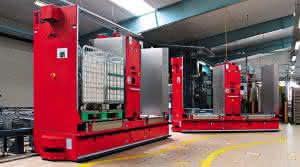
ELSA currently has a mixed operation. This means that old and modernized driverless vehicles drive together. Whenever a new vehicle is delivered to Switzerland, the haulier takes an old vehicle back to Germany for conversion. This happens about every three weeks. "If a converted AGV is delivered at 8 a.m., it is already working in the system by 12 noon," says Pierre-Alain Bigler happily. The reengineering and commissioning of an appliance takes around nine weeks.
A key feature of the state-of-the-art AGVs is the modern energy concept. Pierre-Alain Bigler: "Previously, the old vehicles were fitted with lead batteries. The automatic charging of these energy sources was a process that took eight hours. If all of the battery charging slots were occupied, interchangeable batteries were used." The retrofit vehicles, on the other hand, have a lithium-ion battery on board. These are fast-charging, remain in the vehicle and are automatically charged by six chargers via ceiling contacts.
The conversion of the automated guided vehicle system, which is akin to "open heart surgery", will be completed at the beginning of 2018. Pierre-Alain Bigler emphasizes: "So far, neither the control system nor the retrofit devices have broken down, so there has been no disruption to production. This is probably one of the reasons why the new system has been well received by the company. MLR has mastered the task well."
Wolfgang Degenhard


You might also be interested in
Standardized in design, flexible in use
Automated guided vehicles are increasingly in demand in production and logistics as they automate processes efficiently - but in addition to the vehicle, the right peripherals are also crucial for safe operation. A new solution consisting of a...
 read more...
Outdoor AGV networks production and logistics
An international company in the plastics industry is automating its intralogistics at its German site with a solution from ek robotics. A specially developed vehicle model from the Out Move series, an outdoor AGV, is being used.
read more...Transport systems for automated material flow
The Leo transporters from Bito make it easier for users to get started with the automation of material processes, which is possible from 20,000 euros. The system is a flexible all-in-one complete solution that is ready for immediate use and can be...
read more...Automated logistics for the university hospital
As part of the new construction of the University Hospital of Reims (CHU), France, the hospital has taken a number of steps to improve the needs of its patients and the working environment of its employees.
read more...K.Hartwall: Topping-out ceremony for the German site
The topping-out wreath was raised at the new building in the TIP Innovationspark Nordheide in Buchholz near Hamburg on February 27: The new K.Hartwall plant will comprise approx. 3,500 m² of hall space and around 2,000 m² of office and social areas.
read more...Noerpel Group tests driverless high lift trucks
The Noerpel Group has tested driverless pallet trucks in one of its two logistics facilities in Giengen. During a four-week trial, two autonomous systems were used to transport goods within the warehouse.
read more...Supply and disposal of printing machines by AGV
Numerous companies rely on AGVs in intralogistics to increase efficiency and meet challenges such as the shortage of skilled workers. One such company is GGP Media GmbH in Pößneck, Thuringia.
read more...Sophisticated automation: AGV and cobot combined
On behalf of Krefeld-based Saurer Technologies, the engineering team from Project Automation & Consulting developed a solution for production logistics that combines AGVs and cobots.
read more..."Herbie" robot in the Körber portfolio
Carrybots, a specialist in mobile robotics, is a new partner in the Körber supply chain ecosystem. The aim of this collaboration is to strengthen the position of both companies in intralogistics. Herbie" enables robot-based goods-to-person processes.
read more...