
Advertorial
Stackable transportation from the ground (Advertorial)
InSystems has developed an autonomously navigating automated guided vehicle system (AGV) that picks up and transports individual containers or stacks up to a total weight of 100 kg from the ground. The new development is particularly suitable for the internal material flow of small components or bulk goods as well as for feeding components during assembly processes. It does not require transfer stations or conveyor belts.

The new autonomously navigating transport robot from InSystems Automation can be integrated into any production environment immediately after it has scanned and "learned" its environment once. The special feature is its flexible and space-saving usability: the robot is designed so that it can pick up standard picking containers, small load carriers (600 x 400 mm and 400 x 300 mm) as well as beverage crates individually or in stacks and place them at their destination. No transfer stations or conveyor belts need to be installed and existing production processes do not need to be changed. The vehicle can be loaded up to a stacking height of 1,000 mm with a total load of 100 kg.
Alternative to trolleys or underride AGVs
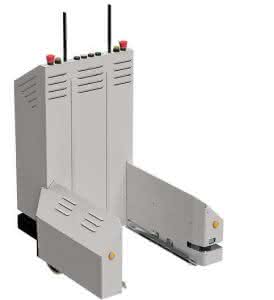
The new transport robot can be used as an alternative to trolleys or underride AGVs in warehouses and production halls. The vehicle ensures that stable stacks can be picked up safely at high speeds: Unlike trolleys, which require positioning rails, or underride AGVs, which can only move the load slowly due to the risk of tipping. They can be used in buffer areas where containers are placed directly on the warehouse floor, picked up from there and transported to machines and workstations. Material in the form of bulk goods, small parts for assembly workstations or picked components can be made available for the production process. The simultaneous transport of several containers in a stack means that the composition of the material can be adapted in many ways. The number of transport trips is also minimized.
Only one drive is required per vehicle side
The vehicle picks up the load automatically by using a laser scanner to detect the position and orientation of the stack and maneuvers it so that the load is threaded into the loading space. The robot's load handling device consists of a skid with an L-shaped cross-section to the right and left of the load compartment. These first move towards each other to slide under the shoulder of the container and then upwards, lifting the container. It is worth mentioning that only one drive is required per vehicle side to generate the infeed movement and the lift. A special mechanism ensures that the load is clamped from both sides and thus secured against unintentional slipping.
Interested parties can get a good impression of the new transport robot at LogiMAT. InSystems has its exhibition stand in Hall 7, Stand A80.
www.insystems.de www.proant.de


You might also be interested in
Standardized in design, flexible in use
Automated guided vehicles are increasingly in demand in production and logistics as they automate processes efficiently - but in addition to the vehicle, the right peripherals are also crucial for safe operation. A new solution consisting of a...
 read more...
Outdoor AGV networks production and logistics
An international company in the plastics industry is automating its intralogistics at its German site with a solution from ek robotics. A specially developed vehicle model from the Out Move series, an outdoor AGV, is being used.
read more...Transport systems for automated material flow
The Leo transporters from Bito make it easier for users to get started with the automation of material processes, which is possible from 20,000 euros. The system is a flexible all-in-one complete solution that is ready for immediate use and can be...
read more...Automated logistics for the university hospital
As part of the new construction of the University Hospital of Reims (CHU), France, the hospital has taken a number of steps to improve the needs of its patients and the working environment of its employees.
read more...K.Hartwall: Topping-out ceremony for the German site
The topping-out wreath was raised at the new building in the TIP Innovationspark Nordheide in Buchholz near Hamburg on February 27: The new K.Hartwall plant will comprise approx. 3,500 m² of hall space and around 2,000 m² of office and social areas.
read more...Noerpel Group tests driverless high lift trucks
The Noerpel Group has tested driverless pallet trucks in one of its two logistics facilities in Giengen. During a four-week trial, two autonomous systems were used to transport goods within the warehouse.
read more...Supply and disposal of printing machines by AGV
Numerous companies rely on AGVs in intralogistics to increase efficiency and meet challenges such as the shortage of skilled workers. One such company is GGP Media GmbH in Pößneck, Thuringia.
read more...Sophisticated automation: AGV and cobot combined
On behalf of Krefeld-based Saurer Technologies, the engineering team from Project Automation & Consulting developed a solution for production logistics that combines AGVs and cobots.
read more..."Herbie" robot in the Körber portfolio
Carrybots, a specialist in mobile robotics, is a new partner in the Körber supply chain ecosystem. The aim of this collaboration is to strengthen the position of both companies in intralogistics. Herbie" enables robot-based goods-to-person processes.
read more...