
Advertorial
Environmental paper with a system (Advertorial)
The number of parcels transported within Germany alone has more than doubled in the last 20 years. In 2015, 2.3 billion parcels were already transported in Germany. An additional annual growth in parcel shipping of between five and seven percent is expected for the future. This makes environmentally friendly packaging materials that are sustainable and conserve existing resources all the more important.

According to a recent study commissioned by the IFH Cologne research institute and the consulting firm KPMG (Consumer Barometer, issue 3/2016: survey of more than 500 consumers), customers also share this view. Three out of four consumers surveyed consider it important that packaging is environmentally friendly. As a result, manufacturers and retailers can successfully differentiate themselves from customers with environmentally friendly packaging for their shipping goods. Older surveys also show that a clear majority consider paper and cardboard to be more environmentally friendly than plastic. And not without good reason: paper is made from renewable raw materials and is ahead of plastic in terms of both environmental damage during production and biodegradability. Even after many decades, plastic is only five percent biodegradable, whereas paper is 100 percent biodegradable after just a few months.
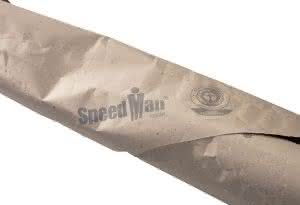
Another important factor is the recycling of packaging. In a study published in 2016, the Öko-Institut wrote: "The transition from a linear to a circular economy is both ecologically and economically necessary in view of climate change, environmental pollution, population growth and resource dependency". Ever since images of huge plastic bag carpets reached consumers, it has been clear that the future belongs to recyclable packaging materials. The German framework conditions for recycling paper-based materials are already excellent today. In 2016, paper recycling reached a new record high with 74.5% of waste paper as a proportion of total raw material use. The recycling rate for packaging paper is likely to be significantly higher. In contrast, the current recycling rate for plastic packaging is only a meagre 36%. The majority of plastic packaging still ends up in waste incineration plants.
Particularly environmentally friendly: recycled paper with the Blue Angel
The use of recycled paper is a particularly simple and efficient way of conserving natural resources. Compared to virgin fiber paper, up to 60 percent energy and up to 70 percent water are saved during production and CO2 emissions are avoided. The use of waste paper as a raw material also makes an important contribution to reducing the burden on forests. The world's first and for decades best-known eco-label for recycled paper is "The Blue Angel".It is also the label with the highest ecological standards for paper and therefore the most environmentally friendly choice for consumers and purchasers. This is because the "Blue Angel" not only stands for the use of 100 percent recycled paper and therefore for a particularly sustainable recycled product. It also guarantees the absence of chlorine, optical brighteners, halogenated bleaching agents and other harmful chemicals in the production processes. This is why around 90 company managers in the German economy are now committed to switching to recycled paper. The CEOs of Lufthansa, Deutsche Telekom and Deutsche Post DHL as well as the CEOs of the retail chains REWE, EDEKA, METRO GROUP and Rossmann are also implementing concrete measures to use paper with the "Blue Angel" in their companies and motivating others to follow their example with public statements.
Parcel senders who use products or services with the "Blue Angel" ecolabel can therefore be sure that they are doing something good for themselves, their customers and the environment. www.ceos-bekennen-farbe.de and www.blauerengel.de
With this in mind, the long-established company Sprick from Bielefeld has developed innovative paper filling and padding systems with recycled paper for professional parcel senders. The paper comes from the company's own production, is made exclusively from 100% recycled paper and has been awarded the "Blue Angel" label. The positive effect on the environment results not only from the recycled paper itself, but also from the fact that the systems only add the required volume to the paper at the point of use, thus significantly reducing transport-related, environmentally harmful emissions. In addition, the internationally patented systems not only protect the environment, but also save costs, as they increase productivity in the packaging process and at the same time reduce the storage space required for the material. Thanks to the different variants, there is a tailor-made solution for every packaging concept. Whether filling or padding, decentralized packing stations or central packing stations, large or small parcel volumes, heavy or light products: Sprick offers a suitable system that can be tested for suitability by the user with absolutely no obligation.
Fresh spices protected with environmental paper
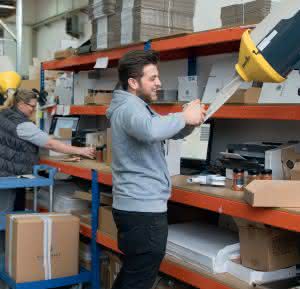
The dynamically growing company Ankerkraut from Hamburg has also convinced itself of this. The spice manufacturer with its self-developed product blends became known throughout Germany last year on the TV show "Die Höhle der Löwen" and now sends out over 500 packages a day.
"With our corporate philosophy, we stand for quality and sustainability and do not use any colorants, preservatives or flavor enhancers in our products, for example," says Stefan Lemcke, Managing Director and founder of Ankerkraut. "So it's only logical that we also pay attention to the environment when it comes to packaging and shipping." Ankerkraut sends its parcels CO2-neutrally and protects the products by using recycled paper with the Blue Angel from Sprick. Initially, the paper was dispensed directly at the packing station from the SpeedMan Box, Sprick's entry-level product for smaller numbers of parcels. "As we grew, we needed an even more ergonomic system," says Jennifer Hellermann, Buyer and Product Manager at Ankerkraut, pointing to the yellow paper dispensers, which are attached to the packing tables with a swivel arm. "The SpeedMan Classic is mounted above the cartons so that the paper is dispensed directly into the carton." This creates a particularly large volume, which corresponds to around seventy times the original material. "We were a little skeptical at first, but are now very satisfied with the resulting increase in productivity," says Hellermann. In terms of the environment, the SpeedMan Classic also works completely without electricity.
Paper and machine from a single source
Sprick, a packaging company specializing in recycled paper, has been headquartered in Bielefeld for over 130 years. Sprick now produces and processes environmentally friendly paper at a total of five production sites throughout Germany. The owner-managed family business also develops and builds machines for customers' packaging applications. It also offers its customers customized and individually designed solutions. The system provider's long-standing customers include companies from various sectors such as the automotive industry, mechanical engineering and the online and mail order business. The systems will be presented this year at the transport logistic trade fair in Munich (Hall B5, Stand 127).Contact: Sprick GmbH & Co. 33607 Bielefeld Phone: +49 5 21 / 93 20 50 E-mail: [email protected] www.papier-sprick.de
Oliver Schmidt, sales manager responsible for filling and padding systems at Sprick, explains the secret of the products' success: "Generally speaking, recycled paper based on 100 percent waste paper and without strengthening additives has very short fibers and is therefore a challenge for any packaging machine. However, thanks to our in-house manufacturing and development capacities - both in paper production and in mechanical engineering - we have been able to develop very reliable and virtually maintenance-free systems for every requirement. The customer therefore receives an environmentally friendly product from a single source that optimizes the packaging process and is guaranteed to work."


You might also be interested in
e2open bonded warehouse solution for several European countries
e2open, a provider of networked supply chain platforms, has expanded its customs warehouse management in Europe. Companies that import goods to Europe now have the option of using various customs warehouse programs.
 read more...
New start-up aims to facilitate access to robotics
Pssbl.Robotics, a start-up founded jointly by Schubert and Weiss, aims to simplify the introduction of robotics in mechanical and plant engineering.
read more...Test shipment with RoRo Car Carrier via Bremerhaven
Last August, the RoRo Car Carrier MV Cosco Shengshi moored in the northern port of Bremerhaven and started its first test shipment in order to expand the service to Europe.
read more...Rhenus grows at sea and on the road
At the northern tip of Lower Saxony, the logistics service provider is preparing for the growing import of cars via Cuxhaven; in Nuremberg, Rhenus is building a new logistics center next to the existing high-bay warehouse; in Dietzenbach, Hesse, the...
read more...Hermann Grewer celebrates his 80th birthday
Hermann Grewer, Honorary Chairman of the North Rhine-Westphalia Transport and Logistics Association (VVWL) and Honorary President of the German Road Haulage, Logistics and Disposal Association (BGL), celebrated his 80th birthday on June 6.
read more...Group7 expands corporate headquarters
The logistics service provider is planning 60,000 square meters of service and logistics center and an administration building with 5,000 square meters of floor space near Munich Airport.
read more...Cross-channel logistics: overcoming hurdles after Brexit
Hardly any other event has presented European road freight transport with such enormous challenges as Brexit. But there are solutions.
read more...Transport Logistic 2023
After a four-year break with a virtual interlude in 2021, Transport Logistic will return to the Munich exhibition grounds from May 9 to 12, 2023.
read more...Focus on internationalization
L.I.T. will be represented twice at Transport Logistic. The Brake-based logistics service provider's service portfolio ranges from warehousing and transportation using various modes of transport to contract logistics and comprehensive value-added...
read more...