
From materialfluss 10/2019
Productivity more than doubled
For the expansion of its European distribution center, pet supplier Fressnapf relies on a sustainable system concept and the intralogistics expertise of SSI Schaefer. With the integrated automation solution, Fressnapf has more than doubled its capacities, dynamics and productivity in order processing.
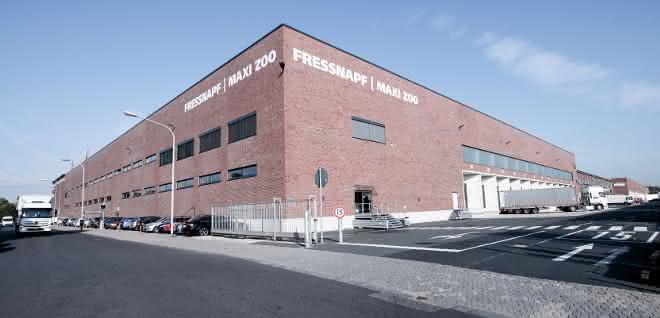
When it comes to the well-being of pets, Fressnapf is the first port of call. The Krefeld-based company is Europe's number one in pet supplies. It offers around 13,000 items ranging from pet food, accessories, care products and toys to cat litter and bird houses. The products are sold throughout Europe via more than 1,500 bricks-and-mortar stores, including over 900 in Germany, as well as via the online store set up in 2009. In total, more than 12,000 people work for the group of companies. 800 of them are responsible for the professional handling of the Europe-wide logistics and supply chain.
Increasing automation in the distribution center
In addition to an import warehouse in Duisburg Logport, two regional warehouses in southern Germany and a warehouse in the east of Germany set up exclusively to serve the e-commerce channel, the European Distribution Center (EDC) at the company's Krefeld site, which was established in 2000 and has been continuously expanded, takes center stage. "The tasks have grown continuously in recent years with the supply of the downstream warehouse locations, layout-based picking for delivery to the stores and the growing range of articles," explains Christian Buschmann, Head of Inbound Logistics & Technology at Fressnapf. "Around 10,000 different items are now stored in our EDC. With this in mind, we began the latest expansion and automation project for the logistics center in 2013 in order to increase capacity and efficiency in order processing."
Intelligently linked systems
The intralogistics specialists from SSI Schaefer were awarded the contract as general contractor for the material flow, system concept and equipment of a complete 13,000 square meter system complex with a ten-aisle narrow-aisle pallet warehouse, a three-aisle automated small parts warehouse (AS/RS) for replenishment and a four-aisle order picking AS/RS along with pallet and container conveyor technology, 38 processing stations, twelve of which are in the setup area and 26 in the order picking area, and 60,000 containers. "The solution concept with the intelligently linked systems for merging and buffering the multi-stage order picking optimally implemented the task, taking into account structural data, growth targets, process efficiency and expansion options, and ensures us maximum availability," says Buschmann, explaining the award of the contract following the ideas competition and tender. "We were not disappointed with the result: with 100,000 packages per day, we have significantly increased our productivity after commissioning the new warehouse complex and more than doubled our output with the same working time."
Optimum processes, especially for small parts
In mid-2017, SSI Schaefer handed over a system for largely automated logistics processes with store-specific picking and provision. The focus: increasing capacity and efficiency, especially in the small parts segment. "Small parts are stocked exclusively in Krefeld and make up around 50 percent of the product range in stock," says Buschmann, referring to Fressnapf's article structure: "It is not very homogeneous, consisting in the non-food segment, for example, of accessories such as leashes, toys or nestable food bowls. In the food segment, our product range also includes snacks and special food in various variants and container sizes." Accordingly, SSI Schaefer's system concept was tailored to optimum storage and efficient picking processes for both bagged goods and small parts. "Where it makes economic sense, we have automated the processes to reduce the workload on our employees," says Buschmann. "SSI Schaefer's concept with the different picking areas for different order requirements is ideally designed for the varying turnover rates of the diversified range of items in our EDC."
Complex processes holistically embedded
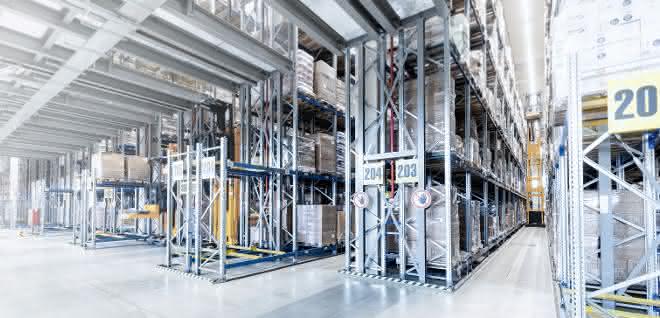
SSI Schaefer set up a multi-user warehouse complex directly connected to the existing warehouse area using conveyor technology. "At the same time, the complex processes were embedded in a holistic material flow," explains Matthias Häußler, project manager at SSI Schaefer. For example, the incoming goods area was built over with a two-storey steel platform construction. On level zero, the incoming goods delivered on pallets are processed, recorded and transferred to storage in accordance with the warehouse management system (WMS). After collection, forklift trucks first take the incoming goods to a ten-aisle manual narrow-aisle warehouse. There, 5,840 pallet spaces are set up for temporary storage. It is used to replenish the AKL and to provide full pallets. A racking system with around 300 pallet spaces has also been set up for the direct supply of promotional goods.
Forklifts transfer the pallets
For the automated processes for preparing the pallets at the setup workstations, forklifts transfer the pallets to the pallet conveyor system on the lower level of the goods-in platform. It guides the pallets on the platform construction above the incoming goods area to two transfer carriages. These operate transfer trolleys, which in turn load 24 lifters. These load and unload the twelve depalletizing stations set up on the upper level of the goods-in platform, with each workstation being operated by two lifters. The packs are separated at the depalletizing stations. The stations are equipped with a three-level conveyor system for this purpose: Empty containers are fed in on the middle level and the target containers are removed on the lower level. A belt conveyor on the top level is used to dispose of old cartons. The conveyor system finally transports the target containers with the separated articles or packs to the miniload or directly to the eight Schäfer Carousel Systems (SCS) for picking.
AKL divided into functional areas
The AKL is divided into two storage blocks according to functional areas: Three aisles with just under 35,000 container storage locations serve as a supply warehouse. The four aisles of the order picking miniload are supplied from here, where more than 22,300 container storage locations are installed for the fast-moving items. A total of seven Schäfer Miniload Crane (SMC) storage and retrieval machines are used for storage and retrieval. Picking stations with flow channels are installed in the aisles of the order picking miniload on the lowest level, which are loaded directly from the back of the miniload. The stations are divided into individual stations and equipped with a pick-by-light system (PBL). "This subdivision enables picking with short walking distances," explains project manager Häußler. An automatic carton erector provides the cartons, which each receive a routing label on two sides at the start of the order.
The target cartons with the labels are transferred to the circulating conveyor system via a vertical conveyor. Integrated scanning technology interacts with the WMS to ensure that the cartons stop at the stations responsible for order picking. There, the pick faces of the PBL system inform the employees about the access compartment and the number of items to be picked. Once the removal has been acknowledged, the conveyor line takes the cartons to the next station. Finally, after picking, the shipping cartons are removed, sealed by an automatic carton sealer to reduce their volume and, after a weight check, labeled with the parcel label by an applicator. The conveyor system then transports the cartons directly to the roller conveyors in the shipping area or to one of the two shipping SCSs specially designed for handling cartons for interim storage. If required, the shipping cartons from the different picking areas are brought together and temporarily stored there.
System can also be used for e-commerce
In addition to the order picking DCS, Fressnapf has more than 10,000 additional storage locations for medium to slow-moving items in eight other order picking SCSs. These are spread over two floors and each level is equipped with one pick-to-tote workstation (PTT) for dynamic picking processes. Here, the source containers are delivered to the employees in sequence and up to seven orders are picked directly into the shipping cartons in parallel. Once picking is complete, the shipping cartons are also automatically removed, sealed to reduce volume and labeled with the parcel label. As an option, the system can also be used for e-commerce and offers, among other things, the possibility of discharging shipping cartons directly after completion at one of the six CEP workstations provided for this purpose via a spiral conveyor directly onto the specially designed gravity roller conveyor in the outgoing goods area. The conveyor system transports order items for store delivery to a downstream consolidation buffer for order consolidation. This has more than 8,700 storage locations for short-term interim storage and provision for palletizing according to route and store. At the same time, the order cartons can be discharged directly onto the 50 dispatch lanes in the outgoing goods area for manual palletizing. This is where the orders are consolidated with the palletized large-volume items from the other storage areas.
More efficiency, productivity and customer service
"The system from SSI Schaefer ensures the required availability and a high cycle rate for order picking," summarizes Fressnapf Logistics Manager Christian Buschmann. "As a result, we have significantly increased efficiency, productivity and customer service and have been able to sustainably improve our cost structure with features such as volume-optimized shipping. We are particularly pleased that the ergonomically designed workstations have made the working environment much more comfortable for our employees."
The logistics service provider SSI Schaefer
The SSI Schaefer Group is a solution provider of modular storage and logistics systems. The company employs around 10,500 people at its international headquarters in Neunkirchen, as well as in around 70 operating companies worldwide and at more than eight production sites in Germany and abroad. Spread across six continents, SSI Schaefer develops concepts and solutions for its customers' industries. The company plans, designs and produces systems for setting up warehouses, factories, workshops and offices, manual and automatic storage, conveying, picking and sorting systems as well as solutions for waste technology and recycling. SSI Schaefer has developed into one of the largest providers of release-ready software for internal material flow. More than 1,100 IT experts develop high-performance applications. The software portfolio with Wamas and SAP covers all processes from warehouse to material flow management. At the same time, SSI Schaefer optimizes the productivity and work performance of its customers with its own solutions and also creates the opportunity to actively manage the warehouse by measuring and evaluating with the help of KPIs.


You might also be interested in
Winner material flow PRODUCTS OF THE YEAR 2023
Conductix-Wampfler: ChargeLine 0865
Two-pole conductor rail segments for efficient opportunity charging of shuttles, suitable for thousands of cycles per day.
 read more...
Hermann Grewer celebrates his 80th birthday
Hermann Grewer, Honorary Chairman of the North Rhine-Westphalia Transport and Logistics Association (VVWL) and Honorary President of the German Road Haulage, Logistics and Disposal Association (BGL), celebrated his 80th birthday on June 6.
read more...Well chilled for sure
V-Zug Kühltechnik AG, developer and manufacturer of refrigeration appliances and part of the successful V-Zug Group, has set up a new production facility for refrigerators of all heights and dimensions at its Swiss site in Sulgen.
read more...Advantageous automation of small parts warehouses
The RSX1 shuttle system will be at the center of Rocketsolution's presence at this year's Logimat trade fair.
read more...Reduced energy requirements in the high-bay warehouse
One of Germany's leading premium car manufacturers is already focusing on energy efficiency in the production of its new SUV model with electric drive. The storage and retrieval machines in a high-bay warehouse at the production site have been...
read more...Low lift pallet truck for light duty applications
Clark has launched a new low lift pallet truck with the model designation LWio15 for light transport tasks. The truck has a load capacity of 1500 kg and is suitable for short distances in goods distribution, production or warehousing.
read more...Internationalization as an opportunity
E-commerce is in a state of flux. Changes in purchasing behavior and procurement problems are keeping e-commerce retailers busy. Logistics plays a decisive role in the overall online shopping experience.
read more...Fulfillment Center for Frisco.pl
Polish eGrocery specialist and TGW deepen partnership
TGW is building a highly automated fulfillment center for Frisco.pl in the Polish capital Warsaw. This is the second project in a row that the two companies have implemented together.
read more...Which world will it be in 2023?
Michael Schreckenberg teaches at the University of Duisburg-Essen as Professor of Physics of Transport and Traffic. Once a year, he addresses the readers of materialfluss, formerly LT-manager, with a critical and humorous expert article on transport...
read more...