
Warehouse-/Picking technology
More productive sawing and automation
Automation and robotics are rapidly gaining ground in metal processing - including in sawing technology. Robot-supported systems are taking over more and more work steps after the sawing process - from removing the cut-off pieces to deburring, weighing, centring and marking, right through to sorting and stacking on pallets or in containers.
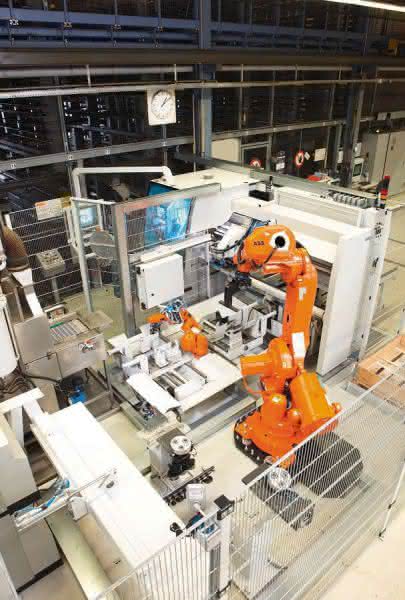
Whether in the steel trade, the automotive and supplier industry or in mechanical and plant engineering: metal processing companies across all sectors have been facing increasing demands for years. Customers expect ever greater production flexibility, from batch size one to large series. The variety of materials and dimensions is constantly increasing, while quality requirements and cost pressure are growing at the same time. In order to survive in global competition in the long term, solutions are therefore required that can implement different production tasks variably and efficiently.
Wide range of options for using robots
As a central component of metal processing, sawing technology offers great potential for optimization. More and more users are relying on intelligently networking individual workflows relating to the sawing process and automating them with robot support. The advantages are obvious: industrial robots work quickly, reliably and precisely - 24 hours a day if necessary and without human intervention. They don't get tired or sick, and they are also extremely versatile with the right tools. "We can now not only carry out various handling and transport tasks, but also numerous processing steps efficiently with the help of robots," explains Volker Bühler, Group Manager TB Robotics at sawing and storage technology specialist Kasto.
Automation starts with the material feed: With the help of suitable conveyor technology, for example roller conveyors or magazines, the raw material to be sawn is fed into the machine. This avoids laborious lifting and carrying and reduces the risk of injury to employees. The sawing process itself also runs unmanned if the machine is equipped accordingly - supported by an automatic material feed and an intelligent machine control system that automatically sets all parameters such as cut-off length or cutting speed based on the job data. Modern production saws can therefore complete different jobs with different materials and diameters one after the other and work autonomously.
Removing, processing, stacking - all automatically
Industrial robots offer further great potential when it comes to handling and further processing the finished sections. For example, they can remove the sawn parts from the machine so that this recurring work step is no longer necessary for employees. The robots can also be used with the appropriate tools to deburr, chamfer, mark, center or measure the workpieces. The sections can be weighed, sorted by size or order and stacked on pallets or in containers. Seamless transfer to an automated guided vehicle system (AGV) is also possible. "For complex processes with different work steps, we also use combinations of several robots and clamping devices," explains Kasto expert Bühler.
For volume saws that only produce a few different component geometries, downstream processes can be automated relatively easily. The situation is somewhat different for individualized contract saws, which have to flexibly process numerous materials and dimensions: "The greater the variety, the more challenging it is to fully cover it," notes Bühler. For example, the optimal selection of robot tools is important. The robot should be able to handle all objects with as few tools as possible. This reduces acquisition costs, shortens non-productive times and increases productivity. Users can choose from mechanical, magnetic or vacuum-operated grippers. These should also be as compact as possible.
Sawing technology on the way to Industry 4.0
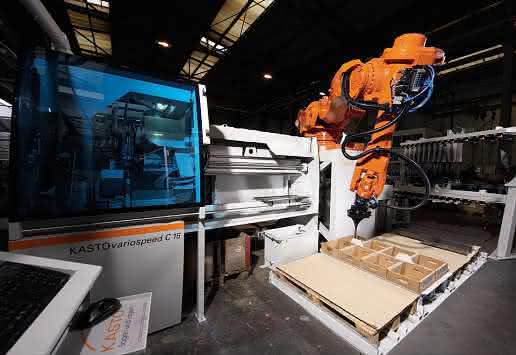
With the right components, sawing, automation and robot technology can be combined to create complex and highly integrated systems that are seamlessly integrated into a continuous material flow. This includes not only the subsequent handling and processing steps, but also the upstream storage: Kasto, for example, implements combined storage-sawing systems for its customers, in which all storage, handling, sawing, marking, palletizing and bundling processes run fully automatically, from the storage of the raw material to the picking of the sections. The control software can be connected to existing ERP systems such as SAP, which further increases transparency and efficiency. The sawing systems can be interlinked with other production machines, for example for turning or milling, to create a digitalized and automated production system that organizes itself independently - in line with Industry 4.0.
The automation of sawing technology offers clear advantages for the user: They can significantly increase their productivity with less manpower, as many processes not only run unmanned, but also much faster. It is easier to compensate for employee absences due to illness, and the robot-supported sawing system simply continues to work even during breaks or after the end of a shift. The result is lower personnel costs and a high degree of flexibility in terms of capacity utilization. For example, companies can process order peaks much better and drastically reduce non-productive times. This also has a rapid economic impact: "We have calculated that the purchase of an industrial robot for our Kastovariospeed production circular saw, for example, pays for itself in less than a year, depending on the shift model," reports Volker Bühler. "Assuming that such a system is in use for more than ten years on average, users can reduce their operating costs in the long term and sustainably."
Users and customers benefit in equal measure
Robot technology also improves working conditions: employees are relieved of heavy, tiring and monotonous tasks and the risk of accidents and injuries is reduced. In addition, the quality of the sawn sections is higher, as the robot processes all parts evenly and precisely, sorts them and stacks them.


You might also be interested in
Standardized in design, flexible in use
Automated guided vehicles are increasingly in demand in production and logistics as they automate processes efficiently - but in addition to the vehicle, the right peripherals are also crucial for safe operation. A new solution consisting of a...
 read more...
Outdoor AGV networks production and logistics
An international company in the plastics industry is automating its intralogistics at its German site with a solution from ek robotics. A specially developed vehicle model from the Out Move series, an outdoor AGV, is being used.
read more...Transport systems for automated material flow
The Leo transporters from Bito make it easier for users to get started with the automation of material processes, which is possible from 20,000 euros. The system is a flexible all-in-one complete solution that is ready for immediate use and can be...
read more...Automated logistics for the university hospital
As part of the new construction of the University Hospital of Reims (CHU), France, the hospital has taken a number of steps to improve the needs of its patients and the working environment of its employees.
read more...K.Hartwall: Topping-out ceremony for the German site
The topping-out wreath was raised at the new building in the TIP Innovationspark Nordheide in Buchholz near Hamburg on February 27: The new K.Hartwall plant will comprise approx. 3,500 m² of hall space and around 2,000 m² of office and social areas.
read more...Noerpel Group tests driverless high lift trucks
The Noerpel Group has tested driverless pallet trucks in one of its two logistics facilities in Giengen. During a four-week trial, two autonomous systems were used to transport goods within the warehouse.
read more...Supply and disposal of printing machines by AGV
Numerous companies rely on AGVs in intralogistics to increase efficiency and meet challenges such as the shortage of skilled workers. One such company is GGP Media GmbH in Pößneck, Thuringia.
read more...Sophisticated automation: AGV and cobot combined
On behalf of Krefeld-based Saurer Technologies, the engineering team from Project Automation & Consulting developed a solution for production logistics that combines AGVs and cobots.
read more..."Herbie" robot in the Körber portfolio
Carrybots, a specialist in mobile robotics, is a new partner in the Körber supply chain ecosystem. The aim of this collaboration is to strengthen the position of both companies in intralogistics. Herbie" enables robot-based goods-to-person processes.
read more...