Warehouse-/Picking technology
Fit for the future of the main plant
Last year, Jungheinrich produced more than 100,000 trucks worldwide for the first time. In order to expand production capacities accordingly, manufacture flexibly and deliver faster, the company has started to implement the enhanced Jungheinrich Production System (JPS) in all plants. A look at the Moosburg main plant, which was modernized and restructured in 2016, shows the changes.
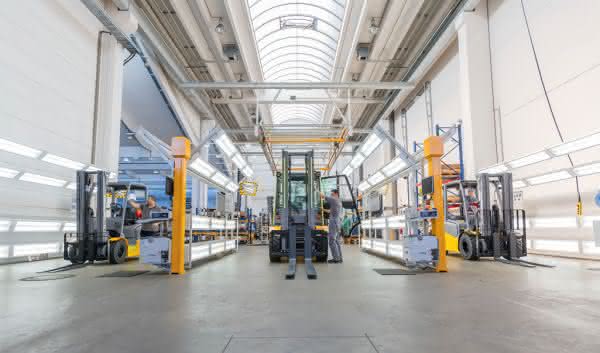
Demand for efficient material handling equipment tailored to individual customer needs continues to rise. In order to benefit from this growth and further increases in incoming orders in the future, Jungheinrich is continuously investing in the expansion of its truck portfolio, the expansion of manufacturing and the modernization of production facilities as well as the optimization of production and logistics processes. The most recent example is the successful modernization of production at the Moosburg plant, which was completed in 2016. This included a surface coating system for powder coating the chassis, a wet painting system for the counterweights and an AGV production line for assembly.
In order to achieve its production targets for 2020, the Group has also set up a JPS academy and model factory. Here, the goals, principles and methods of the JPS are made visible and tangible with the help of a complex simulation. Jungheinrich relies exclusively on its own lean experts as internal trainers to convey the content of the JPS in on-site training sessions. The practical content of the JPS Academy should lead to a sustainable understanding of JPS among managers and employees and sharpen the common understanding of process optimization," emphasizes Oliver Schacht, Head of Lean Management at Jungheinrich AG. In addition, all employees have access to training materials, checklists, forms and other documents via the intranet.
Principles of the Jungheinrich production system
The JPS is developed jointly by the plants and the central Production System department and tailored to Jungheinrich's specific needs. As part of the "Moosburg 2018" project, the contents of the JPS have already been taken into account in the replanning process.
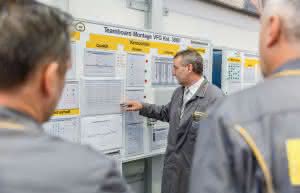
The zero-defect principle follows the guiding principle: "Highest quality is generated in the process and not achieved through testing". With this principle, Jungheinrich strives to keep the error rate in production and assembly as low as possible. Appropriate measures to achieve this are implemented as part of store floor management, for example through the consistent use of the team board: Here, the team manages countermeasures from key figure deviations in up to 15 minutes a day in order to solve problems in a structured and sustainable manner. The traditional quality inspector, who checks the quality of the products on the assembly line, no longer exists in Moosburg. "We don't check quality, we produce it," emphasizes VFG line manager Jörg Schröder.
"We don't test quality, we produce it"Jörg Schröder VFG line manager at Jungheinrich
Flexibility is another principle of JPS. The guiding principle here is: "Maximum flexibility of systems, work organization and suppliers to meet customer requirements." In order to be able to react flexibly to orders on the four assembly lines and produce all variants of counterbalance trucks, new logistics systems are used in Moosburg. This is achieved, among other things, through the consistent optimization of processes and the intelligent balancing of a mixed-model line. Even vehicle variants that require up to 50 percent more assembly time can be assembled in synchronized flow production.
First we sell and then we plan
With the pull principle, Jungheinrich follows the guiding principle: "Only produce what the customer wants". This means that as soon as a truck goes into production planning, it has already been sold to the end customer. The principle is not limited to final assembly, but goes all the way back to prefabrication: The mast, frame, steering axles or counterweights are only manufactured once an order for a vehicle has been placed.
In contrast to previous processes, the pull principle avoids the build-up of unnecessary buffers. As a result, less work in progress is generated and ultimately less capital is tied up and storage capacity is conserved. The "OnePieceFlow" principle is implemented consistently.
"Added value is created in a continuous flow" is the guiding principle of the flow principle. To this end, the material flow in Moosburg was completely restructured with the use of automated guided vehicles (AGVs) in assembly. The individual vehicles are WLAN-controlled via a central master computer and can be permanently localized using automatic reporting points via the SAP system. There are plans to expand the system: in future, customers will also be able to see where their product is in the production process.
The cycle principle is about bringing all areas involved at a production site - from incoming goods to dispatch - into a cycle, following the guiding principle: "The cycle of the entire plant enables a continuous process flow". Finally, the Kaizen principle is based on the guiding principle: "Be creative and continuously develop the standardized processes." This principle is implemented at Jungheinrich through a continuous improvement process (CIP) in which the employees are involved. Optimization workshops, which are used to implement major improvement projects, muda checks (identifying and eliminating waste in any form) and TPM (optimizing the interaction between production and maintenance) are further tools used in Moosburg. The hardware has also been changed: Every employee now has access to the SAP system at their workstation via a terminal, e.g. to assembly drawings or assembly instructions. At the same time, they can enter quality notifications directly in SAP. Together with a consistent training and further education program for employees, this was changed as part of the JPS.
Intensive use of the JPS
The result of using the JPS can be seen directly when touring the prefabrication of the frames and lifting frames as well as the assembly: a clear factory structure with defined main axes, structured material flows and optimized logistics and production processes.
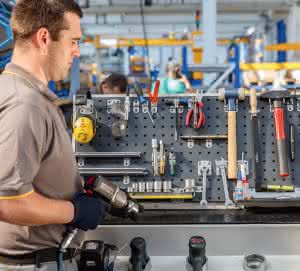
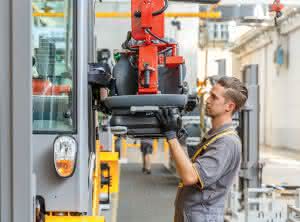
The continuous cycle-guided assembly takes place on AGV conveyors according to the Methods-Time-Measurement (MTM) standard. Each workstation has been designed in accordance with JPS principles and contains only the tools and materials required for this assembly step. In addition, every workstation has been designed with ergonomics in mind: Anti-fatigue mats, special work tables, manipulators or torque supports are designed to relieve the strain on employees. "By using the JPS, the individual assembly steps have been made even more ergonomic and efficient; for example, height-adjustable AGVs, manipulators and torque supports make working in production easier," praises master craftsman Christian Faltlhauser.
Production is supplied by a tugger train system from Jungheinrich, which is loaded from a logistics center for the EFG series and one for the VFG series on the factory premises. The main components and widely varying parts are delivered to the assembly line just-in-sequence.
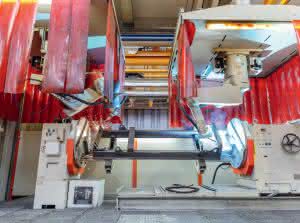
VFG forklifts are essentially assembled on two lines: Converter (hydrodynamic drive) and Hydrostat, each with three series ranging from 1.6 to 5.0 tons load capacity. The forklifts are automatically transported on driverless transport vehicles through the approximately 500 meter long production line. An integrated lift table raises the chassis to an ergonomic working height. The throughput time of a VFG in assembly is around 12 hours. The lift mast is manufactured and powder-coated in advance, the counterweight is painted and the frame is welded and painted. After assembly, each vehicle is placed on a test stand and undergoes a final inspection. All data recorded here is also stored in SAP and linked to the vehicle number and order data. This ensures continuous documentation of the entire production process, including the final inspection for each vehicle.
In the subsequent final assembly stage, components such as forks, load guards, fork extensions, doors, side panels, rear covers or floor panels are fitted and all type and information plates are attached. Special customer-specific equipment requirements are implemented at extra workstations by our own Cust department. These include, for example, camera systems, terminals, special attachments for different industries or special designs with heat or dust protection devices. "The increasing number of variants increases the complexity of production. By modernizing our production and introducing the JPS, we have been able to further increase our efficiency and productivity in counterbalance truck production," explains VFG Line Manager Jörg Schröder. His colleague Marek Scheithauer, Head of Product Management VFG at Jungheinrich Moosburg AG & Co. KG, adds: "The Jungheinrich production system creates the conditions to flexibly and quickly manufacture customized counterbalanced trucks of the highest quality and thus further expand Jungheinrich's competitiveness."
Jungheinrich
Jungheinrich AG, founded in 1953, is one of the world's leading intralogistics companies. With a coordinated portfolio of material handling equipment, logistics systems and services, Jungheinrich offers its customers comprehensive solutions from a single source. Headquartered in Hamburg, Germany, the Group is represented by its own direct sales companies in 36 countries and by partner companies in a further 70 countries. Jungheinrich employs over 14,700 people worldwide and generated annual sales of €2.75 billion in 2015. The Jungheinrich share is listed on the MDAX.
Securing the location in the long term
In summer 2016, the Moosburg plant celebrated a historic success in a unique anniversary: the production of the 50,000th IC engine-powered counterbalanced truck and the 50,000th electric engine-powered counterbalanced truck of the 2nd generation of the 2/3 series. "The investments made and the continued success of our EFG & VFG truck series secure the production site of the Moosburg main plant and thus the approximately 1,000 jobs in the long term," emphasizes Jörg Schröder.
"Even after the "Moosburg 2018" project has been completed, further elements of the JPS that are still under development need to be implemented. It is now important to incorporate the Kaizen principle into our daily work. Employees can further improve processes in team dialogues and optimization workshops," explains Steffen Zaune, Head of TP Production System at Jungheinrich. "The aim is to sharpen the common understanding of all employees - from management level to skilled workers - for process optimization in order to constantly work on maintaining and expanding the company's competitiveness.


You might also be interested in
Standardized in design, flexible in use
Automated guided vehicles are increasingly in demand in production and logistics as they automate processes efficiently - but in addition to the vehicle, the right peripherals are also crucial for safe operation. A new solution consisting of a...
 read more...
Outdoor AGV networks production and logistics
An international company in the plastics industry is automating its intralogistics at its German site with a solution from ek robotics. A specially developed vehicle model from the Out Move series, an outdoor AGV, is being used.
read more...Transport systems for automated material flow
The Leo transporters from Bito make it easier for users to get started with the automation of material processes, which is possible from 20,000 euros. The system is a flexible all-in-one complete solution that is ready for immediate use and can be...
read more...Automated logistics for the university hospital
As part of the new construction of the University Hospital of Reims (CHU), France, the hospital has taken a number of steps to improve the needs of its patients and the working environment of its employees.
read more...K.Hartwall: Topping-out ceremony for the German site
The topping-out wreath was raised at the new building in the TIP Innovationspark Nordheide in Buchholz near Hamburg on February 27: The new K.Hartwall plant will comprise approx. 3,500 m² of hall space and around 2,000 m² of office and social areas.
read more...Noerpel Group tests driverless high lift trucks
The Noerpel Group has tested driverless pallet trucks in one of its two logistics facilities in Giengen. During a four-week trial, two autonomous systems were used to transport goods within the warehouse.
read more...Supply and disposal of printing machines by AGV
Numerous companies rely on AGVs in intralogistics to increase efficiency and meet challenges such as the shortage of skilled workers. One such company is GGP Media GmbH in Pößneck, Thuringia.
read more...Sophisticated automation: AGV and cobot combined
On behalf of Krefeld-based Saurer Technologies, the engineering team from Project Automation & Consulting developed a solution for production logistics that combines AGVs and cobots.
read more..."Herbie" robot in the Körber portfolio
Carrybots, a specialist in mobile robotics, is a new partner in the Körber supply chain ecosystem. The aim of this collaboration is to strengthen the position of both companies in intralogistics. Herbie" enables robot-based goods-to-person processes.
read more...