

Warehouse-/Picking technology
Fast, safe and efficient loading thanks to Safety Jack
Many managers are aware of the need for safety measures in the loading zone. However, trucks are still not adequately secured before loading and unloading - against rolling away, tipping over or excessive deflection. Three "small" measures with the help of a wedge and Safety Jack can help.
Safety measures do not always have to be "big" measures, such as the introduction of automatic loading or an all-integrating docking station. In day-to-day business, the smaller elements that can contribute to greater safety in the loading zone are also crucial. They too can be significantly improved.
Against rolling away
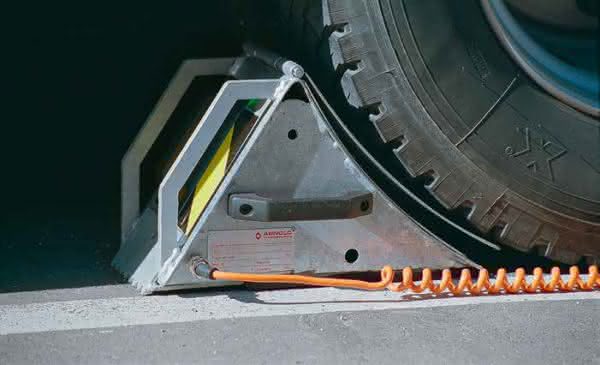
The need for safety measures to prevent trucks from rolling away during loading or unloading has long been a high priority for most responsible parties. However, if implemented in accordance with the regulations - i.e. the truck driver secures the truck and the loader then checks it - this is time-consuming and error-prone without technical support. This process can be supported with monitored wheel chocks such as the Arnold electric chock. This is either wired or uses radio sensors to check whether the wedge has been activated before loading begins. This means that the loader can always see the status from the door via an indicator light without having to go outside.
Against tipping over
The risk of tipping is still too rarely taken into account. As a result, there are still numerous loading situations in which a forklift truck is used to drive onto parked semi-trailers and nothing is done to prevent the risk of tipping. The employers' liability insurance associations stipulate that securing must be implemented in the event of dangerous forces in the longitudinal direction, as the resulting accidents are at least as dangerous as those caused by a truck rolling away.
With the so-called safety jacks, a wide range of solutions have long been available to solve this task quickly and easily. Positioned at the front, they support the trailer to prevent it from tipping over. They can simply be moved manually on rollers and can therefore be used by any trained person without any additional aids.
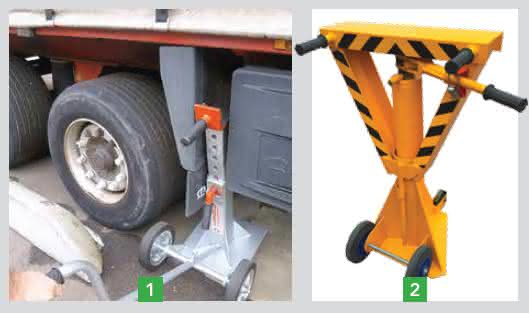
While all models prevent the semi-trailer from tipping over, they usually differ in their design. Inexpensive solutions are usually painted and only equipped with a simple spindle. If longevity is important, a galvanized version should be chosen instead, as they do not immediately start to rust if the paint is damaged. The wider the support chosen, the more the trailer can be prevented from swaying sideways.
Against the spring deflection
The canopies of older loading systems are often too low for the increasingly high trucks. When a forklift truck drives in, they go deep into the often very soft suspension and then bounce particularly high when the forklift truck leaves - and depending on the design, both the vehicle and the canopy are damaged. In many places, the deeper deflection also leads to the problem that the loading bridge cannot bridge as low as the truck deflects. This creates a prohibited tripping hazard between the truck and the bridge. To prevent this, there are aids for the lateral rear support - these safety jacks are pushed laterally under the side members of the vehicle using a long handle and prevent the truck from deflecting too much.
All these measures help to avoid expensive investments and at the same time significantly increase safety during loading.
Dr.-Ing. Annette Arnold


You might also be interested in
Compact motorized castor for pallets and heavy loads
Rulmeca has launched a new motorized roller onto the market. The EPS-AS1 roller motorizes roller conveyors for heavy loads of up to 1,500 kilograms.
 read more...
Torwegge presents new Eco transport trolley
Torwegge has added a new eco transport trolley to its product portfolio. The trolley was developed to facilitate the transportation of heavy loads of up to 250 kilograms in various sectors such as the food industry, retail, catering, healthcare and...
read more...New transport trolley at Logimat
Fetra is also coming to Logimat. The manufacturer of transport equipment for efficient intralogistics processes will be presenting new products and program highlights. Wuppi" will also be there: The aluminum compact trolley is a powerful helper on...
read more...AR Racking equips new Lekkerland logistics centers
The German company, which specializes in consumer goods to go, recently opened two new warehouses in Germany, one in Kerpen and one in Wedemark, which have a storage capacity for 57,459 pallets.
read more...Paper manufacturer with innovative production logistics
Paper manufacturer Franz Veit has made its intralogistics operations much more efficient with the help of Linde Material Handling and Ernst Müller Fördertechnik.
read more...AR Racking equips new Lekkerland logistics centers
Lekkerland is reorganizing its logistics in Germany by 2030 to make it fit for the opportunities and challenges in out-of-home consumption today and tomorrow. As part of this, the storage solutions specialist has supported AR Racking in the opening...
read more...Automated intralogistics system
AMI Förder- und Lagertechnik exhibited an automated intralogistics system at Logimat that covers the entire packaging process right through to shipping.
read more...High-performance electric floor track
Transport system for small load carriers and pallets
Where efficiency and high availability are important, electrically driven floor conveyors are often an alternative to continuous conveyors.
read more...Satellite warehouse turns 40
Westfalia Logistics Solutions celebrated the 40th anniversary of the Satellit load handling device at Logimat. The system is designed for storage on pallets, other loading aids or without pallets.
read more...