

Delegation visit
Ports in Latvia and the Hamburg region strengthen cooperation
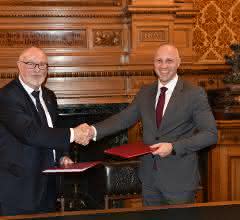
A delegation of the most important transport and logistics companies from Latvia, led by the State Secretary of the Latvian Ministry of Transport Kaspars Ozoliņš, visited the ports of Hamburg and Lübeck last week. As part of the visit program, which included the most important stops in the Port of Hamburg, a meeting was also held with the State Councillor of the Ministry of Economy, Transport and Innovation, Dr. Torsten Sevecke, in Hamburg City Hall. During this meeting, Kaspars Ozoliņš signed a Memorandum of Understanding (MoU) on Thursday together with Ingo Egloff, CEO of Hafen Hamburg Marketing e.V. (HHM). Both sides want to strengthen and expand cooperation between the Latvian ports of Riga, Ventspils and Liepaja and the ports of the Hamburg Metropolitan Region.
In the agreement, the partners agreed to
- a more intensive exchange of information and experience
- the joint conception and implementation of international cooperation projects and
- further cooperation in the development of intermodal transport services between Europe and Asia.
"Latvia and Germany are already partners, but there is always room for better and stronger cooperation with key regions and economic sectors. We are very pleased to give the go-ahead for a close partnership with Germany's largest seaport," said State Secretary Kaspars Ozoliņš. Ingo Egloff added: "Trade and shipping have linked Hamburg and Latvia since the Hanseatic League. Today, it is all the more important to join forces in order to demonstrate a strong alliance on a global level."
The Baltic region is a very attractive market region for northern European ports, where there is strong competition for cargo and traffic. At the interface to global overseas traffic, Hamburg acts as a central hub for the Baltic region. The good transport connections to the Port of Lübeck also offer optimal solutions for trailer and ferry traffic for transport chains to and from Latvia. Both port locations would like to further expand their existing good relations with Latvia.
Following joint events in Latvia - in Riga in 2016 and Liepaja in 2018 - Marina Basso Michael, Head of Market Development Baltic Sea Region/Eastern Europe at HHM, welcomed a Latvian delegation to Hamburg for the first time. "Mutual visits lead to more exchange between existing and potential trading partners. Latvian and German companies and ports benefit equally from this," says Basso Michael.
Seaborne container throughput between the Port of Hamburg and Latvia reached a total of 100,175 TEU (20-foot standard containers) in 2018. The three Latvian ports of Riga, Ventspils and Liepāja handled a total of 66 million tons in 2018, making them the market leader in the Baltic region. A total of four liner services connect the Port of Hamburg with the largest Latvian port of Riga. However, the Port of Lübeck is also considered an important hub for goods flows between Germany and Latvia thanks to its ferry connection to Liepāja via Stena Line. "Latvia, and Liepāja in particular, is a strategically important partner for us for transportation to the Baltic states and Russia. We have ambitious plans to further strengthen the Lübeck - Liepāja axis," says Sebastian Jürgens, Managing Director of Lübecker Hafen-Gesellschaft.
The participants in the 15-strong delegation were also interested in the rail infrastructure during their visit to Hamburg and Lübeck. In addition to its well-equipped Baltic Sea ports, Latvia also has an excellent rail system. Bulk and general cargo handled in the port is transported to and from the seaport hinterland by rail. The EU project "North Sea Baltic Connector of Regions" (NSB Core), which will be implemented by April 2019, also deals with this topic. Port of Hamburg Marketing has been a partner in this international project since 2016 and, together with Latvian partners and others, is investigating the possibilities of multimodal connections between the Baltic countries and the European rail core network. One of the main objectives of the project is to develop new business potential through the integration of Rail Baltica into the European rail system. A follow-up application to the project, called CoReX, was submitted in January 2019. This project, on which the German and Latvian partners want to work together, aims to link Rail Baltica to the Belt and Road Initiative (BRI) and develop supporting measures to open up new business areas for the partners involved.


You might also be interested in
Karsten Dirks becomes operational managing director
As of today, the 53-year-old will take over the operational management of BLG AutoTerminal Bremerhaven. In future, he will be responsible for the site together with Commercial Managing Director Jan Bellendorf.
 read more...
Port of Hamburg suffers from loss of Russian business
The difficult economic development of the global economy is affecting the handling figures of the Port of Hamburg. As in other ports in Northern Europe, seaborne cargo throughput in Hamburg is declining, although individual trade lanes are...
read more...Kiel seaport receives connection to Verona via Hanover/Lehrte
In rail freight transport, Kiel's seaport is gaining additional capacity and faster connections. Since the beginning of September, five new train pairs have been running weekly from Kiel to Verona in northern Italy via the Lehrte mega hub.
read more...First direct train from China reaches JadeWeserPort Wilhelmshaven
On July 13, the first direct train from the Chinese city of Hefei in Anhui province arrived at the JadeWeserPort Wilhelmshaven freight village. The train departed from Hefei on 25 June with a volume of around 100 TEU, mainly household appliances,...
read more...Normalization expected in late spring
Port of Kiel can almost maintain cargo throughput at 6.92 million tons
A total of 6.92 million tons of freight crossed the quayside at Kiel's seaport in 2020. This corresponds to only a slight decrease of 1.2 % compared to the same period last year.
read more...New shipping service gives breakbulk a boost in Rotterdam
In contrast to the neighboring seaports, the port of Rotterdam recorded growth in the volume of bulk goods in 2019.
read more...Covid-19 task force: Port of Antwerp works 100 percent
A Covid-19 task force met at the port of Antwerp for the first time on March 20. One thing is certain: the port of Antwerp remains 100 percent operational.
read more...Hamburger Hafen und Logistik AG
HHLA CEO: Stable operations at the port guaranteed
The supply of the population and companies with goods via the terminal facilities of Hamburger Hafen und Logistik AG (HHLA) is ensured regardless of the measures taken to protect against the spread of the coronavirus, says the head of HHLA.
read more...Container traffic between the Czech Republic and the Port of Hamburg develops positively
Every year, around three million tons of goods are transported to and from the Czech Republic via the port of Hamburg.
read more...