

Power supply/motors/drives
Tsubaki Kabelschlepp lets it roll
Roller-supported systems are gaining ground in the field of cable carriers for large crane systems. With its Roller Supported Chain, Tsubaki Kabelschlepp GmbH has developed a system that is tailored to high-performance applications. Whether modern crane systems for industry or seaport container gantry cranes - in the field of mobile automation for applications with long travel distances or high friction, the principle of "rolling instead of gliding" has been established for several years. For areas of application such as large crane construction, where gliding systems reach their technical limits, the roller bearing energy supply system offers numerous advantages and has proven to be the optimum solution.
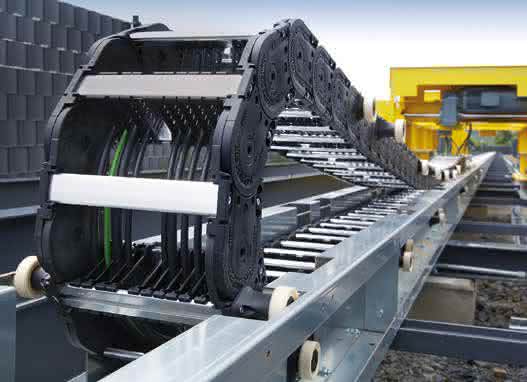
With its Roller Supported Chains (RSC), Tsubaki Kabelschlepp GmbH from Wenden-Gerlingen has now produced the next evolutionary stage of this type of cable carrier. The supplier of cable carrier systems made of different materials and in all sizes has established itself as a specialist for complex projects. "Special customer requests, many hundreds of implemented solutions for a wide range of industries with individual requirements and our precise analysis of existing products on the market have led to the development of this new generation of roller-supported cable carriers with numerous optimizations," explains Peter Sebastian Pütz, Key Account Manager Business Development at Tsubaki Kabelschlepp.
Challenge: Long travel distances and maximum load
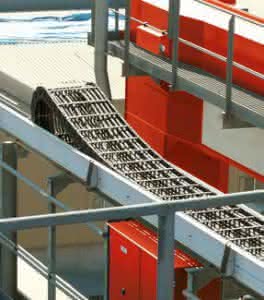
In particular, the strong demand from the crane systems sector with long travel distances challenged the company's engineers. This is because ever higher cycles and travel speeds had to be taken into account. In both the port and the steelworks, unrestricted availability of the crane system is a must, even under maximum load, as unexpected downtimes are associated with high costs. An important prerequisite for safe, trouble-free crane operation is a cable carrier system that can keep up with these increasing demands. "Conventional solutions have not always proved sufficient for these applications. System components are required here that can withstand the loads to the same extent as the overall system itself. In these cases in particular, the roller bearing cable carrier has proven to be a safe, reliable and cost-saving solution," emphasizes the expert.
With the RSC solution, the upper run does not slide on the lower run, but runs on ball-bearing mounted, maintenance-free rollers. These are mounted on the side of the cable carrier. The rollers are mounted to the chain conveyor at a defined distance using plastic brackets and run on the guide rail. Ball bearings and a polyurethane roller surface ensure quiet, low-vibration operation. The fully rolling system has proven itself in practical use with numerous advantages: For example, there is no wear on the sliding surfaces. Considerably less drive power is required for travel distances of more than 50 meters. The tensile and thrust forces are reduced by up to 90 percent compared to gliding arrangements. This minimizes the stress on energy chain components and cables. Another advantage: thanks to the special design, the guide profile of the system can be mounted independently of the specified support distances. Compared to the usual fixed support distances of two meters, the RSC system saves on connection points and therefore the steel construction for the mounting brackets.
Tested to market maturity
Tsubaki Kabelschlepp subjects all systems and components to extensive testing. All necessary short and long-term tests are carried out in the company's own test laboratory. The company has set up its own outdoor test facility to test use under real conditions: On two fully automatic and independently usable outdoor test tracks with travel lengths of more than 100 meters, realistic test series can be carried out at speeds of up to five meters per second - around the clock, seven days a week with specially programmed crane cycles and under real weather conditions. "Every cable carrier, every cable is subjected to the most stringent series of tests before release," emphasizes Key Account Manager Pütz.
Maintenance has also been simplified: all components of the RSC system are easily accessible. The rollers and the modular side parts are easy to reach thanks to recesses in the channel. This means that the rollers can be inspected without having to lift the chain. Worn rollers can be replaced individually during maintenance. "Time-consuming and cost-intensive replacement of the entire cable carrier is therefore no longer necessary. Overall, the low-wear and easily accessible design means significant savings in time and maintenance and repair costs for our customers. Retrofitting is also quick and easy," explains Peter Pütz.
Projects that "step out of line"
The company is constantly confronted with special requests that are not part of its day-to-day business. "One of the most unusual challenges that we have successfully mastered was an offshore crane ship, where the crane's rotary motion was solved using a steel energy chain. The entire system had a mass of 14 tons. Another showcase project is the conversion of a container gantry crane in a German port, where we had to take difficult assembly conditions into account," describes Peter Pütz.
Contact:Tsubaki Kabelschlepp GmbH 57482 Wenden-Gerlingen Tel.: 0 27 62 / 40 03-0 E-Mail:[email protected] www.kabelschlepp.de


You might also be interested in
Compact motorized castor for pallets and heavy loads
Rulmeca has launched a new motorized roller onto the market. The EPS-AS1 roller motorizes roller conveyors for heavy loads of up to 1,500 kilograms.
 read more...
Torwegge presents new Eco transport trolley
Torwegge has added a new eco transport trolley to its product portfolio. The trolley was developed to facilitate the transportation of heavy loads of up to 250 kilograms in various sectors such as the food industry, retail, catering, healthcare and...
read more...New transport trolley at Logimat
Fetra is also coming to Logimat. The manufacturer of transport equipment for efficient intralogistics processes will be presenting new products and program highlights. Wuppi" will also be there: The aluminum compact trolley is a powerful helper on...
read more...AR Racking equips new Lekkerland logistics centers
The German company, which specializes in consumer goods to go, recently opened two new warehouses in Germany, one in Kerpen and one in Wedemark, which have a storage capacity for 57,459 pallets.
read more...Paper manufacturer with innovative production logistics
Paper manufacturer Franz Veit has made its intralogistics operations much more efficient with the help of Linde Material Handling and Ernst Müller Fördertechnik.
read more...AR Racking equips new Lekkerland logistics centers
Lekkerland is reorganizing its logistics in Germany by 2030 to make it fit for the opportunities and challenges in out-of-home consumption today and tomorrow. As part of this, the storage solutions specialist has supported AR Racking in the opening...
read more...Automated intralogistics system
AMI Förder- und Lagertechnik exhibited an automated intralogistics system at Logimat that covers the entire packaging process right through to shipping.
read more...High-performance electric floor track
Transport system for small load carriers and pallets
Where efficiency and high availability are important, electrically driven floor conveyors are often an alternative to continuous conveyors.
read more...Satellite warehouse turns 40
Westfalia Logistics Solutions celebrated the 40th anniversary of the Satellit load handling device at Logimat. The system is designed for storage on pallets, other loading aids or without pallets.
read more...