

Power supply/motors/drives
Energy-efficient over long distances
Whether it's a crane system in a harbor or raw material extraction in a copper mine - energy chains that reliably protect cables even under difficult conditions are in demand, especially over long distances. Large masses are moved, which means that high drive forces are required. However, these can be significantly reduced by using special design principles for both the e-chain and the cables.
Saving energy is not only a major issue when it comes to your own household, but also one of the most important issues in plant engineering - especially where long travel distances have to be covered. Energy consumption is increasingly becoming a factor in the decision to purchase or operate a system. Energy chains can make a significant contribution to reducing the drive energy required and thus to increasing energy efficiency. Conventional energy chains are generally operated smoothly. However, on long travel distances and with high dynamics, the roller energy chain corresponds to the current state of the art, as the energy chain has to apply less force when rolling, as the rolling friction coefficient is lower than the sliding friction coefficient. This makes this energy supply system particularly energy-efficient over long distances: compared to gliding e-chains, the drive power required to move the energy chain is reduced by 57 percent. In addition to the roller e-chain based on the E2/000 energy supply system from igus, the motion plastics specialist also offers a heavy-duty version for extreme requirements and the P4 system for very long travel distances. With the help of different roller types and internal divisions, the roller chains from igus can be adapted to the respective application. What they all have in common are low-maintenance plastic rollers optimized for friction and wear, which ensure that the cable carriers roll instead of glide.
Smooth running thanks to the rolling principle
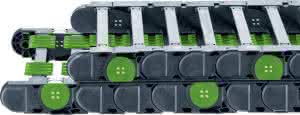
With the P4 roller e-chain, igus has once again refined the design of the roller principle: the rollers of the upper strand run offset through those of the lower strand and not on top of each other as in previous roller chains. This is achieved by installing not one, but two rollers in a chain link. This means that the pair of rollers on the upper strand glides past those on the lower strand. As a result, the rollers run smoothly on a continuous running surface over the entire travel distance. The offset running is supported by comb-like Autoglide bars. In addition, guide troughs - made of corrosion-resistant stainless steel or aluminum, depending on the series - keep the roller chain securely in the track. As the plastic rollers are firmly anchored in the chain links, they cannot get lost. They have a stainless steel ball bearing and are made of tribologically optimized plastic, making them particularly durable. In order to ensure a long service life of the energy chain even when in contact with the guide trough, lateral wear inserts are integrated into the chain links.
"Conductor cables made from special CCA material reduce the weight. This saves drive energy and reduces energy consumption." Rainer Rössel,Head of the chainflex cables division at igus
40 percent less weight
At the same time, it is also worth taking a look at the cables used to save drive energy. In order to meet the increased demands for lower energy consumption, igus has developed the new CF430.D and CF440 motor cable generation for use in energy chains. These shielded and unshielded single cores offer a weight reduction of up to 40 percent compared to the previous generation and over 50 percent compared to the rubber cables commonly used on the market for festoon or chain applications in long travel distances. Depending on the travel distance, cable and cross-section requirements, a weight reduction of several tons is possible.
"This weight reduction is made possible by using a conductor cable made of special CCA material," explains Rainer Rössel, Head of the chainflex cables division at igus. "The cable core made of lightweight aluminum is coated with copper to create what is known as copper-clad aluminum." The combination of both metals offers a number of advantages. Compared to solid copper cables, CCA cables benefit on the one hand from the lower density and therefore lower weight of the aluminum. On the other hand, they offer the great advantage over a pure aluminum conductor that the cross-contact is ensured by the copper coating, which means that the conductor no longer needs to be pretreated before crimping compared to a pure aluminum conductor. In addition, the copper layer massively increases the durability of the entire conductor cable with an optimized strand and strand structure for continuous bending in the energy chain. igus has further improved the stranding process and the insulation sheath material for its CCA lightweights for use in energy chains.


You might also be interested in
Compact motorized castor for pallets and heavy loads
Rulmeca has launched a new motorized roller onto the market. The EPS-AS1 roller motorizes roller conveyors for heavy loads of up to 1,500 kilograms.
 read more...
Torwegge presents new Eco transport trolley
Torwegge has added a new eco transport trolley to its product portfolio. The trolley was developed to facilitate the transportation of heavy loads of up to 250 kilograms in various sectors such as the food industry, retail, catering, healthcare and...
read more...New transport trolley at Logimat
Fetra is also coming to Logimat. The manufacturer of transport equipment for efficient intralogistics processes will be presenting new products and program highlights. Wuppi" will also be there: The aluminum compact trolley is a powerful helper on...
read more...AR Racking equips new Lekkerland logistics centers
The German company, which specializes in consumer goods to go, recently opened two new warehouses in Germany, one in Kerpen and one in Wedemark, which have a storage capacity for 57,459 pallets.
read more...Paper manufacturer with innovative production logistics
Paper manufacturer Franz Veit has made its intralogistics operations much more efficient with the help of Linde Material Handling and Ernst Müller Fördertechnik.
read more...AR Racking equips new Lekkerland logistics centers
Lekkerland is reorganizing its logistics in Germany by 2030 to make it fit for the opportunities and challenges in out-of-home consumption today and tomorrow. As part of this, the storage solutions specialist has supported AR Racking in the opening...
read more...Automated intralogistics system
AMI Förder- und Lagertechnik exhibited an automated intralogistics system at Logimat that covers the entire packaging process right through to shipping.
read more...High-performance electric floor track
Transport system for small load carriers and pallets
Where efficiency and high availability are important, electrically driven floor conveyors are often an alternative to continuous conveyors.
read more...Satellite warehouse turns 40
Westfalia Logistics Solutions celebrated the 40th anniversary of the Satellit load handling device at Logimat. The system is designed for storage on pallets, other loading aids or without pallets.
read more...