

Interview with port manager Andreas Bullwinkel
JadeWeserPort: Long out of the starting blocks
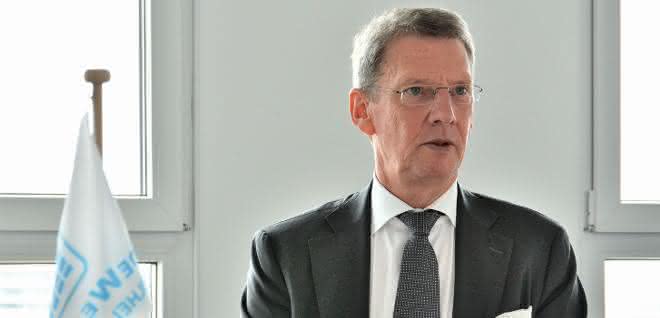
Andreas Bullwinkel has been Managing Director of Container Terminal Wilhelmshaven JadeWeserPort-Marketing GmbH & Co. KG for five years. The port has grown since its opening. Planned and already realized settlements suggest a bright future. In the interview, Bullwinkel also addressed the topics of federalism and transport policy.
LT-manager: How would you describe the status of the JadeWeserPort at the moment? Is the project already up and running?
Andreas Bullwinkel: I still see us as being a bit in the start-up phase, but we are just getting out of the starting blocks and will pick up speed. I am referring to the terminal side, where we have always seen double-digit growth in recent years and for which the operator Eurogate cannot be congratulated often enough. This helps us considerably on the landside, where we want to market a freight center. When the terminal is busy, we have good arguments for companies that want to set up here. Our anchor tenant Nordfrost is currently expanding rapidly, and an online retailer, AE Trade Online, has also moved here. And, of course, the Volkswagen Group's relocation, which is currently under construction. This in turn has triggered further inquiries, which we cannot talk about at the moment. Hopefully, we will be able to announce something at the beginning of the year. First of all, however, we are waiting for Eurogate to succeed in getting another service (editor's note: a route that a shipping company regularly uses and on which JadeWeserPort is regularly called at) here once Volkswagen and Audi are finished with the packaging center. Preferably for North China, for which Volkswagen will primarily pack SKD and CKD shipments. But even without this aspect, I am very confident that we will see more companies settling here in 2019.
LTM : How much cargo does Volkswagen handle?
Bullwinkel: Volkswagen once put the figure at 12,000 containers per year, which go to 15 overseas countries. 1,000 TEU more per month is a figure that doesn't sound like much at first, but it is definitely interesting for some shipping companies.
LTM : That sounds like a domino effect.
Bullwinkel: Yes. Perhaps it will also be possible to use the power of this account to open up further trade lanes. However, we are not the decision-maker here, but the beneficiary who can help with the subsequent development.
LTM : Will the port grow in 2018
grow as it did from 2017 to 2018?
Bullwinkel: The figures we have seen so far suggest that we will be able to achieve double-digit growth again. But cargo shifts can occur quickly, for better or for worse. Realistically, we have to admit that we are starting from modest figures and that double-digit growth is relatively easy to achieve. We are realists, but we are still pleased and see this as proof that we have done more right than wrong.
LTM: And then at some point
million in front of the decimal point ...
Bullwinkel: Yes, but unfortunately it won't happen as quickly as the port's founding fathers had imagined. You can't seriously evaluate a port over two or three years, a project like this is intended to last 100 years. Other large ports such as Rotterdam or Antwerp have taken a very long time to reach their current size. In addition, there are already large and established ports around us today and we are trying to get our foot in the door, so to speak. In a market that is no longer growing strongly, but is a displacement market.
LTM : So what needs to be done?
Bullwinkel: We can play with the three major assets we have here. On the water side, the almost unlimited water depth for the large container ships. On the land side, the excellent hinterland connection with highway and rail and the ready-to-build settlement areas directly at the port. You don't have to wait for permits, you make an inquiry and after six months we have negotiated the contract. We work with these arguments.
LTM : Have there been any moments in recent years when you doubted that JadeWeserPort would get off the ground?
Bullwinkel: Never any doubts. It was just a question of how long it would take. And I sometimes had doubts as to whether we would be able to take these steps in the first five years. When we received the Ocean Alliance with a service here in April 2017, it was clear to me that we would be able to take a recognizable step forward. Not only for us here, but also recognizably for critical observers from outside. Then came the Volkswagen settlement. There were also sobering times; in 2014 we handled 67,000 TEU. I started here in October 2013 and the question of how to get out of the slump was asked quite often. 2015 then saw a bigger jump. This also has to do with the fact that we managed to pacify the somewhat tense relationship between the parties involved. Holger Banik (Managing Director of JadeWeserPort Realisierungs GmbH & Co. KG, which is responsible for construction, maintenance and administration at the port as well as the design of the port tariffs, editor's note) and I have roots in Bremen, which made a lot of things easier. It can only work together and we are now on this path.
LTM : Are you pleased that a positive development has now taken place?
Bullwinkel: Yes. I want to use the time to be able to publish further success stories with the team. We are confident and because we are so confident, we are now also connecting the freight center directly to the railroad. The presentation group and the CT terminal already existed, but there was no direct rail access to the freight center. We are now realizing this and hope to be finished by the end of the year. Trains will then be able to drive directly onto the sites and be loaded and unloaded there.
LTM: How much will it cost?
Bullwinkel: The investment volume is around 1.5 million euros. The siding is another signal to customers: We are ready.
LTM : Speaking for the coming months: What measures do you want to take to put JWP ahead of the competition? What can you do beyond "wait and see"?
Bullwinkel: We are touring the hubs in Germany and presenting the port. We also do this in China. As a further measure, we have also had an employee in India since the beginning of the year who is permanently working the market there. We have already held roadshows in India and will do so again. In the medium term, I also hope that Indian investors will be interested in the freight village here. We will be doing the same in Korea in the future; we have a service that is starting up in Korea. There is a cooperation with a company in Korea that is working the market for us. We have to promote the "Wilhelmshaven" brand - and I deliberately don't say JadeWeserPort here, because the port has to be learned first. So that at some point "Wilhelmshaven" becomes a household name worldwide. Only when shipowners are approached about Wilhelmshaven will they deal with us. You really have to pick up almost every business partner individually and repeat the message over and over again. That is pure door-to-door canvassing and real hard work.
LTM : Is there a glimmer of a move away from the
the JadeWeserPort brand to Port of Wilhelmshaven?
Bullwinkel: The name Wilhelmshaven works better abroad. The names of the ports are working names, as are the names of the terminals. Only those who work with them know them. In Germany you can use the name JadeWeserPort, abroad Wilhelmshaven is easier.
LTM : Do you have the feeling that JadeWeserPort is being looked at more closely, i.e. more critically, than the major ports?
Bullwinkel: Yes, I have that feeling. If there is a problem in a large port and an inland vessel has to wait 100 hours, it is dismissed as a coincidence. Once we are moving five million TEU, many things will go much more smoothly.
LTM: Let's talk about the future - are there already plans to expand the port?
Bullwinkel: No, there is a feasibility study that was published in 2016. The politicians in Hanover are monitoring developments and are ready to act if the market shows a need for action. We currently have a capacity utilization rate of 20 percent. If we quickly move in the direction of one or 1.5 million TEU, I am sure that the signal will be heard. The capacity here reaches up to 2.7, maximum 3.3 million TEU, so there is still plenty of room.
LTM : How much do you feel perceived by
Berlin's politicians?
Bullwinkel: I don't have the feeling that Berlin knows how big the challenges are for the German seaport transport industry. Take the construction site situation - we all ask ourselves why the construction sites around the ports can't be better coordinated. There are so many issues that politicians need to tackle. Take rail transport. Cross-border rail traffic from Germany to the western ports may be subsidized, but if you want to bring the container from the same customer to the German ports, it is not subsidized.
LTM : Is it different abroad?
Bullwinkel: At least that's my perception. But we very much hope that if we can complete a major project for Germany's only deep-water port, the German Chancellor will do us the honor of attending such an event. The coast deserves more attention.
LTM : Has the Federal Government's Maritime Coordinator, Norbert Brackmann, introduced himself since he was appointed in April?
Bullwinkel: No, he hasn't been here yet.
LTM : Or the Minister of Transport?
Bullwinkel: No, not him either. Which is a great pity. Ports cost money, perhaps politicians are worried that they will be confronted with demands straight away. I promise not to demand anything (laughs), just to present the port.
LTM : Do you also need a "caretaker" for the work with the shipowners?
Bullwinkel: Of course I would prefer the 2M and Ocean Alliance alliances to add Central America, South America or South Africa as destinations alongside the Far East and China. Simply because things are going well with us. But it's not that simple. That's why you need an expert to look after you. We have one in the form of the operator Eurogate. The shipping company still says "ship follows cargo", this old paradigm is still intact. But I guess that will change. There are still more than 20 ULCVs (Ultra Large Container Vessels, i.e. ships that can transport more than 12,000 containers, editor's note) on the order books that are yet to be delivered. CMA CGM has equipped its 22,000 TEU ships for LNG. Unfortunately, we do not yet have a bunkering station here. Before a decision is made on the location of a bunkering station, the concepts should be checked for their future viability and efficiency.
LTM : Does federalism stand in the way of a uniform strategy for sea and inland ports?
Bullwinkel: The federal states clearly have different interests. We are still of the opinion that it would be good for all locations to join forces in order to successfully counter the very strong competition in the western ports.
LTM: Can you outline a common approach or describe what this should look like?
Bullwinkel: From our point of view, it would be desirable if there were joint marketing measures abroad under the umbrella term German Ports, as we are already successfully implementing in part with our colleagues from Bremen. We could also imagine implementing joint rail concepts for better connections between the three major container ports in Germany or, on the political side, working together to quickly reduce fiscal taxation, which is equally disadvantageous for all ports. These are things where we believe that by joining forces we could achieve common goals much better and faster.
LTM : How many people does the port now employ?
Bullwinkel: There was nothing here before, there was a dog beach where the port is now. Eurogate now has 600 employees on its payroll, Nordfrost 200 and Volkswagen will create 350 jobs. We currently have around 1,000 jobs that didn't exist before. That is the added value for which investments were made in the port. And not because we just wanted a port as an end in itself.
LTM: Thank you very much for the interview, Mr. Bullwinkel.
Martin Schrüfer spoke to Andreas Bullwinkel; the interview took place at JadeWeserPort in the Pacific One service center within sight of the quay. During the interview, the container ship Seaspan Rio de Janeiro, on Maersk's WAF6 service, called at JaderWeserPort, coming from Bremerhaven and bound for Rotterdam.
Andreas Bullwinkel has been Managing Director of Container Terminal Wilhelmshaven JadeWeserPort-Marketing GmbH & Co. KG since October 1, 2013. Born in Bremen, the 61-year-old began his career with an apprenticeship as a businessman in the shipping and shipbroking industry. He later studied industrial engineering at Bremerhaven University of Applied Sciences. He gained extensive professional experience while working for various shipbrokers in Bremen. For almost ten years, Bullwinkel was Managing Director of Seaports of Niedersachsen GmbH and thus responsible for marketing the ports of Lower Saxony before taking on his current role. He is also a member of the "Ports and Shipping" steering committee of the German Transport Forum.


You might also be interested in
HGK Shipping and Salzgitter cooperate
The companies want to jointly promote and expand sustainable logistics concepts on the waterway in future. Two Salzgitter subsidiaries and HGK Shipping signed a memorandum of understanding to this end on August 10.
 read more...
Settlement projects - done right
How do logistics managers find the right location for a logistics property and how should its sustainability be assessed? Fred-Markus Bohne from Panattoni in conversation with Martin Schrüfer.
read more...The call for innovation rings out
Demand for space in the logistics real estate sector has been increasing for years, with drivers such as e-commerce, the coronavirus pandemic and the expansion of regional stockpiling structures fueling demand.
read more...Port Representative Office: Karin Lengenfelder replaces Jürgen Behrens
After almost 48 years, Jürgen Behrens, Head of the Port of Hamburg Representative Office South, is retiring from logistics.
read more...5G test field planned in the port of Duisburg
With the joint project "5G.Logport Duisburg", duisport, the City of Duisburg and the University of Duisburg-Essen are applying for funding from the state of North Rhine-Westphalia to set up a 5G test field in the Port of Duisburg.
read more...AI supports ports with car handling
With 2.1 million vehicles in 2019, AutoTerminal Bremerhaven is one of the largest car ports in the world. With Isabella 2.0, the partners BIBA - Bremen Institute for Production and Logistics at the University of Bremen, BLG Logistics and...
read more...Testing at JadeWeserPort Wilhelmshaven
Fully automatic shunting locomotives are coming
Recently, the JadeWeserPort companies' application for funding for a research project to test the fully automated shunting process in the screening group in the freight village (GVZ) of Germany's only deep-water container port, JadeWeserPort...
read more...3D crane simulator in the Port of Duisburg
The duisport Group has unveiled its own crane simulator in Duisburg's free port: This is not only intended to set new standards in the field of technical development in the logistics industry, but the inland port is also investing in the training...
read more...NRW Minister President Laschet visits the port of Rotterdam
Rotterdam, 04.10.2017 - Armin Laschet, who was elected Minister President of North Rhine-Westphalia at the end of June this year, visited the port of Rotterdam on his first trip abroad. The CDU politician went on a tour of the...
read more...