

Logistics service providers
Energy consumption always in view
Hellmann has a long tradition of environmental and energy-conscious action. The family-run logistics service provider with headquarters in Osnabrück committed itself early on to thinking about future generations and introduced an environmental management system back in 1996. Even then, the recording and monitoring of energy consumption was an issue that has now been taken a step further with the introduction of a systematic energy management system.
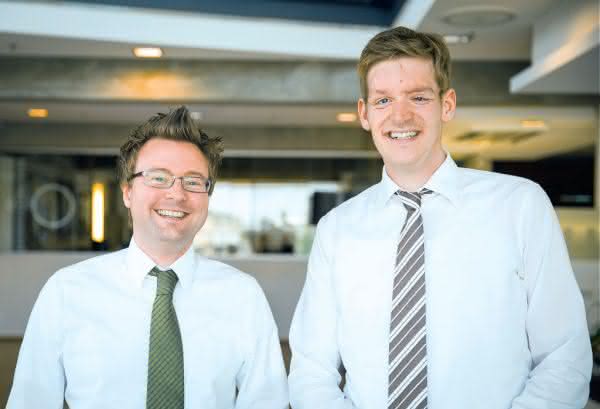
With the aim of continuously monitoring the energy data, the search began for a suitable platform, which was identified internally in the finance department in Controlling. "Basically, all the processes for data entry and processing were already established here. We just had to have the corresponding masks and units created," explains Daniel Hülemeyer, who is jointly responsible for energy management in the QHSE team at Hellmann. "We were therefore able to quickly focus on the necessary training and communication packages." In line with the basic idea of energy management, the training sessions took place via web conference, so that no additional consumption was caused by traveling. "It was important to us that we approached the topic authentically and set an example in the team," adds QHSE colleague Tobias Jüchter, who was the first to switch to an electric car in the company car pool.

Intra says: Energetically great!
We leave lip service and showcase projects to the politicians, we logisticians tackle problems and solve them in a verifiable and sustainable way. The ISO certification gives Hellmann a competitive advantage in the long term, which will pay for the effort. Hellmann's concept is clearly recognizable, consistently implemented, energetically excellent and knows only winners: employees, customers - and the environment.
Initial experience shows that the reference to the figures used still caused difficulties. "Everyone can imagine from their private environment whether a fuel consumption of 6 l/100 km is a lot or a little. But assessing the electricity consumption of 25,000 kWh per month for a transshipment warehouse is a rather abstract figure to begin with," explains Hülemeyer. "And so initially there were also some input errors in the 1,000 range, for example because incorrect readings were taken. However, this has now stabilized thanks to continuous monitoring and reworking."
Information on the energy sources is recorded
- Diesel fuel
- Gasoline fuel
- Natural gas
- Heating oil
- Electricity
As well as the reference values
- Storage space
- Office space
- Number of employees
A benchmarking system is then used to process and compare the data entered in the form of key figures. This reveals the potential for savings measures, which, however, must still be examined individually in the next step. "Contract logistics in particular, with different storage facilities such as cold storage cells, make it impossible to simply use the key figures and you have to familiarize yourself with the site conditions," explains Jüchter. "This is easier for the majority of office locations for air and sea freight. Here, 95% of our office space is rented and we use a standardized IT infrastructure, which is our primary energy driver. An "outlier", which may have been caused by incorrect billing by the energy supplier, can be identified very easily." In general, however, these locations play a subordinate role in the overall assessment and have been grouped together in a low-priority energy cluster.
In addition to the ongoing switch to LED lighting, the most effective measure currently in place at Hellmann is the replacement of old heating systems. For example, natural gas consumption in a contract logistics warehouse was reduced by around 25% by switching to modern boilers with intelligent controls. Other locations then move up the "priority list" and modernization is systematically examined in this way.
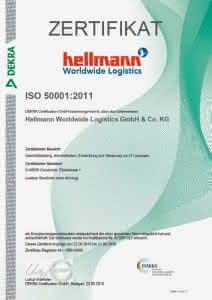
The concept also impressed the Dekra auditors, who approved the issue of an ISO 50001 certificate. Jüchter sums up: "For us, this is important proof of compliance with the requirements of the Energy Services Act and also great feedback on the work we have done."


You might also be interested in
Major project in the Korean retail sector
Knapp builds Korea's largest shuttle system
Together with Knapp and Doosan Logistics Solutions, Asung Daiso is building a new highly automated omnichannel logistics center in Yangju, South Korea. The facility is the largest shuttle system ever built by Knapp in South Korea.
 read more...
Jungheinrich implements automation for...
Fully automated large warehouse launched in Páty
Gebrüder Weiss has put an automated warehouse into operation in Hungary, largely replacing manual processes. The new logistics center near Budapest increases efficiency, capacity and sustainability and at the same time responds to increasing demands...
read more...Highly automated in all product ranges
Richard Kearns knows how his supply chain and his new warehouse in Hernando (Mississippi, USA) are doing because he receives feedback every day.
read more...Hellmann expands cross-border e-commerce
Hellmann is strengthening its e-commerce business with the cross-border product "near", relying on the expertise of Jan Bierewirtz.
read more...Returns logistics: automated, sustainable and future-oriented
Returns have become an integral part of e-commerce - and continue to pose one of the biggest logistical challenges, particularly in the fashion segment. High volumes, short processing times, complex quality requirements and increasing customer...
read more...New CFO at Dachser
Thomas Hiemer has been Chief Financial Officer (CFO) at logistics service provider Dachser since January 1, 2025. As a member of the Executive Board, he is responsible for Finance, Controlling, Tax & Treasury (FCT).
read more...Geis takes over Gras Group
On January 1, 2025, the Geis Group will acquire all shares in the Gras Group, headquartered in Neuwied near Koblenz. This strengthens the company's presence in economically important regions of Germany and expands its role in the IDS Group.
read more...Distribo 3.0: Sustainable and open to technology
With the Distribo 3.0 logistics hall, the transport and logistics service provider Zufall Logistics Group aims to set a new benchmark for sustainable logistics properties. Planned in 2021 under the aspects of process reliability, technological...
read more...Nagel-Group strengthens presence in Poland
Nagel-Group, a European food logistics company, is expanding its infrastructure in Poland: In Zabrze, an industrial city in the heart of Silesia, a modern service and logistics complex will be put into operation from the second half of 2025.
read more...