

Logistics service providers
BLG develops smart containers
BLG Logistics, together with Bosch, the Bremen Institute for Production and Logistics (BIBA), GS1 Germany and queo, has come out on top in a technology competition organized by the German Federal Ministry for Economic Affairs and Energy with a digital lighthouse project for the automotive industry: The "SaSCh" project is part of the "Paice" funding program.

The "SaSCh" project - an acronym for "Digital Services for the Design of Agile Supply Chains" - aims to provide important impetus for the digitalization of the economy. The project focuses on the development of a cyber-physical system that digitally records the quality data of car parts in the supply chain. The project was officially launched in November. On average, a car consists of around 10,000 individual parts. A high percentage of these components are procured externally. The production of a vehicle is therefore based on a complex supply chain in which a large number of suppliers and logistics service providers are involved. "This high level of complexity places enormous demands on quality management," explains Jakub Piotrowski, Director Business Development Contract at the BLG Logistics Group. The company has many years of experience in automotive parts logistics and offers its customers from the automotive industry individual solutions: from the procurement of packaging materials to the precise sequencing of production supplies and the handling of plant logistics, including module assembly.
"Taken as a whole, our planned measures ensure that high-quality products are delivered to the point of consumption on time, in full and economically."Jakub Piotrowski, Director Business Development Contract, BLG Logistics Group
Jakub Piotrowski emphasizes: "High product quality is not dependent on one company alone, but on the successful interaction of all partners along the supply chain." The basis for this is, on the one hand, a cross-company exchange of information. Secondly, the data collected must be prepared in a way that is understandable for users. This is where the SaSCh research project comes in: Through the consistent use of sensors, the quality and condition of the components moving in the supply chain are to be better assured. Stationary and mobile sensor solutions will help to record quality-relevant data. "In the spirit of the Internet of Things, we are developing smart containers that make the transportation of goods even more transparent," says Jakub Piotrowski. The aim is to create a lean and robust supply chain for the automotive industry without special transports, reworking, production downtimes or recalls. However, other industries can also benefit from the results of the project.
Use case for the automotive industry
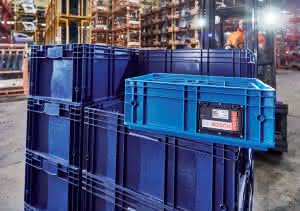
This is the first time that a project has created and validated the technical and methodological requirements for a cross-company exchange of sensor and quality data and used this data in digital services in combination with the existing options for exchanging tracking and tracing data. SaSCh, which is designed for a period of 36 months, initially comprises five sub-projects, which also reflect the respective competencies of the partners in the project consortium. BLG Logistics is focusing on and working on logistics issues: What must digital services and business models look like so that end-to-end monitoring of quantities and qualities is possible within logistics? Together with Bosch, the BLG Industrial Logistics division will also test the solution approach as part of a simplified use case from the automotive industry. GS1 Germany will ensure the standardization of the processes. BIBA is responsible for scientific exploitation and provides support with its innovations for 3D condition monitoring and autonomous planning and control.
The research and development project is funded by the BMWi and supervised by the "Information Technologies/Electromobility" project management organization at the German Aerospace Center.
In order to make digital services simple and intuitive for people to use, queo contributes its experience in designing intuitive user interfaces. In complex situations in particular, different end devices should provide visual support for simple decision-making. Bosch is also involving its small and medium-sized suppliers during the course of the project.
Research project with lighthouse character
The project has a lighthouse character, not least due to the use case from the automotive industry and the companies involved. The partners in the consortium have strong cooperation networks.
Frank Dreeke, CEO of the BLG Logistics Group, is delighted that SaSCh is one of 13 research projects to have been awarded the contract by the Federal Ministry for Economic Affairs and Energy: "This project fits perfectly into our digitalization strategy. We have been pursuing the topics of digitalization and Industry 4.0 at the highest level for some time. This is because digitalization is faster than anything we have experienced before and is massively changing logistics requirements and processes."


You might also be interested in
Major project in the Korean retail sector
Knapp builds Korea's largest shuttle system
Together with Knapp and Doosan Logistics Solutions, Asung Daiso is building a new highly automated omnichannel logistics center in Yangju, South Korea. The facility is the largest shuttle system ever built by Knapp in South Korea.
 read more...
Jungheinrich implements automation for...
Fully automated large warehouse launched in Páty
Gebrüder Weiss has put an automated warehouse into operation in Hungary, largely replacing manual processes. The new logistics center near Budapest increases efficiency, capacity and sustainability and at the same time responds to increasing demands...
read more...Highly automated in all product ranges
Richard Kearns knows how his supply chain and his new warehouse in Hernando (Mississippi, USA) are doing because he receives feedback every day.
read more...Hellmann expands cross-border e-commerce
Hellmann is strengthening its e-commerce business with the cross-border product "near", relying on the expertise of Jan Bierewirtz.
read more...Returns logistics: automated, sustainable and future-oriented
Returns have become an integral part of e-commerce - and continue to pose one of the biggest logistical challenges, particularly in the fashion segment. High volumes, short processing times, complex quality requirements and increasing customer...
read more...New CFO at Dachser
Thomas Hiemer has been Chief Financial Officer (CFO) at logistics service provider Dachser since January 1, 2025. As a member of the Executive Board, he is responsible for Finance, Controlling, Tax & Treasury (FCT).
read more...Geis takes over Gras Group
On January 1, 2025, the Geis Group will acquire all shares in the Gras Group, headquartered in Neuwied near Koblenz. This strengthens the company's presence in economically important regions of Germany and expands its role in the IDS Group.
read more...Distribo 3.0: Sustainable and open to technology
With the Distribo 3.0 logistics hall, the transport and logistics service provider Zufall Logistics Group aims to set a new benchmark for sustainable logistics properties. Planned in 2021 under the aspects of process reliability, technological...
read more...Nagel-Group strengthens presence in Poland
Nagel-Group, a European food logistics company, is expanding its infrastructure in Poland: In Zabrze, an industrial city in the heart of Silesia, a modern service and logistics complex will be put into operation from the second half of 2025.
read more...