

Lifting tables
Lift up your desk - More ergonomics at the workplace
According to the DAK Health Report 2018, 35 million sick days a year in Germany are due to back pain. In addition, 75 percent of all working people suffer from pain, one in seven for at least three months. Aktion Gesunder Rücken (AGR) e.V. advises the use of lifting tables in warehouses and production halls.
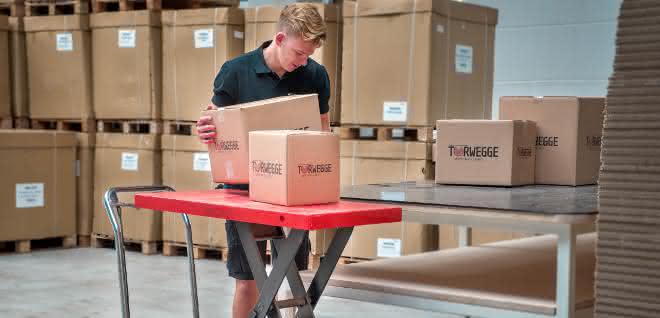
To avoid absences due to excessive strain, ergonomic workplace design is of great importance.
importance. More and more companies are recognizing this. Uwe Eschment, Managing Director at Torwegge, is pleased with the growing awareness. Every day, he works on making processes in intralogistics and production more health-friendly. Torwegge develops and sells components and systems for intralogistics processes that contribute to the effortless transportation of goods, including lifting tables. "It's not just about somehow getting loads to the right working height," says Eschment. "The tables must be infinitely height-adjustable, easy to operate and easy to readjust, as well as offer sufficient legroom. Depending on the application, they should also be mobile." The AGR has summarized these points in a checklist. If a lift table meets the criteria, its use generally leads to a reduction in work stoppages and increased efficiency. Employee satisfaction also increases.
Lifting, transporting, loading and unloading
Lift tables are available in various designs. This makes them suitable for various applications, some of which go beyond simply lifting goods. Torwegge supplies industrial companies, for example, that equip their assembly stations with lift tables to ensure effortless height compensation when transferring workpieces from one level to another. "Our standard lifting tables from the TO-ELS series are ideal for this purpose," says Eschment. Depending on the variant, the standard lifting tables have a load capacity of 500 to 2,000 kilograms and can reach a height of up to 3.5 meters in a maximum of 34 seconds. Table length and width are also variable.
Overcome loading edges of up to 80 centimetres
If loads not only need to be lifted but also transported, lift table trolleys are a good choice. Torwegge's standard solution here: Scissor lift table trolleys with a height of up to 1.3 meters for loads between 150 and 350 kilograms. Smooth-running castors and a hydraulic foot pump ensure ergonomic handling. "The xetto push trolley, which we recently added to our range, is ideal for loading and unloading vehicles," says Eschment. The solution from Hoerbiger Automotive Komfortsysteme moves loads of up to 250 kilograms at a height of up to one meter and overcomes loading edges of up to 80 centimetres. The company also develops customized solutions. One example is a heavy-duty lifting table with roller conveyor for the timber industry: chipboard panels weighing up to 55,000 kilograms can be placed on a seven by 2.8 meter platform and lifted and lowered with little effort.
Ergonomic aids should become standard
Lifting tables are not the only means of improving workplace ergonomics in intralogistics and production. "Many people aren't even aware of all the things that affect staff health," says Eschment. He recently noticed this at the Motek trade fair in Stuttgart. Torwegge's stand at the trade fair was themed around ergonomics. In addition to xetto, the functionality of smooth-running castors and heavy-duty castor rails for conveyor systems were also demonstrated. "Some visitors were very surprised at how comfortable it is to move even heavy loads and what to look out for," says Eschment. He now hopes that lifting tables will soon be standard in production halls and warehouses - just like the other helpful systems.


You might also be interested in
Compact motorized castor for pallets and heavy loads
Rulmeca has launched a new motorized roller onto the market. The EPS-AS1 roller motorizes roller conveyors for heavy loads of up to 1,500 kilograms.
 read more...
Torwegge presents new Eco transport trolley
Torwegge has added a new eco transport trolley to its product portfolio. The trolley was developed to facilitate the transportation of heavy loads of up to 250 kilograms in various sectors such as the food industry, retail, catering, healthcare and...
read more...New transport trolley at Logimat
Fetra is also coming to Logimat. The manufacturer of transport equipment for efficient intralogistics processes will be presenting new products and program highlights. Wuppi" will also be there: The aluminum compact trolley is a powerful helper on...
read more...AR Racking equips new Lekkerland logistics centers
The German company, which specializes in consumer goods to go, recently opened two new warehouses in Germany, one in Kerpen and one in Wedemark, which have a storage capacity for 57,459 pallets.
read more...Paper manufacturer with innovative production logistics
Paper manufacturer Franz Veit has made its intralogistics operations much more efficient with the help of Linde Material Handling and Ernst Müller Fördertechnik.
read more...AR Racking equips new Lekkerland logistics centers
Lekkerland is reorganizing its logistics in Germany by 2030 to make it fit for the opportunities and challenges in out-of-home consumption today and tomorrow. As part of this, the storage solutions specialist has supported AR Racking in the opening...
read more...Automated intralogistics system
AMI Förder- und Lagertechnik exhibited an automated intralogistics system at Logimat that covers the entire packaging process right through to shipping.
read more...High-performance electric floor track
Transport system for small load carriers and pallets
Where efficiency and high availability are important, electrically driven floor conveyors are often an alternative to continuous conveyors.
read more...Satellite warehouse turns 40
Westfalia Logistics Solutions celebrated the 40th anniversary of the Satellit load handling device at Logimat. The system is designed for storage on pallets, other loading aids or without pallets.
read more...