

Conveyor technology & components
Sustainably on the move
Conveyor technology contributes to "green logistics" in several ways: They are usually produced using recycled materials, achieve considerable energy savings during operation, reduce maintenance costs and provide a diverse pool of recyclable material at the end of their life cycle. And - as gigantic out-door systems for bulk goods, for example - they win the race against trucks in terms of efficiency and sustainability.

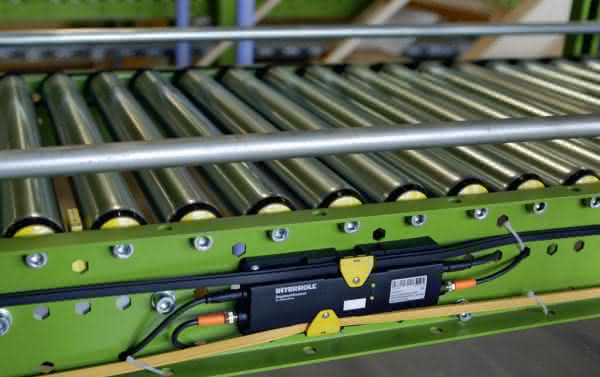
Some time ago, natural fashion retailer hessnatur replaced the outdated 400V drive technology in its dispatch center with around 38,000 storage locations at the company headquarters in Butzbach with energy-efficient and maintenance-friendly 24V technology from Interroll. As sustainability plays a central role for hessnatur, a solution was sought that would allow the metal base frame of the existing conveyor system to be reused and only the conveyor rollers and plastic components to be replaced. With the 24V RollerDrive including the DriveControl and ZoneControl control systems from Interroll, all requirements could be optimally implemented.
The accumulation zones in the dispatch center were equipped with RollerDrive EC310. The ZoneControl controls each individual zone. The curves are equipped with RollerDrive EC310 and DriveControl. A system driven by RollerDrive is always decentralized. The drives are located in each individual conveyor zone, which can be switched on or off individually. Movement in the entire conveyor only takes place when goods are actually being conveyed without accumulation pressure.
"In terms of green logistics, SSI Schaefer is increasingly focusing on minimizing the energy requirements of storage and retrieval machines."Rudolf Muhlfinger Business Development SSI Schaefer
Drive power only when required
Only the RollerDrives that are required for the optimum flow of the conveyed goods are driven. According to Interroll, this means "enormous potential for energy savings as well as a significant reduction in noise and wear. This protects the environment and improves working conditions".
"Whether decentralized 24-volt drives, energy-efficient drum motors or flow storage systems that use gravity - our solutions are designed for minimized energy consumption and a long life cycle," says Irma Slavinskaite, Senior Product Marketing Manager at Interroll. "This approach makes them ideal key components for a sustainable material flow that conserves resources and protects the environment. At the same time, Interroll's components enable the modernization and capacity expansion of existing systems, so that in many cases the environmental consumption of new buildings becomes superfluous."
Sorter: 99 percent recyclable
"New products and systems from Vanderlande are designed with sustainability in mind right from the start," say the company's managers. "We focus on how they will be used by customers and individual operators. This approach has already been used in many new concepts, such as the "Crossorter" sorting solution, the "Adapto" storage/retrieval system and the "Pick@Ease workstation for order picking".
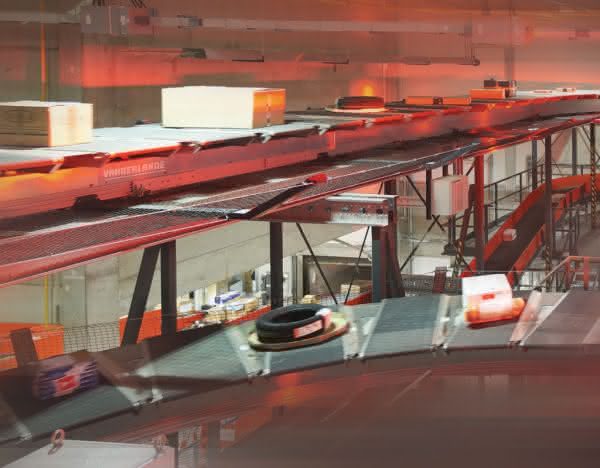
The Crossorter was "designed as an extremely flexible and cost-effective sorting solution for companies in the parcel and postal sector". In terms of environmental performance, it offers energy savings of up to 80 percent compared to conventional sorters, easy maintenance and an improved working environment thanks to a low noise level. The system complies with cradle-to-cradle principles, as 99 percent of the materials can be recycled and 90 percent are environmentally friendly.
Another example of an energy-friendly solution is the "Greenveyor", a conveyor belt system that can achieve energy savings of up to 45 percent.
Slim design helps save energy
Vanderlande has installed a total of 14 "Blueveyor" baggage handling systems in the arrivals area of Amsterdam's Schiphol Airport. A pilot project had already shown that the Blueveyor's energy consumption is up to 56 percent lower than that of conventional conveyors.
The Blueveyor minimizes energy consumption, the use of natural resources and environmental impact, and reduces maintenance costs. The Blueveyor is made of homogeneous materials that can be returned to technical or biological cycles. The materials can always be recycled. Maintenance costs are reduced as all components can be easily dismantled and the lean concept requires fewer spare parts.

"With our belt conveyors, we provide an economical and ecologically valuable solution for bulk and general cargo transportation."Regina Schnathmann Head of Communications and Public Relations Beumer Group
The Blueveyor consumes less than half the energy compared to conventional belt conveyor technology. Energy is saved due to the minimal belt bending and the minimal belt tension required. And due to the slim design, fewer parts and less mass need to be accelerated.
CO2-neutral logistics facility
Energy-efficient conveyor technology is rarely installed as a stand-alone solution, but usually forms an integral part of the realization of sustainably designed logistics systems. This is also the case with the new logistics center of the fashion jewelry and accessories supplier beeline GmbH in Cologne, which SSI Schaefer built a few years ago as general contractor for construction and intralogistics.
In addition to increasing efficiency, the modular and expandable overall system should be CO2-neutral and powered by renewable energy. Photovoltaics and geothermal energy supply more electricity than is required for heat, light, hot water and system operation. The integrated heating system has an amortization period of just four years, the photovoltaic system eight years. The electricity generation generates revenue of more than 140,000 euros per year.
Energy-efficient conveyor technology
SSI Schaefer's intelligent system concept is also designed for resource efficiency. The basis for this is the automation in the warehouse through energy-efficient conveyor technology in combination with dynamic systems such as a four-aisle miniload, which is operated by four energy-saving stacker cranes, a shuttle warehouse and ten sorter-operated picking workstations.
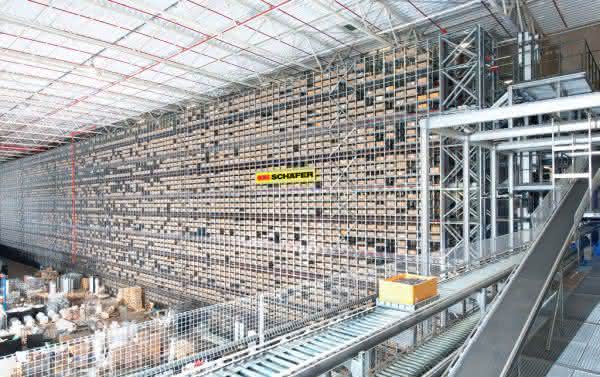
"In addition to fundamental measures to increase energy efficiency such as lightweight construction, energy-efficient drive systems or concepts for energy recovery, SSI Schaefer is increasingly focusing on minimizing the energy requirements of storage and retrieval machines in terms of green logistics," says Rudolf Muhlfinger, Business Development at SSI Schaefer. "This is achieved by compensating for the dead weight of the lifting equipment through the use of counterweights. In addition, predictive maintenance, monitoring of the main bearings on the stacker cranes using sensors and automatic lubrication systems on the conveyor technology also contribute to sustainability."
Lightweight RBG consumes less energy
Gebhard Fördertechnik's warehouse technology products are developed with the aim of implementing targeted lightweight construction. "The use of innovative materials and joining processes is a matter of course," emphasizes the company and offers the composite SRM "Cheetah Eco" as proof: "It weighs less than half of its predecessor models, so that the consumption of electrical energy during acceleration is more than halved," explains Jörg Eder from Gebhardt Fördertechnik.
In addition, the reduction in stacker crane speed developed by Gebhardt enables lower energy consumption when throughput is low. The control system automatically reduces the speed of the storage and retrieval machine when the order backlog is low. As a reduction to 70 percent of the speed leads to a halving of the kinetic energy, "energy can be saved very easily".
Out-door conveyor technology beats trucks when it comes to sustainability
The Beumer Group also implements its comprehensive sustainability concept in external logistics projects, for example in the realization of environmentally friendly, kilometre-long belt conveyor systems, which prove to be significantly more efficient and environmentally friendly than the use of trucks for the transport of bulk goods, even over very long distances.
Belt conveyor or truck? This question arose for the Asia Cement Group, a large building materials manufacturer headquartered in Taipei, Taiwan, as the distance between the quarry and the newly built plant is around 30 kilometers. The limestone has to be transported quickly to the plant, where two kiln lines with a capacity of 4,200 tons per day each are installed, for which the Asia Cement Group requires 14,000 tons of raw material every day. The company therefore opted for a troughed belt conveyor from Beumer. As the site consists of mountains and bamboo forests, the trucks would have had to drive mostly on public roads: Detours, longer transportation times, higher costs and significantly higher emissions would have been the consequences.
The belt conveyors can handle long distances, large inclines and tight curve radii. They overcome rugged terrain and obstacles such as rivers, roads, buildings or rails. Horizontal and vertical curves can also overlap in the track layout. Apart from support pillars and the steel structure, there is hardly any need to interfere with the landscape.
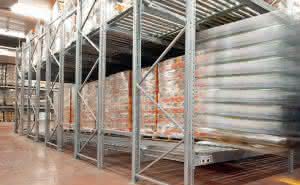
Flow storage: utilizing gravity and saving electricity
Particularly in the food and beverage industry and large production companies, high volumes of palletized goods need to be stored quickly, buffered intelligently and made available quickly for dispatch or further processing in the factory. This is where modern flow storage systems come into their own, not only in terms of speed, capacity, availability and occupational safety, but also in terms of sustainability.Flow storage systems use the principle of the inclined plane: pallets or parcels are stored in flow channels consisting of a series of roller conveyor modules arranged one behind the other. As these are mounted at an incline of four percent, goods move automatically from the input to the output location using gravity. This saves energy costs.
Thanks to the direct line routing, material is transported much faster than by truck. In addition, belt conveyors require up to 90 percent less primary energy than comparable truck transports.
5.5 million euros less operating costs
If, as in this case, 7.5 million tons of raw materials are transported per year, the belt conveyor saves 74 million kWh annually, which is equivalent to the energy consumption of more than 20,000 single-family homes. And by saving diesel fuel, the operating costs for the company are reduced by more than 5.5 million euros per year.
Regina Schnathmann, Head of Communications and Public Relations at the Beumer Group: "We are equipping the systems with environmentally friendly electric drives and low-energy belts, among other things. When the belt conveyor system is conveying downhill, it operates in generator mode. The electrical energy generated from this is fed back into the public grid via a regenerative unit, which reduces the operating costs of the entire system.
Reinhard Irrgang


You might also be interested in
Compact motorized castor for pallets and heavy loads
Rulmeca has launched a new motorized roller onto the market. The EPS-AS1 roller motorizes roller conveyors for heavy loads of up to 1,500 kilograms.
 read more...
Torwegge presents new Eco transport trolley
Torwegge has added a new eco transport trolley to its product portfolio. The trolley was developed to facilitate the transportation of heavy loads of up to 250 kilograms in various sectors such as the food industry, retail, catering, healthcare and...
read more...New transport trolley at Logimat
Fetra is also coming to Logimat. The manufacturer of transport equipment for efficient intralogistics processes will be presenting new products and program highlights. Wuppi" will also be there: The aluminum compact trolley is a powerful helper on...
read more...AR Racking equips new Lekkerland logistics centers
The German company, which specializes in consumer goods to go, recently opened two new warehouses in Germany, one in Kerpen and one in Wedemark, which have a storage capacity for 57,459 pallets.
read more...Paper manufacturer with innovative production logistics
Paper manufacturer Franz Veit has made its intralogistics operations much more efficient with the help of Linde Material Handling and Ernst Müller Fördertechnik.
read more...AR Racking equips new Lekkerland logistics centers
Lekkerland is reorganizing its logistics in Germany by 2030 to make it fit for the opportunities and challenges in out-of-home consumption today and tomorrow. As part of this, the storage solutions specialist has supported AR Racking in the opening...
read more...Automated intralogistics system
AMI Förder- und Lagertechnik exhibited an automated intralogistics system at Logimat that covers the entire packaging process right through to shipping.
read more...High-performance electric floor track
Transport system for small load carriers and pallets
Where efficiency and high availability are important, electrically driven floor conveyors are often an alternative to continuous conveyors.
read more...Satellite warehouse turns 40
Westfalia Logistics Solutions celebrated the 40th anniversary of the Satellit load handling device at Logimat. The system is designed for storage on pallets, other loading aids or without pallets.
read more...