

Conveyor technology & components
Casting blocks in time
High cycle times and 24/7 capacity utilization - that's everyday life in foundries. At the Nemak Dillingen aluminum foundry, casting ingots of different sizes and weights were to be transferred to the adjacent production facilities via a conveyor system with many transitions. The conveyor technology elements from FAB prove their worth in rough operation, varying temperatures and dirt loads.
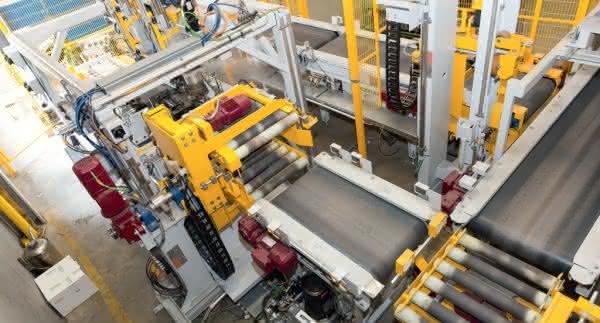
The aluminium foundry Nemak Dillingen GmbH in Dillingen in Saarland specializes in the production of highly complex aluminium components such as cylinder heads, engine blocks, transmission parts and structural components for the automotive industry. Manufactured with the utmost precision, the products are used in the automotive industry all over the world.
The task
The company produces continuously, 24 hours a day, 7 days a week and places high demands on system availability, robustness, accessibility and process transparency. The system control and visualization should ensure the interfaces to the production systems and automatic transport and provide reliable system data for production and maintenance.
The automatic transport and handling of engine blocks between the casting plant and the downstream processing centers, including the heat treatment furnaces, was to be integrated into the building structure with existing production facilities.
A wide variety of transport units are used: on the one hand, trays measuring 2.1 x 1.6 meters, conveyed two at a time in parallel and cycled with a total payload of 1,500 kilograms, and on the other hand, individual cast blocks with a payload of around 40 kilograms.
The challenge
Casting blocks with different dimensions and weights are to be transferred to the adjacent production systems via a conveyor system with many transitions, buffered or individually in the required cycle time and transferred again. Transport elements, lateral guides and sensors had to be planned in such a way that the different geometries were taken into account.
The FAB concept
The produced engine blocks are placed directly onto the transport line or trays by robots and then transported to the production areas on roller, chain or belt conveyors.
Features of the installed conveyor technology
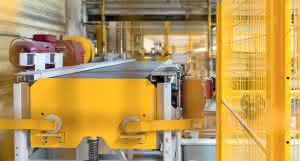
- Low-maintenance, robust conveyor technology with stable lateral guidance
- Vertical conveyor with belt technology for dynamic operation
- Precise positioning via position-controlled drive units
- Fall protection at transitions to the vertical conveyor
- Belt conveyor with rubberized roller support
- Roller conveyor with rubberized support roller for safe transport
- Roller conveyors with heavy-duty support rollers for large effective widths
- Chain conveyors with steel support profiles and cast aluminum drive and deflection assemblies
- Control technology for separation and buffer operation
- Clear visualization of the transport process
The FAB concept comprises two core components for material flow systems suitable for pouring:
- Conveyor with a payload of up to 7.5 tons for automatic transport in the heat treatment area for trays.
- Conveyors with a payload of up to 50 kg/block for transporting cast parts throughout the entire casting and machining process.
The buffering and separation of the blocks on the conveyor line guarantee a stable supply to the production areas in the required cycle time. The support elements, such as robust belts, coated rollers and thick-walled steel rollers, are the basis for high availability and minimal wear. Sensors and drive technology are easily accessible and yet protected. High positioning accuracy, adjustable stable side guides and clear visualization of the entire system are further basic components for high availability.
The procedure
During the planning phase, the optimum processes are discussed with the customer and the appropriate equipment and safety technology are defined in the design specification. The FAB concept is the basis for implementation.
The material flow
After the cooling section, the cast engine blocks are transferred individually to the FAB vertical conveyor, equipped with a turntable and roller conveyor, at 25-second intervals. The conveyor unit is rotated during lifting. The engine blocks are then buffered on belt conveyors in batches of 10 and automatically transported to the neighboring operating area via a conveyor bridge.
Jutta Kreider


You might also be interested in
Compact motorized castor for pallets and heavy loads
Rulmeca has launched a new motorized roller onto the market. The EPS-AS1 roller motorizes roller conveyors for heavy loads of up to 1,500 kilograms.
 read more...
Torwegge presents new Eco transport trolley
Torwegge has added a new eco transport trolley to its product portfolio. The trolley was developed to facilitate the transportation of heavy loads of up to 250 kilograms in various sectors such as the food industry, retail, catering, healthcare and...
read more...New transport trolley at Logimat
Fetra is also coming to Logimat. The manufacturer of transport equipment for efficient intralogistics processes will be presenting new products and program highlights. Wuppi" will also be there: The aluminum compact trolley is a powerful helper on...
read more...AR Racking equips new Lekkerland logistics centers
The German company, which specializes in consumer goods to go, recently opened two new warehouses in Germany, one in Kerpen and one in Wedemark, which have a storage capacity for 57,459 pallets.
read more...Paper manufacturer with innovative production logistics
Paper manufacturer Franz Veit has made its intralogistics operations much more efficient with the help of Linde Material Handling and Ernst Müller Fördertechnik.
read more...AR Racking equips new Lekkerland logistics centers
Lekkerland is reorganizing its logistics in Germany by 2030 to make it fit for the opportunities and challenges in out-of-home consumption today and tomorrow. As part of this, the storage solutions specialist has supported AR Racking in the opening...
read more...Automated intralogistics system
AMI Förder- und Lagertechnik exhibited an automated intralogistics system at Logimat that covers the entire packaging process right through to shipping.
read more...High-performance electric floor track
Transport system for small load carriers and pallets
Where efficiency and high availability are important, electrically driven floor conveyors are often an alternative to continuous conveyors.
read more...Satellite warehouse turns 40
Westfalia Logistics Solutions celebrated the 40th anniversary of the Satellit load handling device at Logimat. The system is designed for storage on pallets, other loading aids or without pallets.
read more...