

Conveying and lifting technology
Flexible expansion for peak loads using a modular system
In hardly any other industry has the demand for a flexibly expandable material flow been greater in recent months than in the energy industry: concerns about supply bottlenecks caused the demand for energy to skyrocket within a very short space of time.
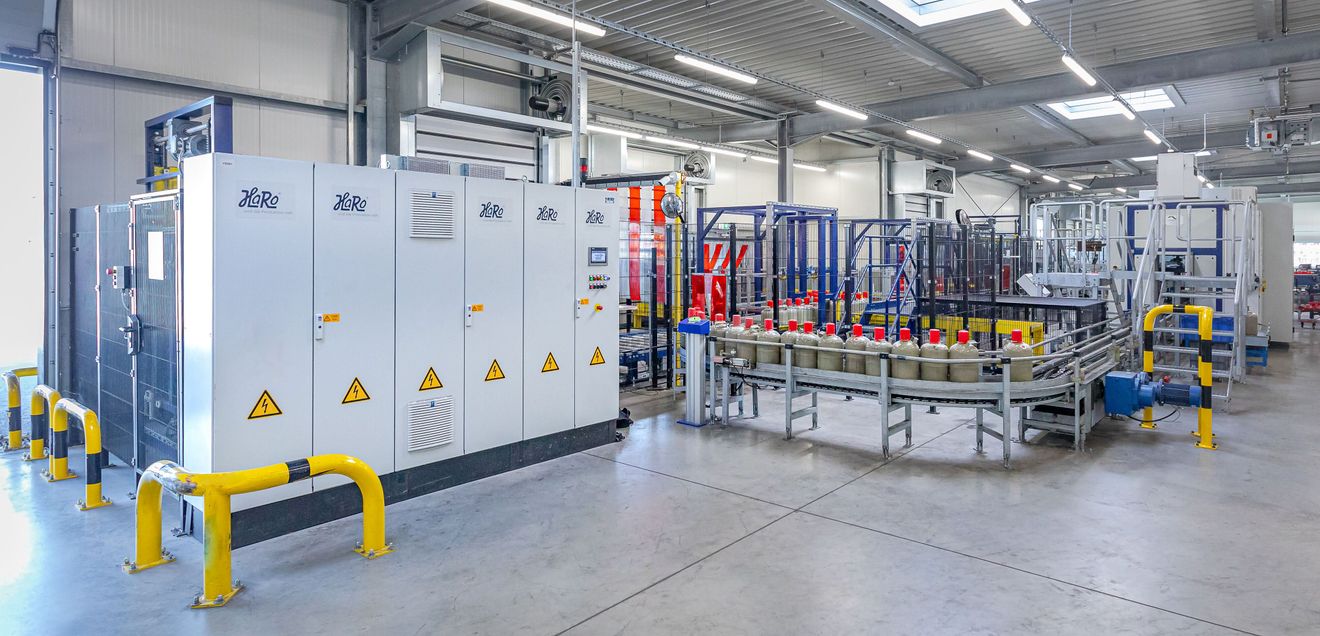
Handling such large quantities is also important for one of the leading supply companies for liquid gas in Germany, the Westfalen Group with its subsidiary Caratgas. With the help of the modular system from the Sauerland-based conveyor technology manufacturer HaRo Anlagen- und Fördertechnik, the conveyor system for filling gas cylinders installed at Caratgas in Krefeld was able to grow in line with the increased capacity utilization within a short space of time.
The Westfalen Group is active in the fields of technical gases, cooling and heating, filling stations and mobility as well as respiratory home therapy. With its products and services, it increasingly offers solutions that help customers to become more sustainable. Founded in Münster in 1923, the family-owned company is now represented by numerous subsidiaries and associated companies at over 20 production sites in Germany, the Netherlands, Belgium, France, Switzerland and Austria - including Krefeld.
Here, Caratgas focuses primarily on the storage, filling and handling of propane gas. The company approached the Rüthen-based HaRo Group back in 2020 with an inquiry about the installation of two conveyor systems: the first was a powered conveyor system for empty and full steel pallets with an automatic push-out system for de-palletizing empty gas cylinders and an automatic push-in system for palletizing filled gas cylinders. The second, also powered conveyor system serves as system 2 for transporting empty and full steel pallets with an automatic push-out system, but only for empty gas cylinders that are subject to TÜV inspection.
Customized intelligent concepts
The HaRo Group designed an intelligent concept for each of the two requirements, consisting of the two main components of driven roller conveyors and chain conveyors, which depalletize and palletize the gas cylinders fully automatically before and after filling.
The details of the material flow in the first system: the single or double steel pallets are initially loaded manually using a forklift truck. After the employee has acknowledged the loading of the goods using a switch, the single pallet moves directly to the push-out unit using the powered roller conveyors, while the doubled pallet is first transported to the de-doubling unit after an automatic height check. "A vertical lifting unit equipped with forklift tines then separates the pallets and moves the lower steel pallet directly to the push-out unit," says Markus Löseke, Head of Design at the HaRo Group, explaining the technical details of the process. Meanwhile, the upper pallet is lifted and, after the lower pallet has been removed, is lowered and also transported towards the push-out unit for de-palletizing the gas cylinders.

Once they arrive at the push-out unit, the transport securing device of the steel pallets is first lifted upwards, then the bottles are automatically pushed off the steel pallet onto the chain transport line and transported to the filling system. The empty pallet is moved to the next free roller conveyor positions.
To palletize the filled gas cylinders, the empty steel pallets are first positioned and fixed on the full cylinder push-in unit using a stopper-pusher combination. The transport lock is then lifted up again so that the full cylinders are pushed into the pallet by the chain conveyor. After the successful palletizing process, the safety device is lowered again and the filled pallets are transported to storage via the driven roller conveyors.
Separating and palletizing
To separate and palletize the TÜV-compliant propane gas cylinders, Caratgas installed a second conveyor system that works in a similar way to the first system: "At this system, the empty steel pallets are first loaded using a forklift truck and transported along the roller conveyors to the position of the TÜV-compliant empty cylinder insertion unit," says HaRo's design department. Once the safety device on the pallet has opened automatically, the empty bottles are pushed into the pallet by the chain conveyor. Once the palletizing process is complete, the safety device is lowered and the steel pallet filled with the TÜV-compliant bottles is automatically transported to the removal station via the roller conveyors.
With increasing capacity utilization, Caratgas turned to the Rüthen-based HaRo Group again two years after the installation of the conveyor systems described above with the aim of increasing the buffering options at the systems and decoupling the dependency on manual forklifts for loading and unloading. "We were able to meet these requirements by implementing additional chain conveyors and thus buffer spaces at the loading and unloading points of the system, which also gives the system a high degree of automation. The depalletizing and palletizing of the gas cylinders runs completely automatically, no manual intervention is required," says Markus Löseke.
With the ability to flexibly adapt and expand conveyor systems, which has become more important than ever in energy supply companies in particular, Caratgas makes use of a fundamental advantage of the HaRo concept: "The requirements in today's industrial companies are changing rapidly, making it all the more important to be able to adapt the internal material flow flexibly and easily to the changes," says Christoph Hackländer, Managing Director of the HaRo Group. "That's why we always offer our customers the option of expanding existing conveyor systems with the help of our modular system - without the need for major interventions in ongoing production."


You might also be interested in
"Dancing with Robots"
With a live performance under the motto "Dancing with Robots", Trapo will be presenting intelligent automation and robotics solutions for the packaging industry at Interpack 2026.
 read more...
China's industry undergoing AI transformation
China has launched its 15th five-year plan and is positioning robotics as a central component of its modern industrial system. The aim is to transfer artificial intelligence more strongly into physical applications and thus boost economic growth.
read more...Bosch Rexroth at the Logimat 2026
Humanoid robot on AMR platform
Mobile robotics is well established in intralogistics, now humanoid robotics is moving more into focus. At Logimat, Bosch Rexroth is presenting a mobile humanoid robot on an AMR platform for the first time.
read more...Exoskeleton: strength to put on
Automation specialist Comau is expanding its portfolio of wearable robots with a new exoskeleton. The wearable system reduces muscle strain by up to 50 percent and is aimed at a wide range of applications in industry and SMEs.
read more...Flexible lever solutions
Aero-Lift Vakuumtechnik will be exhibiting at Fachpack in Nuremberg from September 23 to 25, 2025. There, the supplier from Baden-Württemberg will be presenting its portfolio of tube lifters from the Force-Lift series - including the Force-Lift | 2,...
read more...Overhead conveyor systems - an alternative to KLT transport
In logistics, companies are faced with the challenge of optimizing their internal material flow in order to maximize productivity, cost savings and efficiency. Overhead conveyor systems play an important role in this context. Due to their flexible...
read more...Save costs with a retrofit
The Spinner Group updated its ageing logistics system with the help of system integrator Klinkhammer Intralogistics: a targeted retrofit of the automated small parts warehouse and conveyor technology meant that it was no longer necessary to invest...
read more...Handling devices and more
Expresso aims to enable customers to improve the efficiency of their intralogistics processes through the use of high-quality handling and transportation equipment. In addition to positioning and conveying systems, the German manufacturer offers a...
read more...Compact motorized castor for pallets and heavy loads
Rulmeca has launched a new motorized roller onto the market. The EPS-AS1 roller motorizes roller conveyors for heavy loads of up to 1,500 kilograms.
read more...