
AGVs and robotics
One manufacturer, various AGV solutions
Volkswagen produces vehicle components in Kassel. The gearboxes, exhaust systems and other components are manufactured on spatially separated production lines. The two AGVs from DS Automotion, which handle internal transportation there, are just as versatile.

Each in its own way, both contribute to making production more flexible with high process stability. With their help, Volkswagen Kassel operates automotive parts production according to the principles and using the methods of Industry 4.0. The Kassel plant is the most important transmission manufacturer and is one of the most important component suppliers for the vehicle manufacturing plants of the Volkswagen Group. Exhaust systems and mold-hardened load-bearing body parts for Volkswagen's "Modular Transverse Toolkit" are also produced in Kassel. The parts are transported in specially designed transport boxes from the 45 or so laser cutting machines, where they are given their final shape, to a container shipping system with 8,000 storage spaces.
For this purpose, an automated guided vehicle system from DS Automotion with 18 customer-specific underride vehicles transports 500 (800 in the final version) empty containers from the empties warehouse in the correct position for loading by robot to the laser park and from there to the container dispatch system. The vehicles, which went into operation in 2012, check the course calculated by the master computer using permanent magnets embedded in the floor.

"Two fundamentally different AGVs from DS Automotion work in two production areas at the VW plant in Kassel. Each of them is tailored to the production requirements."Stefan Greif Logistics Planner Volkswagen AG
Intelligent navigation and charging concept
The master computer also switches a traffic light system at a level crossing with manned vehicles. There is also a connection to the emergency call system so that the AGV vehicles can move to the side in an emergency to form a rescue lane. After each transport cycle, the vehicles drive to one of the six charging stations to recharge their NiCd batteries. Given the long distance, this avoids traffic jams in front of the charging stations due to simultaneous demand and thus maximizes availability. Carsten Kühlewind, system planner at Volkswagen, confirms: "The AGV ran stably right from the start and passed the performance test straight away."
AGVs with automated series vehicles
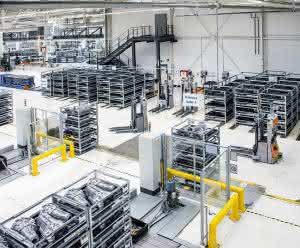
For gearbox assembly, which has been taking place in a new hall since 2014, the planners were able to freely design the internal parts transport. The transport containers are equipped with contour trays for holding certain gearboxes and are transported empty to the end of the line and loaded containers back again by automated high-lift forklifts from an AGV from DS Automotion. 240 gearbox frames are moved per shift. For this application, the Volkswagen planners favored a system with automated series vehicles due to the low number of vehicles required. This creates synergies in the area of maintenance, as these are already in use in the company in manned operation.
The vehicles are equipped with lithium-ion batteries and are charged at two stations according to a cyclical schedule. The route calculated by the control system is checked using laser navigation. One of the challenges was the high transport weight of up to 1.9 tons, especially because the vehicles have to cross a carpet of brushes due to the "Clean Factory Concept". Stefan Greif Logistics Planner, Volkswagen AG: "The fact that two completely different AGV systems are in use at the Kassel plant shows the usefulness of application-oriented and not necessarily identical solutions".
www.volkswagen.dewww.ds-automotion.com


You might also be interested in
Standardized in design, flexible in use
Automated guided vehicles are increasingly in demand in production and logistics as they automate processes efficiently - but in addition to the vehicle, the right peripherals are also crucial for safe operation. A new solution consisting of a...
 read more...
Outdoor AGV networks production and logistics
An international company in the plastics industry is automating its intralogistics at its German site with a solution from ek robotics. A specially developed vehicle model from the Out Move series, an outdoor AGV, is being used.
read more...Transport systems for automated material flow
The Leo transporters from Bito make it easier for users to get started with the automation of material processes, which is possible from 20,000 euros. The system is a flexible all-in-one complete solution that is ready for immediate use and can be...
read more...Automated logistics for the university hospital
As part of the new construction of the University Hospital of Reims (CHU), France, the hospital has taken a number of steps to improve the needs of its patients and the working environment of its employees.
read more...K.Hartwall: Topping-out ceremony for the German site
The topping-out wreath was raised at the new building in the TIP Innovationspark Nordheide in Buchholz near Hamburg on February 27: The new K.Hartwall plant will comprise approx. 3,500 m² of hall space and around 2,000 m² of office and social areas.
read more...Noerpel Group tests driverless high lift trucks
The Noerpel Group has tested driverless pallet trucks in one of its two logistics facilities in Giengen. During a four-week trial, two autonomous systems were used to transport goods within the warehouse.
read more...Supply and disposal of printing machines by AGV
Numerous companies rely on AGVs in intralogistics to increase efficiency and meet challenges such as the shortage of skilled workers. One such company is GGP Media GmbH in Pößneck, Thuringia.
read more...Sophisticated automation: AGV and cobot combined
On behalf of Krefeld-based Saurer Technologies, the engineering team from Project Automation & Consulting developed a solution for production logistics that combines AGVs and cobots.
read more..."Herbie" robot in the Körber portfolio
Carrybots, a specialist in mobile robotics, is a new partner in the Körber supply chain ecosystem. The aim of this collaboration is to strengthen the position of both companies in intralogistics. Herbie" enables robot-based goods-to-person processes.
read more...